
Water parameters
Overview
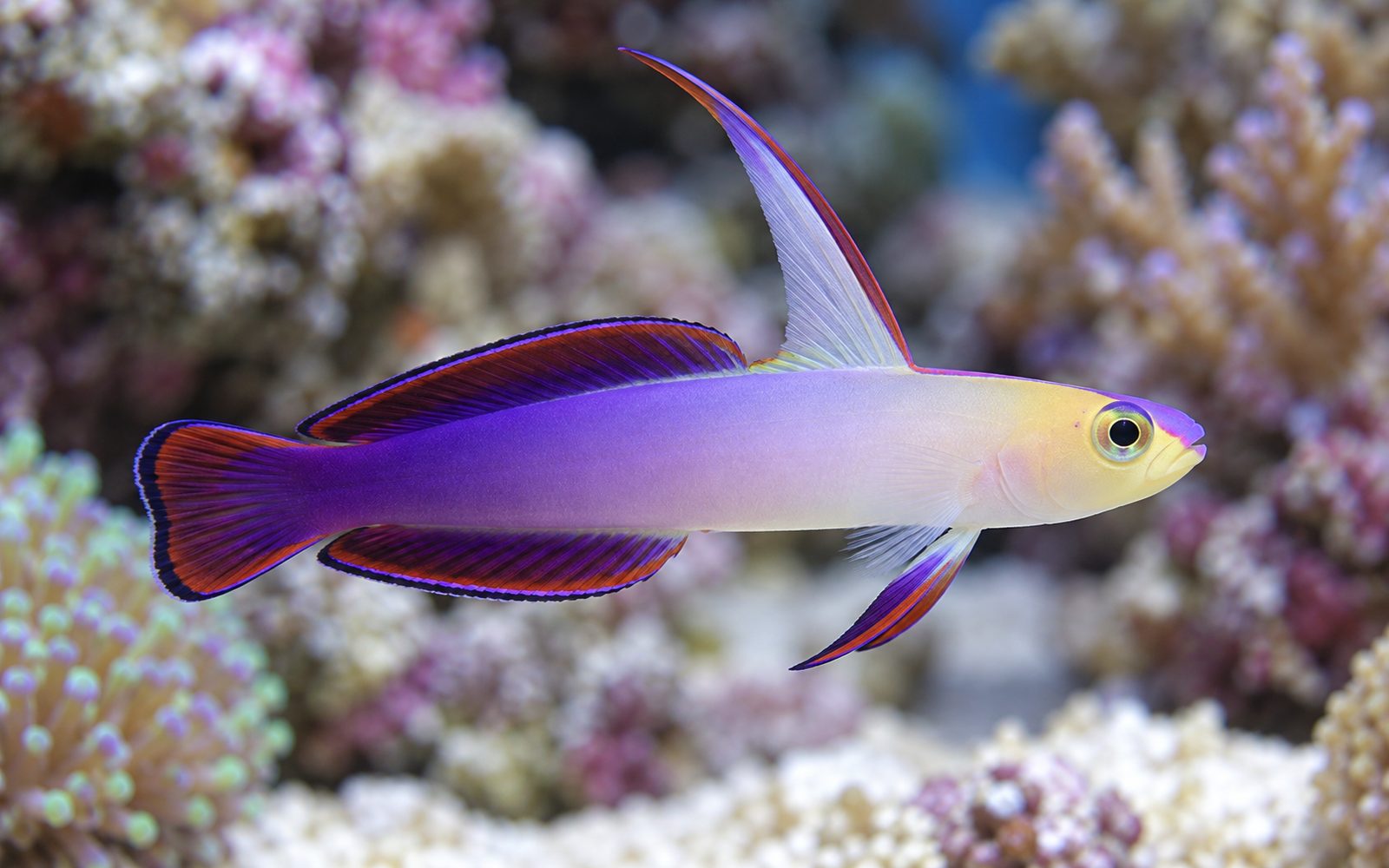
The purple firefish is a close relative of the firefish (Nemateleotris magnifica). With its yellowish head, the purple line on its snout, its lilac body and fins that darken to purple-maroon toward the rear, it has a more exquisite coloration. Its tall, slender dorsal fin and its habit of hovering above its burrow are the same as its relative's.
Because it lives deeper in the wild, it is usually more expensive than the firefish and somewhat shyer. Its care is the same: peaceful companions, plenty of hiding places and a tight lid.
Natural Habitat
It lives in the Indo-West Pacific, usually on reef slopes below 25 meters, over sand and rubble bottoms. It hovers a little above its burrow, picking plankton from the current; in danger it flees into its burrow or the nearest crevice.
Tank Setup
- Volume: at least 75 liters for a single fish or a pair.
- Water: salinity 1.023–1.026 specific gravity, pH 8.1–8.4, temperature 24–27°C; stable values.
- Reef compatibility: reef safe; it leaves corals and invertebrates alone.
- Lid: a fully closed or mesh lid is essential; it leaps straight up when startled.
- Light and layout: because it comes from deep water, it likes shaded corners. Provide a rock structure with holes and a sand substrate.
Diet
Carnivorous and a plankton feeder. In the wild it catches small crustaceans brought by the current in the water column. Offer frozen mysis, brine shrimp, copepods and fine granules. Feed small meals 2–3 times a day; among greedy tankmates, watch that it does not miss out on food.
Behavior and Compatibility
Very peaceful and shy. It is normal for it to spend its first days hiding in a new aquarium. It is territorial toward unfamiliar fish of its own species and toward the firefish; do not keep the two together in a small aquarium.
Good companions: clownfish, neon goby, shrimp gobies, cardinalfish, blennies, cleaner shrimp.
Avoid: dottybacks, aggressive damsels, hawkfish, lionfish, large predators; the firefish in a small aquarium.
Group and Colony Structure
Kept singly or as a mated pair. Mated pairs hover together constantly; two unfamiliar adults, however, will fight, and the weaker one may jump out and be lost.
Breeding
The pair lays its eggs inside the burrow and guards them. Breeding in the aquarium is rare; raising the planktonic larvae requires expertise. Almost all fish sold are collected from the wild; choose healthy individuals that are eating and hold their fins erect.
Health and Common Problems
- Jumping: the most common cause of loss.
- Shipping stress: because it comes from deep water, it is sensitive in the first days; keep the light low and provide a calm environment.
- Marine white spot and velvet: quarantine new fish.
Sexing
There is no reliable external difference. Two fish that hover together and share the same burrow are very likely a mated pair.
Tank mates
This list is calculated automatically from the species profile and grows as new species are added to the catalog. Try it in the planner for a definite answer.
Should not be kept together



Hobbyist notes
Things you won't find in books, learned by trial and error. The most helpful ones are on top.
Change history and contributors
- Page created · October 16, 2026