
Water parameters
Overview
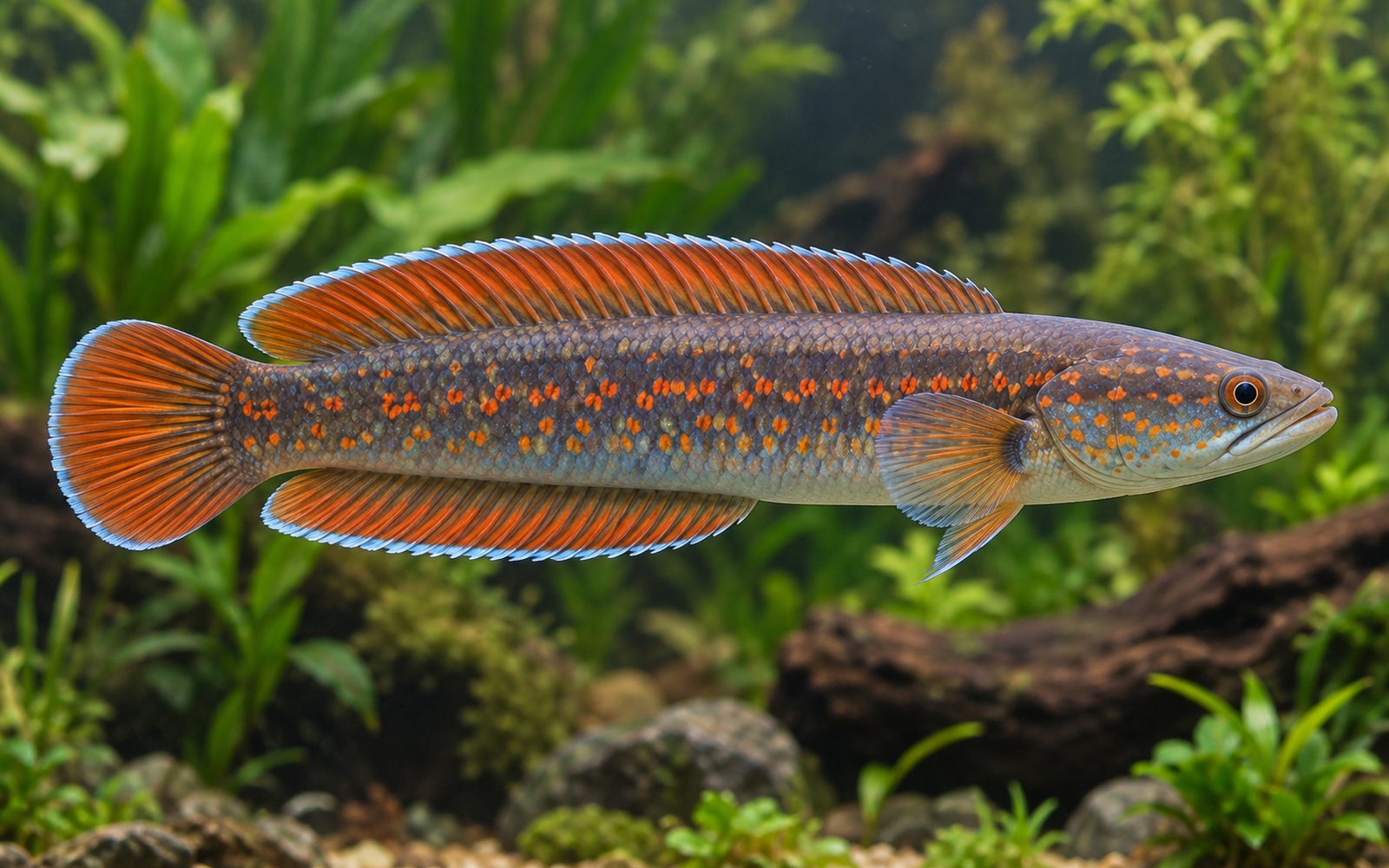
With its long, cylindrical body, flat head and fin running the whole length of its back, the rainbow snakehead is a typical snakehead; but it stays at 20 cm and is one of the most colorful species. Its bluish gray-brown body is decorated with orange spots, and its fins with orange-red and blue-white edges.
It breathes air from the surface with a special organ above its gills; it can drown if it cannot reach the surface. The male carries the eggs in his mouth.
Legal status: Snakeheads are considered invasive species in some countries; in the USA, for example, unpermitted import and transport of all snakehead species is banned. Check local regulations before buying and never release any snakehead into the wild.
Natural Habitat
It lives in shallow, vegetated ponds and swamps of the Brahmaputra basin in the Assam region of India. The region is subtropical; the water cools noticeably in winter.
Tank Setup
- Volume: at least 120 liters for a single fish, 150–200 liters for a pair.
- Lid: a very tight lid; it both jumps and escapes through the smallest gap. Leave an air gap between the water surface and the lid.
- Decor: dense plants, roots, floating plants and hiding places; dim light.
- Season: lowering the temperature to 16–18°C for a few months in winter supports its health and willingness to breed.
Diet
Carnivorous. Worms, shrimp, mussels, fish fillet, frozen bloodworms and sinking pellets. Live feeder fish become a habit and carry disease. It is prone to obesity; feed adults every two to three days.
Behavior and Compatibility
An ambush predator; it eats fish and shrimp that fit in its mouth. It is territorial toward its own kind; apart from a compatible pair, more than one individual will fight.
Good companions: a species tank is best. In a large aquarium it can be tried with calm species too big for its mouth that can stand up for themselves.
Avoid: small fish, shrimp, fin-nipping species, other snakeheads.
Group and Colony Structure
Alone or a compatible pair. The safest way to get a pair is to raise several juveniles together and pick the two that pair off.
Breeding
The male takes the eggs laid by the female into his mouth and incubates them; after the fry leave the mouth they remain under the parents' protection for a while. Breeding begins when the water warms up after a cool winter period.
Health and Common Problems
- Escape and drying out: the most common cause of loss.
- Obesity: in overfed fish.
- Constantly high temperature: a shortened lifespan is reported in fish not given a cool period.
Sexing
Hard to tell apart. Males are usually more colorful, with larger heads and longer fins; females are plumper and plainer.
Tank mates
This list is calculated automatically from the species profile and grows as new species are added to the catalog. Try it in the planner for a definite answer.
Usually compatible
 Firemouth Cichlid
 Buffalohead Cichlid
 Festivum
 Geophagus surinamensis
 Rainbow Cichlid
 Gymnogeophagus balzanii
 Pearl Cichlid
 Blood Parrot
 Redhead Cichlid
Should not be kept together





Hobbyist notes
Things you won't find in books, learned by trial and error. The most helpful ones are on top.
Change history and contributors
- Page created · October 16, 2026