
Water parameters
Overview
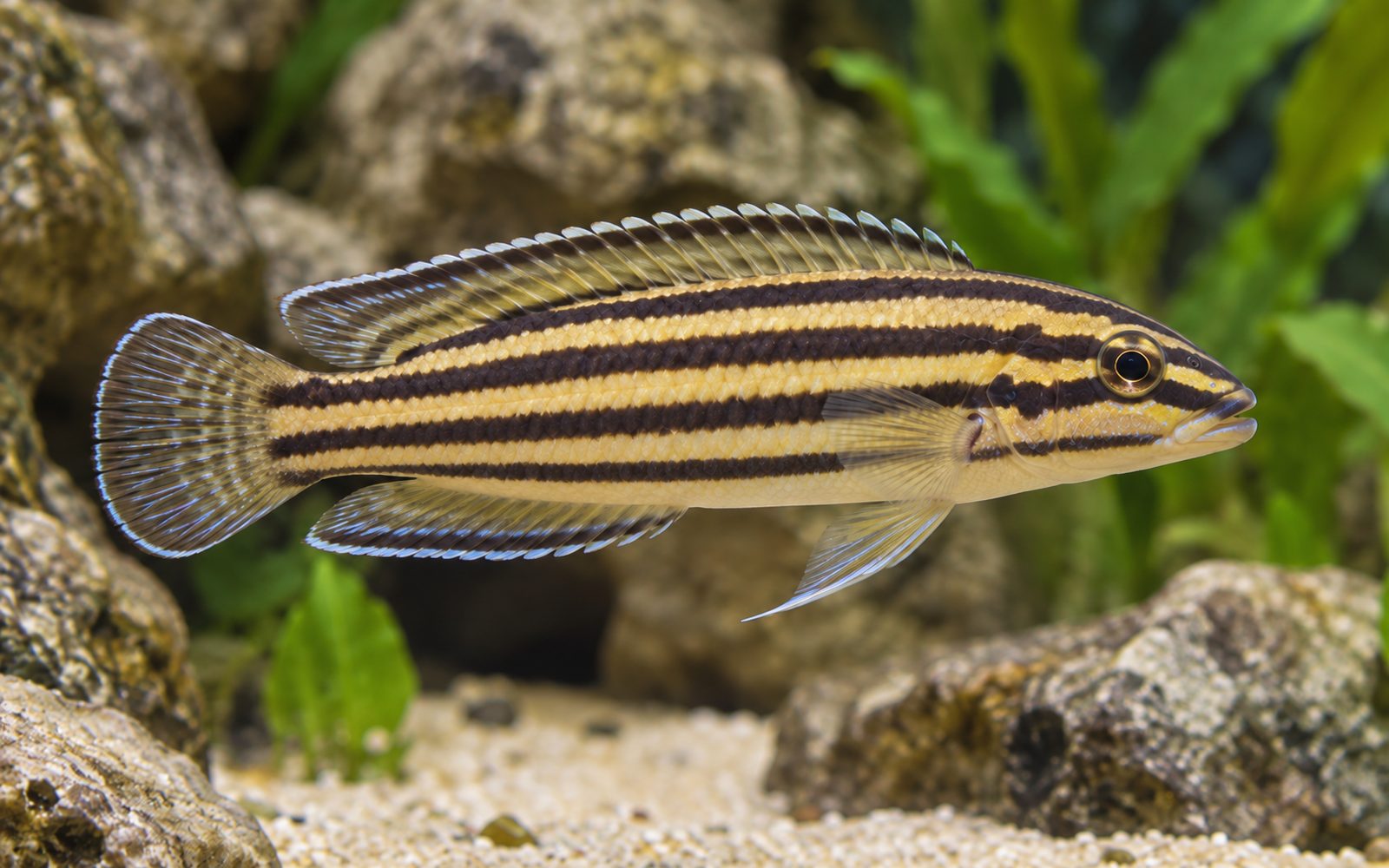
Julidochromis regani is one of the largest species of the genus and reaches 10–12 cm. Its long, cylindrical body carries four dark horizontal stripes on a yellowish-beige background; the dorsal fin runs the length of the body. The thickness of the stripes and the background color vary with the local form; forms sold under place names such as "Kipili" are found in the trade.
The most typical behavior of Julidochromis is that they always swim with their belly turned toward the nearest rock surface; they are often seen hanging upside down or tilted on their side under a rock overhang. Another interesting feature of the genus is that the female is larger than the male and takes charge of the pair.
Natural Habitat
It lives along the lake's rocky shores, in crevices and hollows among rock piles; it is also seen in transition zones where rock meets sand. Each pair claims a rock group and spends most of its life in this small area. It feeds by picking up small invertebrates on the rock surface.
Tank Setup
- Volume: at least 100 liters for a pair; 200 liters or more with other species.
- Rockwork: stacked rock piles with narrow crevices and multiple entrances. Stones must be set firmly on the bottom; the pair may dig underneath them.
- Water: pH 8–9, hard and stable; a 25% water change every week.
- Substrate: fine sand.
- Plants: Anubias attached to rock and Vallisneria usually do fine.
Diet
In the wild it feeds on small invertebrates. In the aquarium a small cichlid granule or quality flake food should be the staple; vary it with frozen mysis, cyclops and brine shrimp. It also picks up food that falls between the rocks. Small amounts 1–2 times a day are enough.
Behavior and Compatibility
The pair lives in its own rock territory and chases off fish that approach it, especially when there are eggs and fry. It is generally indifferent to fish outside its territory.
Good companions: Cyprichromis, Paracyprichromis, shell-dwelling cichlids in a sandy area, Altolamprologus, Synodontis catfish; Tropheus in a large aquarium.
Avoid: other Julidochromis species (they hybridize), Neolamprologus species competing for the same caves in a small aquarium, shrimp, aggressive Malawi mbuna.
Group and Colony Structure
- Kept as a pair. Compatibility within the pair is critical: in incompatible pairs the large female may kill the male.
- The safest way is to grow up 5–6 juveniles together and choose the pair that forms naturally.
- Once the pair is established, the fry can stay in the aquarium for a long time; older siblings help protect the little ones and several generations are seen together in the tank.
- When juveniles approach adult size, the parent pair starts chasing them; they should be removed then.
Breeding
A few dozen eggs are laid on the ceiling or wall of a cave or narrow crevice. The eggs hatch in around 3 days and the fry become free-swimming after about a week. The nest is often out of sight; the fry suddenly appear among the rocks. They are fed newly hatched brine shrimp, cyclops and powdered food. A compatible pair spawns again at regular intervals.
Health and Common Problems
- Hardy; in soft water and at low pH it fades and becomes prone to disease.
- Bacterial infection and bloat: seen with poor water and overfeeding.
- Wounds from pair fights: in incompatible pairs the male gets cornered with torn fins; he should be removed without delay.
Sexing
Difficult from the outside. In Julidochromis the female is usually slightly larger and plumper than the male. A definite distinction is made by looking at the genital papilla.
Tank mates
This list is calculated automatically from the species profile and grows as new species are added to the catalog. Try it in the planner for a definite answer.
Usually compatible
 Yellow Regal Peacock
 Egyptian Mouthbrooder
 Yellow Tail Acei
 Butterfly Goodeid
Anatolian Killifish
Eastern Happy
Red Shoulder Peacock
Butterfly Goodeid
Anatolian Killifish
Eastern Happy
Red Shoulder Peacock
 Fairy Cichlid
Blue Orchid Peacock
Sulphur Head Peacock
Fairy Cichlid
Blue Orchid Peacock
Sulphur Head Peacock
Should not be kept together





Hobbyist notes
Things you won't find in books, learned by trial and error. The most helpful ones are on top.
Change history and contributors
- Page created · October 16, 2026