
Water parameters
Overview
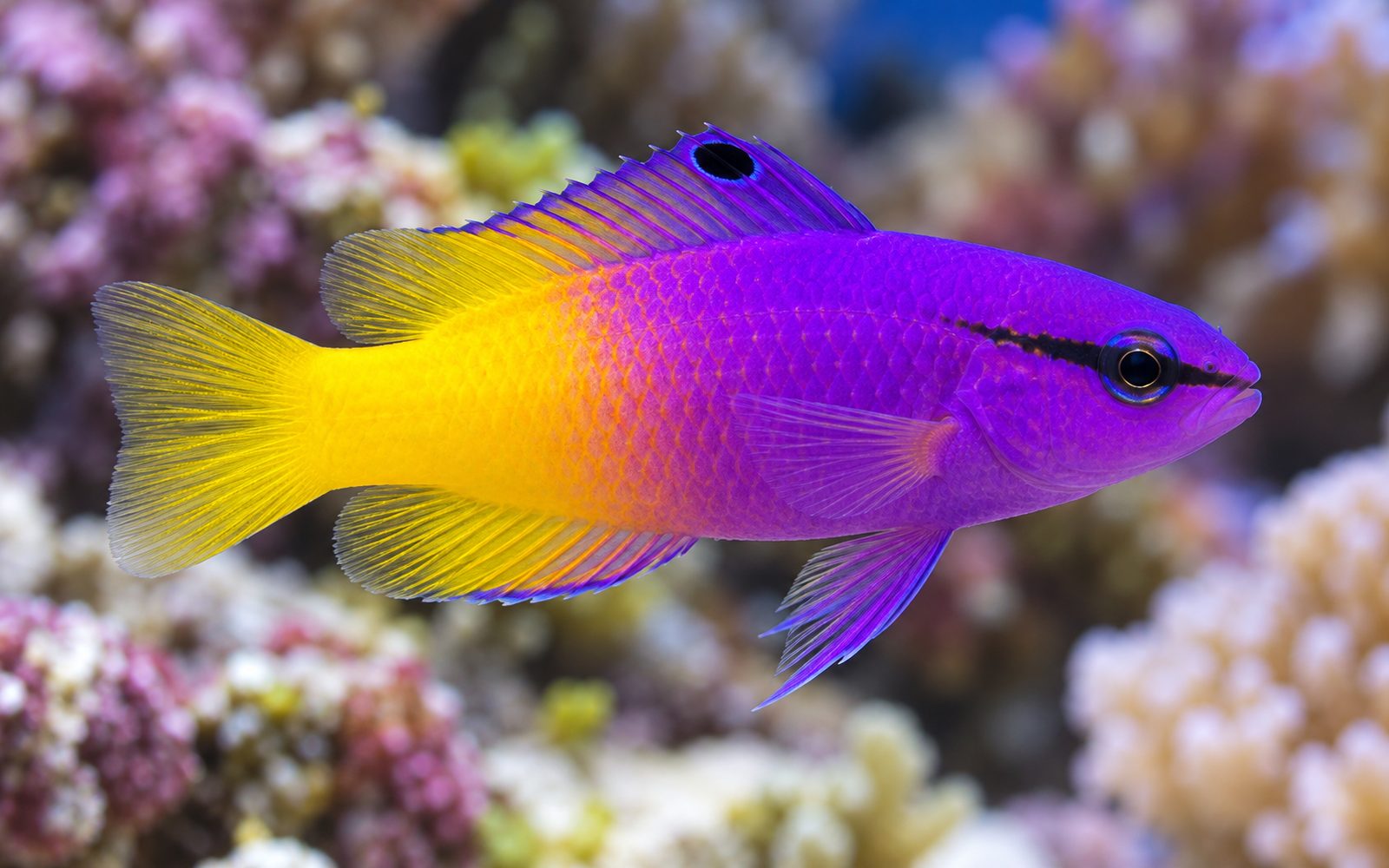
With the front half of its body a vivid purple and the rear half bright yellow, the royal gramma is one of the most colorful small fish in reef aquariums. The two colors meet in a soft transition in the middle; the thin black line through the eye and the black spot at the front of the dorsal fin are among its distinguishing features.
It is hardy, easy to feed and peaceful. For this reason it is often recommended to new marine aquarists. Its habit of swimming upside down under caves and overhangs is an interesting behavior; the fish always orients itself to the nearest surface.
The similarly colored royal dottyback (Pictichromis paccagnellae) is much more aggressive; its colors are separated by a sharp line and it has no black spot on the dorsal fin.
Natural Habitat
It lives in groups on Caribbean reef slopes, at the mouths of caves, overhangs and rock holes. Each fish claims a hole and picks off plankton drifting past.
Tank Setup
- Volume: at least 75 liters for a single fish.
- Water: salinity 1.023–1.026 specific gravity, pH 8.1–8.4, temperature 24–27°C.
- Reef compatibility: reef safe; it leaves corals, shrimp and snails alone.
- Layout: a rock structure with caves and overhangs; the fish chooses one of them as its home.
- Lid: it may jump, especially in a new aquarium and when chased; a lid is recommended.
Diet
Carnivorous and a plankton feeder. Offer frozen mysis, brine shrimp, copepods and granules. Twice a day, as much as is eaten within a few minutes, is enough. It usually catches food as it drifts past its cave; make sure the flow carries food there.
Behavior and Compatibility
Peaceful toward other fish; it only chases fish that approach its cave. It is more territorial toward its own species and similarly shaped fish (dottybacks, other grammas).
Good companions: clownfish, gobies, blennies, cardinalfish, chromis, tangs, cleaner shrimp.
Avoid: dottybacks, aggressive damsels, lionfish and predators whose mouths it fits into.
Group and Colony Structure
In a normal-sized aquarium it is kept as a single individual. In a large aquarium (300 liters and up) with a rock structure full of caves, a small group of one male and several females can be tried; the whole group should be added at the same time. Two males together will fight.
Breeding
The male builds a nest of filamentous algae inside his cave and invites the female. The female lays her eggs in the nest and the male guards them. Spawning in the aquarium is not rare; the larvae are planktonic and raising them requires expertise.
Health and Common Problems
- A hardy species; in a new aquarium it is normal for it not to come out of its cave for a few days.
- Marine white spot and velvet: quarantine new fish.
- Jumping: a risk in an uncovered aquarium.
Sexing
Males are usually larger and have longer pelvic fins. A definite external distinction is difficult.
Tank mates
This list is calculated automatically from the species profile and grows as new species are added to the catalog. Try it in the planner for a definite answer.
Should not be kept together



Hobbyist notes
Things you won't find in books, learned by trial and error. The most helpful ones are on top.
Change history and contributors
- Page created · October 16, 2026