
Water parameters
Overview
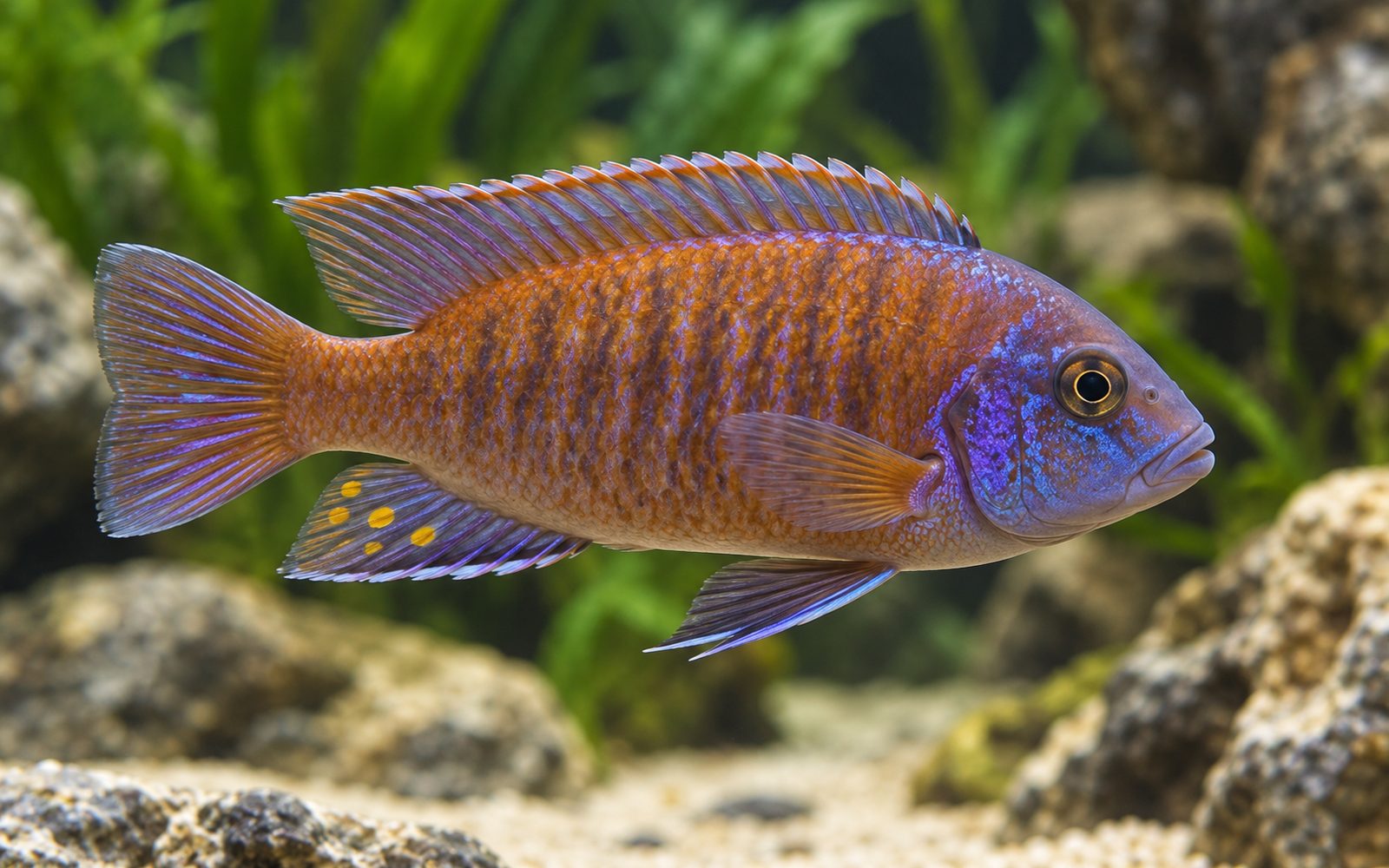
The rusty cichlid gets its name from the rust-brown color of its body. Under light, a purple-lavender sheen shows on the head and fins. Although it looks plain next to the showy blue and yellow mbuna, it adds a different tone to a Malawi aquarium that aims for color variety.
Its real value lies in its temperament: it is one of the calmest mbuna species and rarely seriously attacks other species. Together with the yellow lab, it is among the first choices for those who want to set up a calm mbuna community. Because of this calmness, it can be bullied when kept with very aggressive species.
Natural Habitat
It lives on the rocky shores of the small islands in the southeast arm of Lake Malawi (around Boadzulu). It scrapes the algae layer on the rocks and picks up the small invertebrates within it. The water is hard, alkaline and stable.
Tank Setup
- Volume: at least 200 liters and 100–120 cm in length for a harem and a few mbuna of similar temperament.
- Rockwork: Many caves and crevices; since it is a calm species, places where it can hide are important.
- Water: Hard and alkaline (pH 7.8–8.5); aragonite substrate or Malawi salt.
- Maintenance: Strong filtration, weekly 30–50% water changes.
Diet
Omnivorous, with an emphasis on algae and plant-based food. A spirulina-based mbuna food should be the staple, and brine shrimp or mysis can be added a few times a week. Bloodworms and foods containing mammalian meat should be avoided.
Behavior and Compatibility
A peaceful mbuna; males display to each other, but fights are brief. It is rarely aggressive toward other species. In the same aquarium as aggressive mbuna, it hides constantly and its colors fade.
Good companions: yellow lab, saulosi, yellow-tail acei, maingano, socolofi, Synodontis catfish suited to hard water.
Avoid: very aggressive mbuna such as kenyi, elongatus, auratus and chipokae, large predatory haps, community fish, shrimp and snails.
Group and Colony Structure
- Harem: 1 male and 3–4 females; thanks to its calm temperament, more than one male can also be kept in a large aquarium.
- Community: A balanced community is built together with harems of 3–4 mbuna species of similar temperament.
- Not keeping it with another species of similar brown tones prevents unnecessary rivalry between males.
Breeding
A mouthbrooder. The male courts in front of a cave; the female picks up the eggs in her mouth and they are fertilized with the help of the egg spots on the male's anal fin. The female carries 10–25 eggs for about 3–4 weeks. It produces fewer fry than other mbuna; the fry hide in rock crevices.
Health and Common Problems
- Malawi bloat: the wrong diet and stress.
- Bullying: loss of appetite, fading colors and torn fins when kept with aggressive species.
- Weakness after brooding: after brooding, females should be fed small amounts frequently for a few days.
Sexing
The sexes are similarly colored and difficult to tell apart. Males grow slightly larger, carry more prominent yellow egg spots on the anal fin and darken in color during courtship. For reliable sexing, the genital papilla is examined.
Tank mates
This list is calculated automatically from the species profile and grows as new species are added to the catalog. Try it in the planner for a definite answer.
Usually compatible
 Yellow Regal Peacock
 Firemouth Cichlid
 Rainbow Cichlid
 Pearl Cichlid
 Red Hump Eartheater
 Egyptian Mouthbrooder
 Yellow Tail Acei
 Butterfly Goodeid
American Flagfish
Anatolian Killifish
Butterfly Goodeid
American Flagfish
Anatolian Killifish
Should not be kept together





Hobbyist notes
Things you won't find in books, learned by trial and error. The most helpful ones are on top.
Change history and contributors
- Page created · October 16, 2026