
Water parameters
Overview
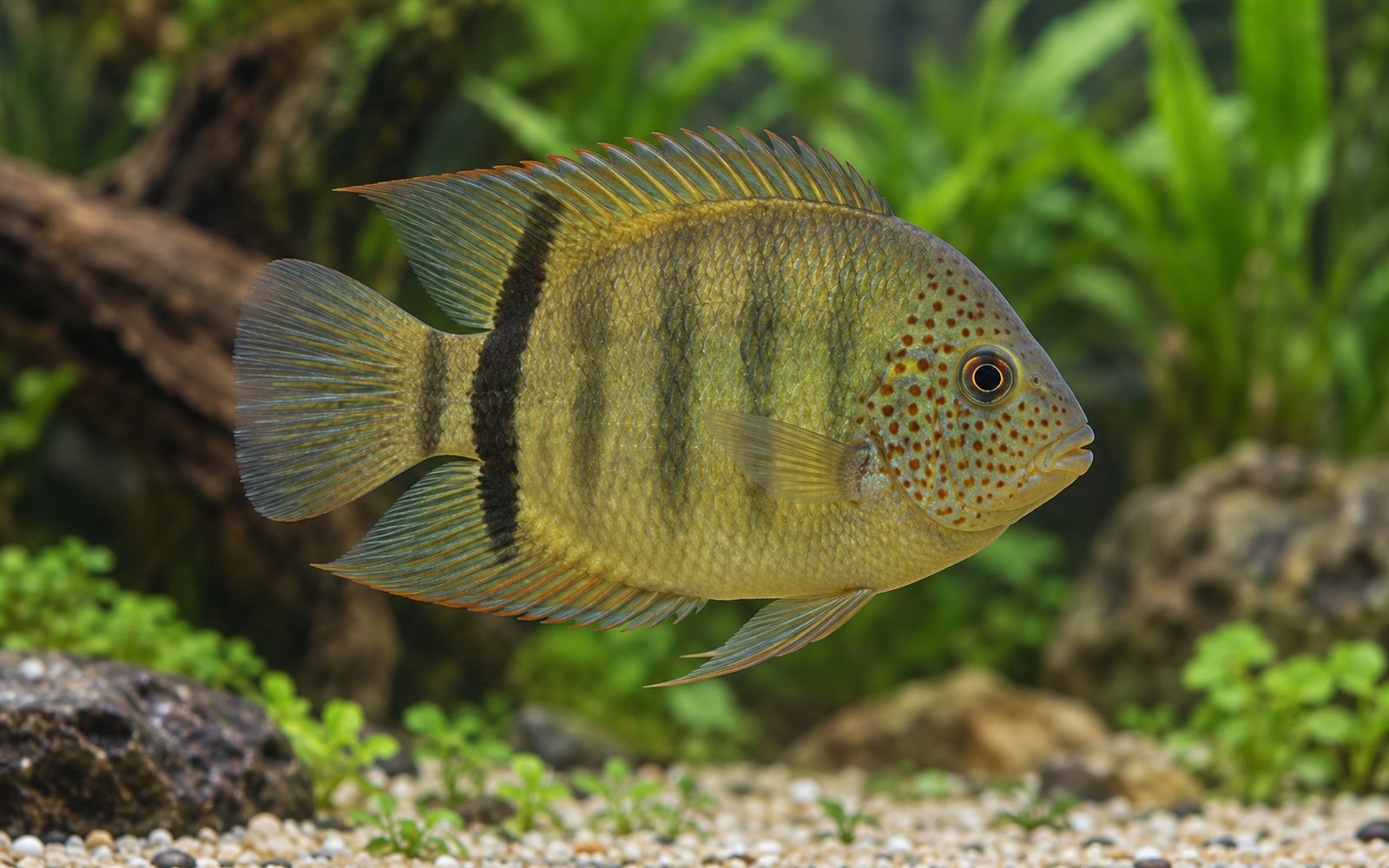
With its tall, laterally compressed body, the severum is reminiscent of the discus; that is why it is called the "poor man's discus" in English. The wild coloration has faint vertical bands on a greenish-gold background. The dark band near the tail, running from the dorsal fin down to the anal fin, is distinct in almost every individual. The most commonly seen form in aquariums is the gold severum.
For many years it was sold as Heros severus. When the genus was re-examined in recent years it was split into several species; most severums in the trade today are thought to be Heros efasciatus or a mix of these species. There is no difference between them in terms of care.
It is a slow-growing, long-lived fish that gets used to its owner. It is much more docile than Central American cichlids; even so, it is a 20 cm cichlid and eats any fish that fits in its mouth.
Color and Fin Varieties
- Gold severum: yellow–orange body, bands almost invisible; the most common form.
- Red spotted gold: rows of red spots on a gold background.
- Turquoise severum: a form close to the wild type with a pronounced greenish-blue sheen.
Natural Habitat
It lives in slow-flowing tributaries, flooded forests and lake shores of the Amazon basin. It roams in small groups under fallen trees, roots and overhanging vegetation. The water is usually soft, slightly acidic and warm.
Tank Setup
- Volume: at least 250 liters and 120 cm of length for a single fish or a pair; 400 liters or more together with other large fish.
- Depth: at least 50 cm of water height, as the body is tall.
- Decor: roots, large flat stones and fine sand. Tough-leaved plants (Anubias, Java fern, Cryptocoryne) hold up; soft stem plants are eaten.
- Filter: a canister filter turning over 4–6 times the tank volume per hour; a 30% water change weekly.
- Light: it likes a dim setting. Floating plants provide shade and reduce shyness.
Diet
Omnivorous and genuinely needs plant matter. A cichlid granule containing spirulina is suitable as the staple; vary it with blanched peas, spinach, zucchini and frozen shrimp and mysis. Adults are fed once or twice a day, as much as they finish in a few minutes.
Behavior and Compatibility
In daily life it is calm, even a little shy; in a spacious tank it rarely bothers other fish. During breeding it resolutely guards the area around the spawning stone and chases its neighbors at that time.
Good companions: angelfish, festivum, uaru, Geophagus species, silver dollars, large plecos, large and fast tetras.
Avoid: neons and similar small tetras, shrimp, Central American cichlids much more aggressive than itself (it gets bullied by them), layouts with soft plants.
Group and Colony Structure
The severum can be kept alone and is not bothered by it. Pairs choose each other; a randomly bought male and female do not always get along. The reliable way is to raise 5–6 juveniles together and separate the pair that forms. Keeping several adult severums in the same aquarium requires at least 400 liters and decor that breaks lines of sight.
Breeding
A mature pair (about 12–15 cm) lays a few hundred to a thousand eggs on a flat stone or root it has cleaned. The eggs hatch in 3–4 days and the fry become free-swimming a few days later. Both parents guard the fry; the fry are fed baby brine shrimp. Young pairs may eat their first eggs; this usually improves after a few attempts.
Health and Common Problems
- Hole-in-the-head disease (HLLE): associated with poor water quality and a monotonous diet; regular large water changes and vitamin-enriched food prevent it.
- Intestinal parasites: if white, stringy feces and loss of appetite appear, consult a veterinarian.
- White spot (ich): especially after sudden drops in temperature.
Sexing
The male has reddish-brown squiggly lines and spots on its head and cheeks; its dorsal and anal fins are longer and more pointed. The female's face is more plainly colored and many females show a dark spot on the dorsal fin. Sexing is confirmed by the shape of the papilla during spawning.
Tank mates
This list is calculated automatically from the species profile and grows as new species are added to the catalog. Try it in the planner for a definite answer.
Usually compatible
 Altum Angelfish
 Firemouth Cichlid
 Buffalohead Cichlid
 Chocolate Cichlid
 Festivum
 Geophagus altifrons
 Geophagus surinamensis
 Rainbow Cichlid
 Gymnogeophagus balzanii
Should not be kept together





Hobbyist notes
Things you won't find in books, learned by trial and error. The most helpful ones are on top.
Change history and contributors
- Page created · October 16, 2026