
Water parameters
Overview
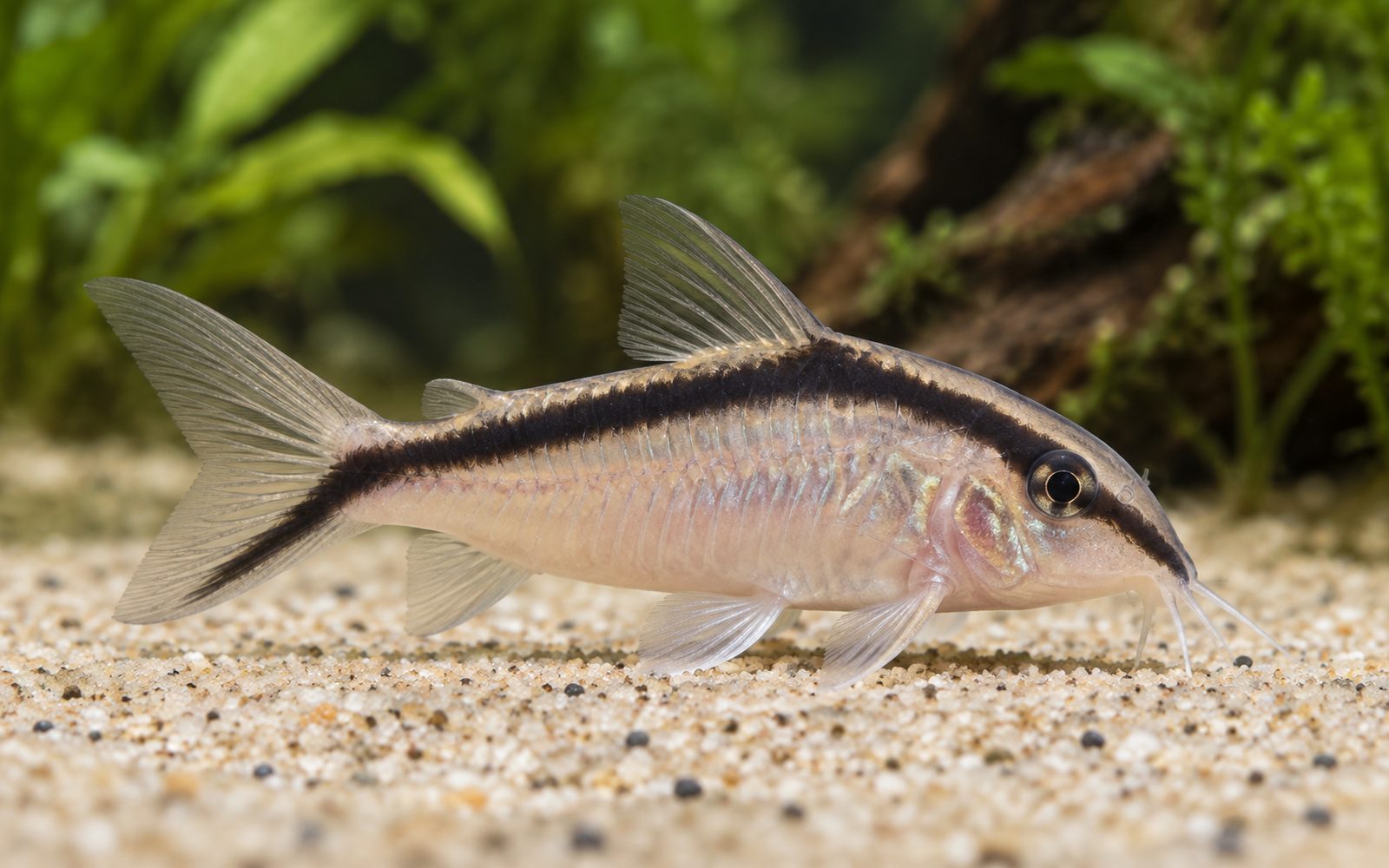
The skunk cory is recognized by a single but very striking marking on its pale cream-pink body: a black stripe that starts at the tip of the snout, passes over the eye, arches along the back and ends in the lower lobe of the tail. Its scientific name describes this curved (arched) stripe, and the English name "skunk" also comes from the stripe on its back. Adults are around 5 cm.
The similarly patterned C. narcissus has a longer snout and is larger; arcuatus has a short, rounded snout.
It is a relatively sensitive species; newly arrived fish in particular weaken quickly in poor water conditions. In a mature, clean aquarium, however, it lives for years.
Natural Habitat
It lives in clear, flowing streams with sandy bottoms and along riverbanks in the upper Amazon basin, in Peru, Ecuador and Brazil. In these waters it roams in large groups, searching for food on the sand with its barbels.
Tank Setup
- Volume: at least 60 liters for a group of 6–10.
- Substrate: fine, rounded sand.
- Water: 22–26°C; soft to moderately hard, well oxygenated and with gentle flow. Nitrate should be kept low; a 25–30% water change weekly is recommended.
- Decor: shaded areas with roots and plants, open sand at the front.
- Filter: a filter that circulates the water well without stirring up the bottom; gentle surface movement improves gas exchange.
Diet
Sinking granules and tablets; frozen bloodworms, brine shrimp and daphnia. Whet the appetite of newly arrived fish with frozen food and then switch them to dry food. It is important that the food reaches the bottom and is not snapped up by fast fish.
Behavior and Compatibility
Peaceful and social. In a group the fish forage together on the bottom; when kept in small numbers they tend to hide more.
Good companions: small tetras, rasboras, pencilfish, apistogrammas, otocinclus, shrimp.
Avoid: cichlids that claim the bottom, large and boisterous fish, species that need warm water.
Group and Colony Structure
At least 6, ideally 10 or more individuals. A large group is more active and visible. It can roam together with other corydoras but is more at ease with its own species.
Breeding
Breeding in the aquarium is possible, but it is not one of the easy-breeding corydoras. Attempts use the same methods as for other corydoras: triggering with a cooler water change and feeding live food; the female sticks the eggs to the glass and leaves.
Health and Common Problems
- It is sensitive to shipping and sudden water changes; quarantine and slow acclimation are recommended.
- Barbel erosion: sharp or dirty substrate.
- It is very sensitive to salt and copper-based medications.
- Quarantine: observing newly arrived fish in a separate aquarium for 2–3 weeks prevents diseases from being carried into the main aquarium.
Sexing
Viewed from above, females are broader and plumper; males are slimmer and slightly smaller.
Tank mates
This list is calculated automatically from the species profile and grows as new species are added to the catalog. Try it in the planner for a definite answer.
Usually compatible
 Flame Tetra
 Blackfin Corydoras
 Polystictus Corydoras
 Emerald Cory
 Emerald Dwarf Rasbora
 Porthole Catfish
 Keyhole Cichlid
 Geophagus surinamensis
 Cryptocoryne Parva
 Gold Spot Pleco (L001)
Should not be kept together






Hobbyist notes
Things you won't find in books, learned by trial and error. The most helpful ones are on top.
Change history and contributors
- Page created · October 16, 2026