
Water parameters
Overview
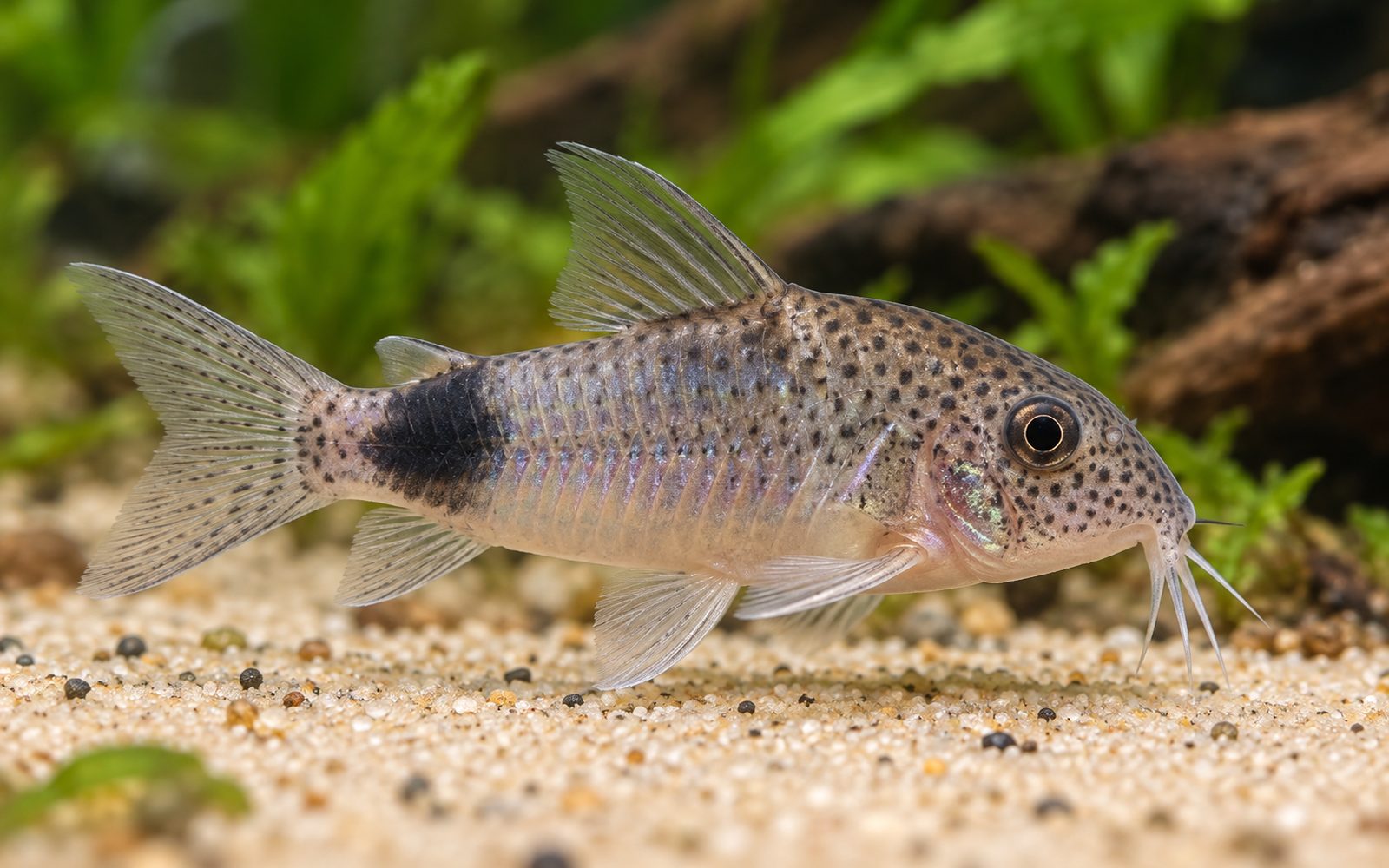
The smudge-spot cory stands out with its gray-violet sheen and interesting pattern: the head and the front half of the body are sprinkled with fine dark spots, while on the rear half there is a large dark blotch with diffuse edges that widens toward the caudal peduncle. The English name "smudge-spot" comes from this blurry blotch, and the name "violet cory" from the purplish tone of the body. Adults are around 5 cm.
This pattern makes it easy to tell apart from other corydoras. Although it was a rarely seen species for a long time, captive-bred fish are also sold today.
Natural Habitat
It lives in clear, slow-flowing waters with sandy bottoms in streams of the Madeira River basin in the Brazilian state of Rondônia. In these streams it roams in groups near the banks, where leaves and branches accumulate; in the aquarium, a few dried leaves and pieces of root scattered over the sand create a similar environment.
Tank Setup
- Volume: at least 60 liters for a group of 6–10; footprint matters.
- Substrate: fine, rounded sand.
- Water: 22–26°C; soft to moderately hard, clean and oxygen-rich water. A 25% water change weekly is enough.
- Decor: shaded areas with roots and plants; an open sand area at the front.
Diet
Make sinking tablets and granules the staple; supplement with frozen bloodworms, brine shrimp and daphnia. Feeding in the evening lets bottom fish eat in peace.
Behavior and Compatibility
A peaceful, calm bottom dweller. In a group the fish forage on the bottom; it does not bother fish or shrimp.
Good companions: tetras, rasboras, small peaceful barbs, dwarf gouramis, apistogrammas, otocinclus, shrimp.
Avoid: cichlids that claim the bottom, large and predatory fish.
Group and Colony Structure
At least 6, ideally 10 or more individuals. A large group is bolder and is seen more often in the open during the day. It can roam together with other small corydoras. If breeding is planned, a ratio of 2 males to each female improves spawning success.
Breeding
It breeds in the aquarium. Like other corydoras, spawning is triggered by a somewhat cooler, large water change. The female sticks the eggs to the glass and the undersides of leaves. The eggs hatch in 3–5 days; the fry are raised on microworms and freshly hatched brine shrimp.
Health and Common Problems
- Barbel erosion: sharp or dirty substrate.
- It is sensitive to nitrate buildup; regular water changes are essential.
- It is sensitive to salt and copper-based medications.
- Quarantine: observing newly arrived fish in a separate aquarium for 2–3 weeks prevents diseases from being carried into the main aquarium.
Sexing
Viewed from above, females are broader and plumper; males are smaller and slimmer. The difference is best seen by comparison in mature females carrying eggs and when the group is together.
Tank mates
This list is calculated automatically from the species profile and grows as new species are added to the catalog. Try it in the planner for a definite answer.
Usually compatible
 Flame Tetra
 Blackfin Corydoras
 Polystictus Corydoras
 Emerald Cory
 Emerald Dwarf Rasbora
 Porthole Catfish
 Keyhole Cichlid
 Geophagus surinamensis
 Cryptocoryne Parva
 Gold Spot Pleco (L001)
Should not be kept together






Hobbyist notes
Things you won't find in books, learned by trial and error. The most helpful ones are on top.
Change history and contributors
- Page created · October 16, 2026