
Water parameters
Overview
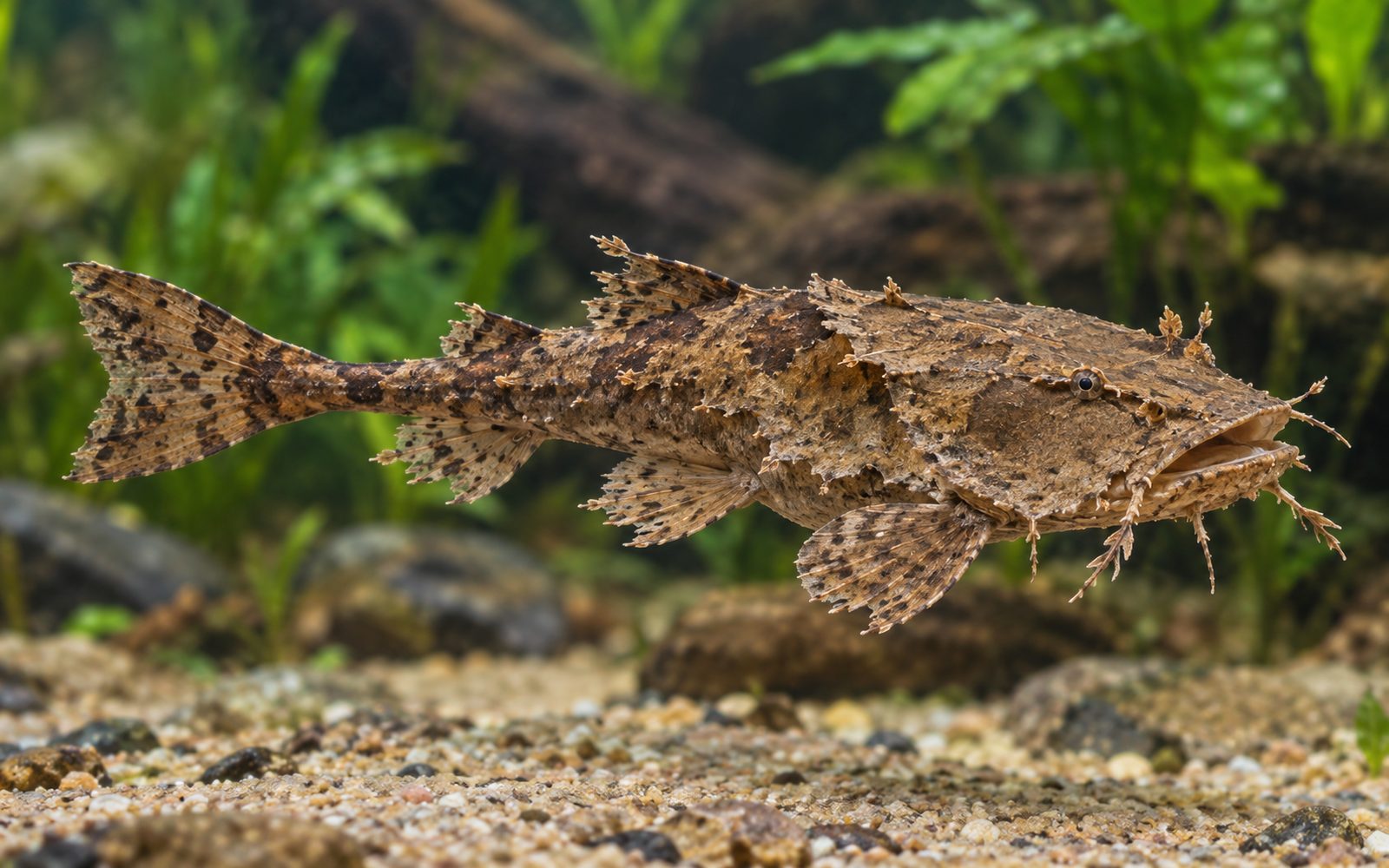
The squarehead catfish is the best-known member of the small family Chacidae, which contains only a few species. It has an almost square, very wide and flat head, a mouth that can open as wide as the head itself, and tiny eyes. Its brown-mottled skin, covered with small fleshy bumps, makes it look like a leaf fallen to the bottom or a piece of rotting branch.
Adults reach about 20 cm. It spends most of its life motionless, and when prey comes close it suddenly opens its mouth and sucks it in. It is also reported to wiggle the short barbels around its mouth to lure small fish closer. Because it rarely moves, some hobbyists find it boring; others consider it one of the most interesting aquarium animals.
Natural Habitat
It lives in the slow-flowing rivers, streams and ponds of South Asia, on muddy or sandy bottoms among leaf litter. It spends the day half-buried and motionless and hunts at night.
Tank Setup
- Volume: at least 120 liters for one individual; a large floor area matters more than swimming space.
- Substrate: soft sand covered with plenty of dried leaves; the fish disappears among them.
- Lighting: dim; floating plants and shaded corners.
- Flow: very gentle; it does not like strong currents.
- Water: 22–25°C, pH 6.0–7.5; clean and stable.
Diet
Carnivorous. In the wild it feeds on live fish and large invertebrates. In the aquarium it can gradually be weaned onto fish fillet, shrimp, large bloodworms and earthworms offered with tongs. One or two feedings a week is enough for adults; overfeeding causes bloating and obesity.
Behavior and Compatibility
It does not attack or chase other fish, but it swallows any creature that fits in its mouth. Because its mouth is so wide, even fish approaching half its own length are at risk. For this reason it is usually kept alone or with its own kind.
Good companions: its own kind; in very large aquariums, large and calm fish that definitely will not fit in its mouth.
Avoid: all small and medium-sized fish, shrimp; large species that dig up the substrate and disturb the motionless fish.
Group and Colony Structure
It is mostly kept as a single individual. Several individuals of similar size can live together in an aquarium with a large floor area; if their sizes differ greatly, the larger one may swallow the smaller.
Breeding
It very rarely breeds in the aquarium, and reliable information on its breeding behavior is scarce. The fish sold are mostly wild-caught.
Health and Common Problems
- Overfeeding: the most common problem; one or two meals a week is enough.
- Skin infections: poor water caused by a dirty bottom and rotting leaves affects its skin; clean the bottom and change water regularly.
- Its scaleless skin is sensitive to medications.
Sexing
Difficult to tell apart externally. Mature females are noticeably plumper when carrying eggs.
Tank mates
This list is calculated automatically from the species profile and grows as new species are added to the catalog. Try it in the planner for a definite answer.
Usually compatible
 Firemouth Cichlid
 Rainbow Cichlid
 Gymnogeophagus balzanii
 Pearl Cichlid
 Red Hump Eartheater
 Cryptocoryne Parva
 Lifalili Jewel Cichlid
 Weeping Moss
 Flame Moss
Should not be kept together





Hobbyist notes
Things you won't find in books, learned by trial and error. The most helpful ones are on top.
Change history and contributors
- Page created · October 16, 2026