
Water parameters
Overview
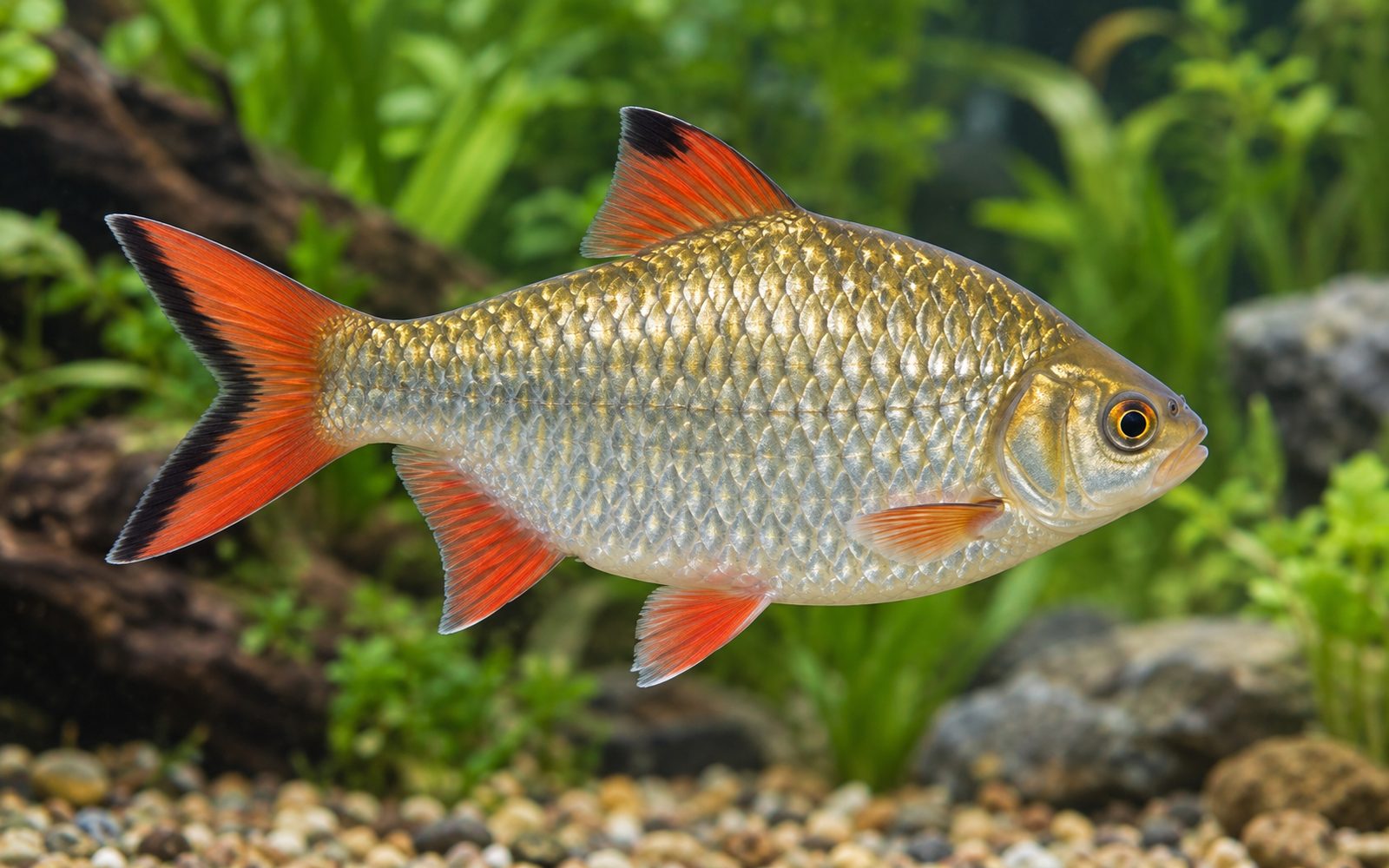
The tinfoil barb is a large barb that lives in the big rivers of Southeast Asia. It is very showy, with shiny silver-gold scales, red fins and black stripes along the edges of the tail lobes. It is sold in stores as 4–5 cm juveniles, but it grows fast and reaches 30–35 cm as an adult.
For this reason it is one of the fish most often bought by mistake in the hobby. An adult school needs a tank of at least 1000 liters and more than 200 cm long; standard home aquariums are not suitable for this species.
Natural Habitat
It lives in the rivers and canals of the Mekong and Chao Phraya basins, the Malay Peninsula, Sumatra and Borneo, and in forests flooded during the rainy season. It roams in schools in fast-flowing, oxygen-rich water.
Tank Setup
- Volume: at least 1000 liters and 200 cm or more in length for 5–6 adults. A large, open swimming area is essential.
- Water: 23–26°C; a wide pH range. Very powerful filtration and high oxygen levels are needed.
- Decor: a simple layout with roots and large rocks; soft plants are eaten in a short time.
- Lid: it jumps powerfully and fast; a heavy, tight-fitting lid is essential.
- Maintenance: a large biological load; a 30–50% weekly water change.
Diet
Omnivorous and fond of plant foods. Large granules and pellets, spirulina, blanched vegetables (zucchini, spinach, peas), frozen mysis shrimp and bloodworms. It eats small fish and shrimp that fit in its mouth.
Behavior and Compatibility
Peaceful but very active and large. It does not attack fish of similar size; however, its fast swimming stresses shy species, and it eats small fish. It swims as a school, using the whole tank.
Good companions: peaceful giant fish of similar size: bala sharks, large plecos, clown loaches, large gouramis, calm giant catfish.
Avoid: small fish such as neons, rasboras and guppies; dwarf shrimp; slow and shy species; planted tanks.
Group and Colony Structure
Keep at least 5, ideally 6 or more. Tinfoils kept singly or in pairs become skittish and swim in a constant state of panic. This makes the required tank volume even larger; before buying, make sure you can house an adult group.
Breeding
It does not breed in home aquariums. Commercial production is done on farms in Southeast Asia, in large ponds and with the help of hormones.
Health and Common Problems
Hardy; the real problems come from small tanks: stunting, curved spines, injuries and bacterial infections linked to poor water. It can injure itself by hitting the lid while jumping.
Sexing
Very hard to tell apart externally. Mature females have a slightly fuller belly.
Tank mates
This list is calculated automatically from the species profile and grows as new species are added to the catalog. Try it in the planner for a definite answer.
Usually compatible
 Firemouth Cichlid
 Chocolate Cichlid
 Festivum
 Geophagus surinamensis
 Gymnogeophagus balzanii
 Pearl Cichlid
 Threadfin Acara
 Blood Parrot
 Redhead Cichlid
 Red Hump Eartheater
Should not be kept together









Hobbyist notes
Things you won't find in books, learned by trial and error. The most helpful ones are on top.
Change history and contributors
- Page created · October 16, 2026