
Water parameters
Overview
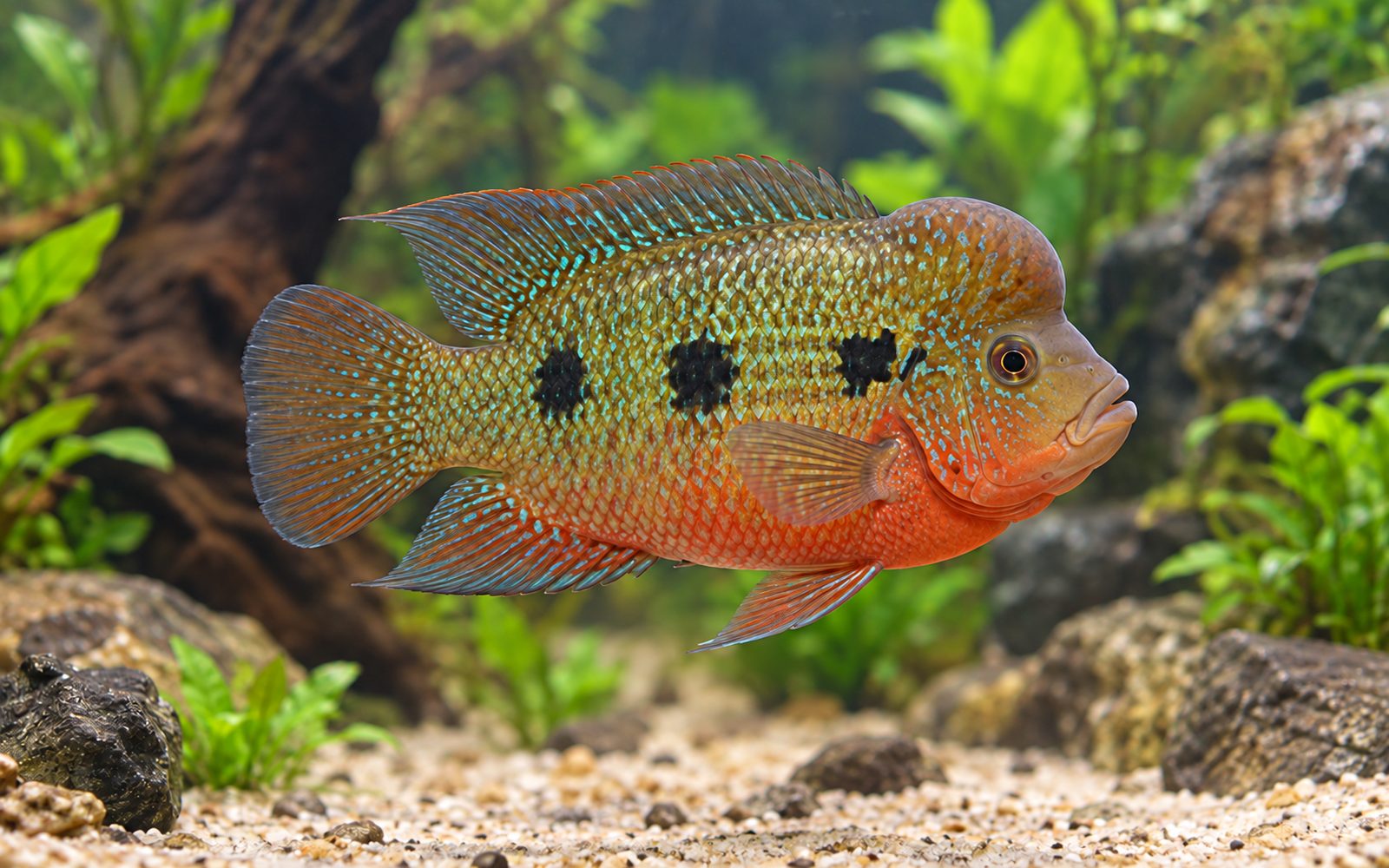
The trimac takes its name ("three-spotted") from the three black blotches lined up along its body. Its greenish-gold body is decorated with shiny blue–green spots; its throat and belly are red–orange. Mature males develop a prominent hump on the forehead. It is considered one of the main species used to create flowerhorn hybrids; that is why much of the flowerhorn's hump and color heritage comes from it.
It is a powerful and extremely aggressive fish that can exceed 30 cm. It defends its territory constantly, not only during breeding. It suits only hobbyists who can dedicate a large, single-fish setup to it.
Natural Habitat
It lives in Pacific-draining rivers, lakes and lagoons from southern Mexico to Guatemala and El Salvador. In warm, moderately hard waters it feeds on small fish, crustaceans and insects.
Tank Setup
- Volume: at least 400 liters and 150–180 cm of length for a single adult.
- Decor: a few large, stable rocks; a wide swimming area. Keeping plants is not practical.
- Equipment: a powerful canister filter or sump, a guarded heater and a heavy lid.
- Water: moderately hard, slightly alkaline water; 25–28°C is ideal.
- Maintenance: a 30–50% water change weekly.
Diet
Mainly carnivorous. Use large cichlid granules as the staple; vary them with frozen shrimp, mysis, mussels and fish fillet, and add vegetables occasionally. Live feeder fish are not recommended. One meal a day is enough for adults.
Behavior and Compatibility
Intelligent and interactive; it recognizes its owner. However, it sees every fish in the aquarium as a rival or prey, and may attack a hand. Even individuals raised together as juveniles can seriously harm each other as they mature.
Good companions: it is best kept alone. In a very large aquarium, only large, robust plecos.
Avoid: all community fish, other cichlids, shrimp, snails, plants.
Group and Colony Structure
Keeping it alone is recommended. A pair is only possible by raising juveniles together and a controlled introduction using a perforated divider; the male can kill the female in a short time.
Breeding
The pair lays hundreds to over a thousand eggs on a cleaned stone. The larvae are moved into dug pits; the parents guard the fry very fiercely. To prevent hybridization, it should not be bred together with other Amphilophus species.
Health and Common Problems
- Hole-in-the-head disease (HLLE): in poor water quality.
- Injuries: from fights and from attacking the glass or decor.
- Digestive problems: with overfeeding; skipping food one day a week eases digestion.
- Bacterial infections: develop in dirty water after injuries.
Sexing
The male is noticeably larger, with a nuchal hump and long, pointed fins. The female is smaller; a dark spot may appear on the dorsal fin, but this is not reliable. Sexing is confirmed by the papilla.
Tank mates
This list is calculated automatically from the species profile and grows as new species are added to the catalog. Try it in the planner for a definite answer.
Usually compatible
 Banded Jewel Cichlid
 Spotted Tilapia
 Flowerhorn
 Jack Dempsey
 Jaguar Cichlid
 Red Devil Cichlid
 Red Terror Cichlid
 Cryptocoryne Parva
 Wolf Cichlid
 Zebra Tilapia
Should not be kept together








Hobbyist notes
Things you won't find in books, learned by trial and error. The most helpful ones are on top.
Change history and contributors
- Page created · October 16, 2026