
Water parameters
Overview
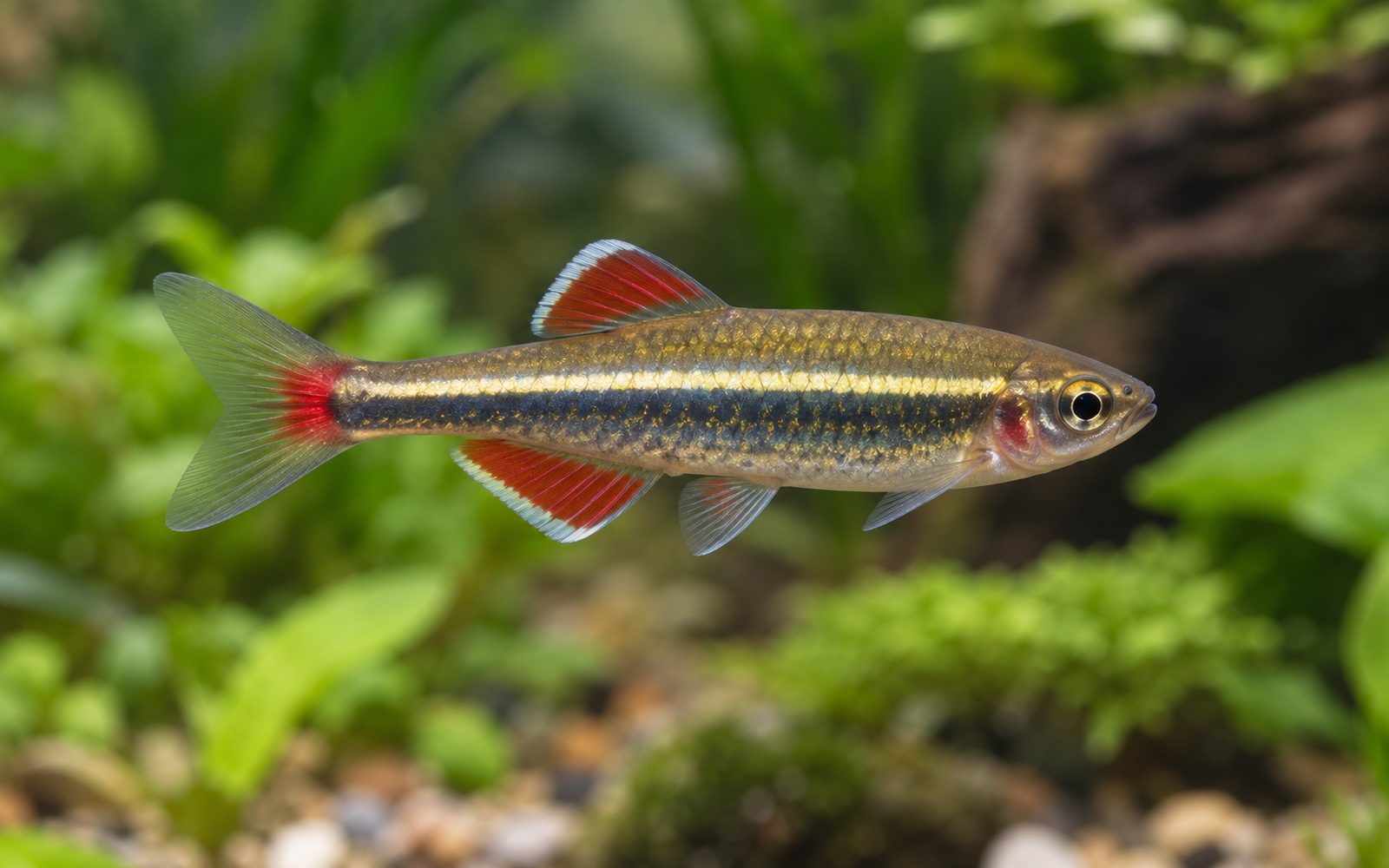
The White Cloud Mountain minnow is named after White Cloud Mountain near the city of Guangzhou in China. Its slender, bronze-olive body carries a bright gold-white stripe running from the eye to the tail, with a dark band below it. The base of the tail is red; the dorsal and anal fins are red with white edges.
It grows to about 4 cm. It is not a tropical fish: it is at its healthiest in cool water at room temperature, and keeping it above 25°C for long periods shortens its lifespan. For a long time it was counted among the carps (Cyprinidae); in current classification it is placed in its own family, Tanichthyidae. Wild populations have declined sharply due to habitat loss; all fish in the trade are captive-bred.
Color and Fin Varieties
- Golden white cloud: a captive-bred form with a yellowish-gold body and a paler lateral stripe; it keeps its red fins.
- Long-fin white cloud: a form with elongated dorsal, anal and tail fins; it should not be kept with fin-nipping species.
Natural Habitat
It lives in the hilly regions of southern China and in northeastern Vietnam, in clear, cool mountain streams and in the shallow, vegetated pools these streams form. The water cools markedly with the seasons; in winter it can drop below 15°C.
Tank Setup
- Volume: at least 54 liters and 60 cm length for a group of 8–10.
- Water: 18–22°C is ideal; pH 6.5–8, adapts widely from soft to hard. A heater is not needed in most homes.
- Flow: gentle to moderate; keep oxygen high.
- Layout: plants along the edges, open space in the middle. Plants suited to cool water (vallisneria, Java moss, hornwort) do well.
- Lid: it can jump; use a lid.
- Outdoors: in temperate climates it can also be kept in garden ponds in summer.
Diet
Omnivorous and greedy. Make small flakes and granules the staple; frozen brine shrimp, daphnia and mosquito larvae bring out its colors. Give small amounts once or twice a day.
Behavior and Compatibility
Peaceful and social. It swims in the middle and upper layers as a group. Males display to each other with their fins fully spread; these displays are harmless and are the species' most beautiful behavior.
Good companions: Other small species that like cool water: pearl danios, glowlight danios, emerald dwarf rasboras, Neocaridina shrimp, some Corydoras species (C. paleatus), snails.
Avoid: Fish big enough to fit it in their mouths (including goldfish), tropical species that need warm water.
Group and Colony Structure
At least 8, ideally 12 or more individuals. In a large group the males display more and the colors come alive. Kept in small numbers, their colors fade and they hide. The male-to-female ratio is not critical.
Breeding
One of the easiest egg scatterers to breed in the aquarium. It lays its eggs among plants; the parents chase eggs and fry less than many other species do, so fry can grow up on their own in a planted aquarium. For more fry, a separate tank with moss is used and the adults are removed after a few days. The fry start on infusoria and powdered food, then take newly hatched brine shrimp.
Health and Common Problems
- Warm water: staying above 25°C for long periods increases susceptibility to disease and shortens lifespan.
- White spot: can appear after sudden temperature changes.
- Water quality: a 25% water change every week is enough.
Sexing
Males are slimmer and more colorful; the red and white edges on their fins are prominent, and during displays they spread their fins to the fullest. Females have fuller bellies and are paler.
Tank mates
This list is calculated automatically from the species profile and grows as new species are added to the catalog. Try it in the planner for a definite answer.
Usually compatible
 Flame Tetra
 Blackfin Corydoras
 Polystictus Corydoras
 Emerald Cory
 Emerald Dwarf Rasbora
 Porthole Catfish
 Keyhole Cichlid
 Cryptocoryne Parva
 European Bitterling
 Adolfo's Cory
Should not be kept together







Hobbyist notes
Things you won't find in books, learned by trial and error. The most helpful ones are on top.
Change history and contributors
- Page created · October 16, 2026