
Water parameters
Overview
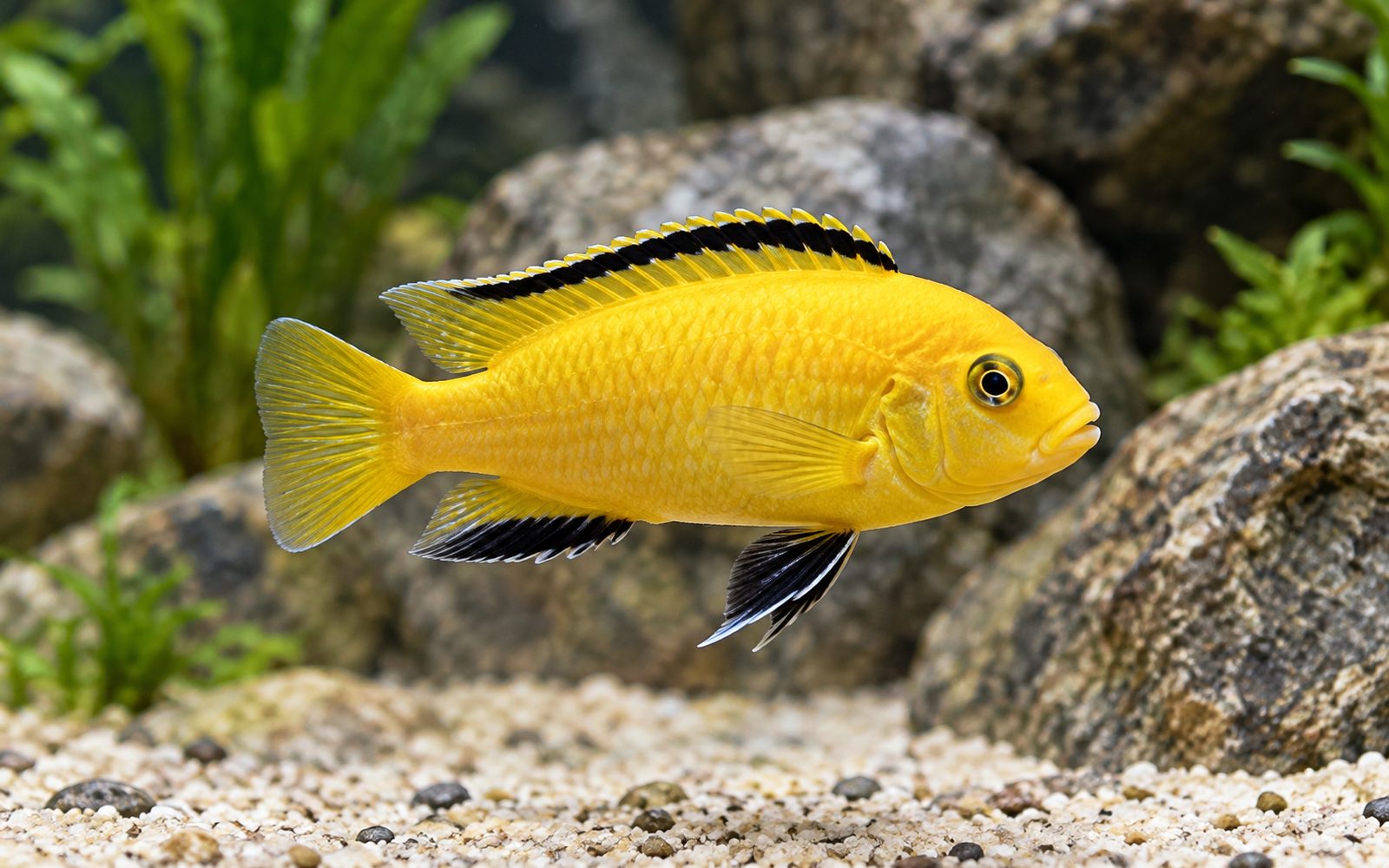
The yellow lab is one of the most commonly kept cichlids in the aquarium, from the "mbuna" group that lives along the rocky shores of Lake Malawi. Its bright yellow color, combined with the black stripe on the dorsal and pelvic fins, is very striking. It is noticeably less aggressive than other mbuna, which makes it a good species for starting a Malawi aquarium.
But note: "docile" applies within the mbuna. It is not compatible with community fish such as neons and guppies, with shrimp or with a planted aquarium.
Natural Habitat
It lives among and at the base of rocks in the clear, hard, alkaline (pH 7.8–8.6) water of Lake Malawi, which has a stable temperature. In the wild it is found deeper and more solitary than other mbuna; it picks insect larvae, snails and small crustaceans from rock crevices.
Tank Setup
- Volume: at least 200 liters and 120 cm in length for a Malawi aquarium.
- Rockwork: Most of the aquarium should be filled with rocks forming many caves and crevices; this spreads out territorial fights. It is important to set the rocks on the bottom (because of the risk of collapse).
- Water: Hard and alkaline. With soft tap water, coral sand or aragonite substrate and Malawi salt are used.
- Filter: Strong; because mbuna are kept crowded, the waste load is high.
Diet
Omnivorous; it is not as herbivorous as other mbuna. A quality cichlid pellet, spirulina food and frozen mysis shrimp or brine shrimp a few times a week. Overly fatty and protein-heavy foods such as bloodworms can lead to "Malawi bloat"; they should be given sparingly.
Behavior and Compatibility
It is peaceful among mbuna but still a cichlid: males defend their own territory. To spread out aggression, 3–4 females per male and a crowded mbuna community are preferred. Fights increase in the same aquarium as similar yellow species (e.g., yellow Metriaclima).
Good companions: other peaceful mbuna (Pseudotropheus saulosi, Iodotropheus sprengerae) and Synodontis catfish suited to hard, alkaline water (e.g., Synodontis petricola from Lake Tanganyika).
Avoid: all community fish (neons, guppies, corydoras — water parameters and temperament), shrimp, snails, South American cichlids, plants (most are uprooted or eaten; Anubias can survive).
Group and Colony Structure
In mbuna a harem setup is used so that aggression does not focus on a single fish: 3–4 females per male. For Labidochromis, a group of 1 male and 3–4 females is kept in an aquarium of 200 liters or more together with similar groups of other peaceful mbuna species.
Deliberately keeping Malawi aquariums somewhat crowded (with strong filtration) makes it harder for a single fish to set up a territory and intimidate the others. There should be no other yellow mbuna male of a similar color in the same aquarium.
Breeding
A mouthbrooder. The male courts in front of a cave; the female picks up her eggs in her mouth as soon as she lays them, and they are fertilized as she reaches for the "egg spots" on the male's anal fin. The female carries 10–20 eggs in her mouth for about 3–4 weeks, not eating during this time. When released, the fry are small but fully developed fish and eat finely crushed food.
Health and Common Problems
- Malawi bloat: swollen belly, loss of appetite, rapid breathing. Triggered by the wrong diet and stress; fatal if not treated early.
- Hole in the head: insufficient water changes and nutrition.
- Injury: in territorial fights; enough rocks and the right male-to-female ratio are the best prevention.
Sexing
In males the black on the pelvic fins is more intense and the black stripe on the dorsal fin more distinct; there are prominent yellow-orange "egg spots" on the anal fin. Females are slightly paler and smaller, but because some females also have a black edge, sexing is not always easy.
Tank mates
This list is calculated automatically from the species profile and grows as new species are added to the catalog. Try it in the planner for a definite answer.
Usually compatible
 Yellow Regal Peacock
 Firemouth Cichlid
 Rainbow Cichlid
 Pearl Cichlid
 Red Hump Eartheater
 Egyptian Mouthbrooder
 Yellow Tail Acei
 Butterfly Goodeid
American Flagfish
Anatolian Killifish
Butterfly Goodeid
American Flagfish
Anatolian Killifish
Should not be kept together





Hobbyist notes
Things you won't find in books, learned by trial and error. The most helpful ones are on top.
Change history and contributors
- Page created · October 16, 2026