
Water parameters
Overview
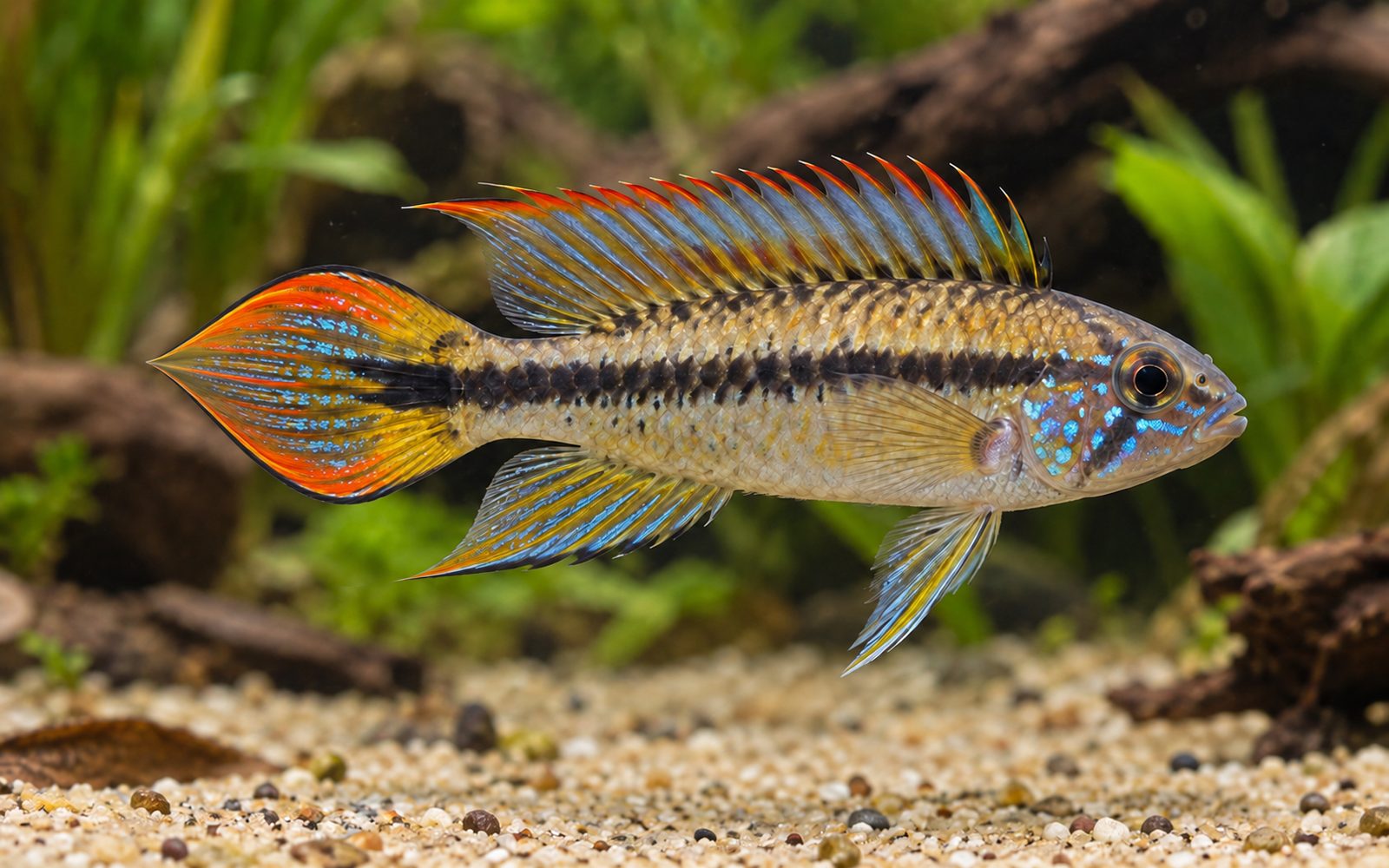
Apistogramma agassizii is one of the earliest known species of the genus and one of those kept longest in the aquarium. It was described in 1875 and is named after Louis Agassiz, who organized a scientific expedition to the Amazon. A dark stripe runs from the eye to the tail along the male's slender body; its most distinctive feature, however, is its pointed, spade- or spear-shaped tail. The tail carries orange, blue and dark bands.
Because of its wide range, color and pattern vary greatly by locality. Most fish sold come from breeding farms in Europe and Asia; these adapt to a wider range of water values than their wild relatives.
Color and Fin Varieties
- Fire Red (red agassizii): a farm-bred form with an intensely red–orange tail and fins.
- Regional forms (Tefé, Santarém, Alenquer): wild forms sold under the name of their collection site; color and pattern vary by locality. They should not be crossed with each other so that the lines are preserved.
Natural Habitat
It ranges over much of the Amazon basin, from Peru to eastern Brazil. It lives along the banks of slow-flowing streams, in flooded forests and at lake edges, among thick leaf litter and branches. The water is usually very soft, acidic and in many places stained tea-colored by tannins.
Tank Setup
- Volume: at least 60 liters for one male and 2–3 females; a length of 80 cm is more comfortable.
- Caves: a separate cave for each female (coconut shell, small ceramic or stone cave).
- Substrate and decor: fine sand, dried leaves, roots and dense planting; obstacles that break lines of sight reduce fighting. Dim light and floating plants put the fish at ease.
- Water: 25–27°C is ideal. Farm-bred fish adapt to pH 7 and moderate hardness; wild fish and breeding require soft, acidic water. A 25–30% water change every week; nitrate should stay low.
- Filter: gentle flow; a sponge filter or a turned-down canister filter is suitable.
Diet
Carnivorous. Make frozen bloodworms, brine shrimp, daphnia, cyclops and mysis the staple; it also accepts small sinking granules. Live food boosts color and the urge to breed. Feed 1–2 times a day, as much as is eaten within a few minutes.
Behavior and Compatibility
It sets up territories in the bottom zone; it usually leaves alone peaceful fish swimming in the middle and upper layers. The male patrols a large area that covers the females' territories and is harsh toward other males. A female guarding fry chases away any fish that approaches her cave.
Good companions: small tetras such as cardinals and neons, pencilfish, hatchetfish, harlequin rasboras, otocinclus.
Avoid: other Apistogramma males in a small aquarium, shrimp, large or aggressive cichlids, fin-nippers such as tiger barbs.
Group and Colony Structure
It lives in a harem: 1 male and 2–3 females. Each female sets up a small territory around her own cave; the male moves between these territories. A single pair can also be kept, but then the female may be overwhelmed by the male's attention. Two males should only be tried in an aquarium of 120 cm or more that is well divided by decor.
Breeding
The female lays usually 50–150 eggs on the ceiling of the cave and takes on the care largely alone; during this time she turns bright yellow. At around 26°C the eggs hatch in 2–3 days, and the fry become free-swimming about a week later. The female leads the brood around the bottom. The fry are fed newly hatched brine shrimp. Temperature and pH affect the sex ratio of the fry; at higher temperatures the proportion of males increases. In a small aquarium, if the female attacks the male, the male should be removed.
Health and Common Problems
It is sensitive to poor water quality and accumulated nitrate; sudden pH changes cause stress. Internal parasites are common in wild-caught imports, so quarantine is recommended. It is hardy in a mature aquarium with regular water changes.
Sexing
Sexing is easy. The male reaches about 8 cm; its dorsal and anal fins are long and its tail is pointed and colorful. The female stays around 5 cm; her fins are short and her tail is rounded. A female guarding fry is instantly recognized by the black eye bar on a yellow background and black-edged pelvic fins.
Tank mates
This list is calculated automatically from the species profile and grows as new species are added to the catalog. Try it in the planner for a definite answer.
Usually compatible
 Emerald Betta
 Emerald Cory
 Porthole Catfish
 Keyhole Cichlid
 Firemouth Cichlid
 Cupid Cichlid
 Buffalohead Cichlid
 Festivum
 Geophagus altifrons
Should not be kept together





Hobbyist notes
Things you won't find in books, learned by trial and error. The most helpful ones are on top.
Change history and contributors
- Page created · October 16, 2026