
Water parameters
Overview
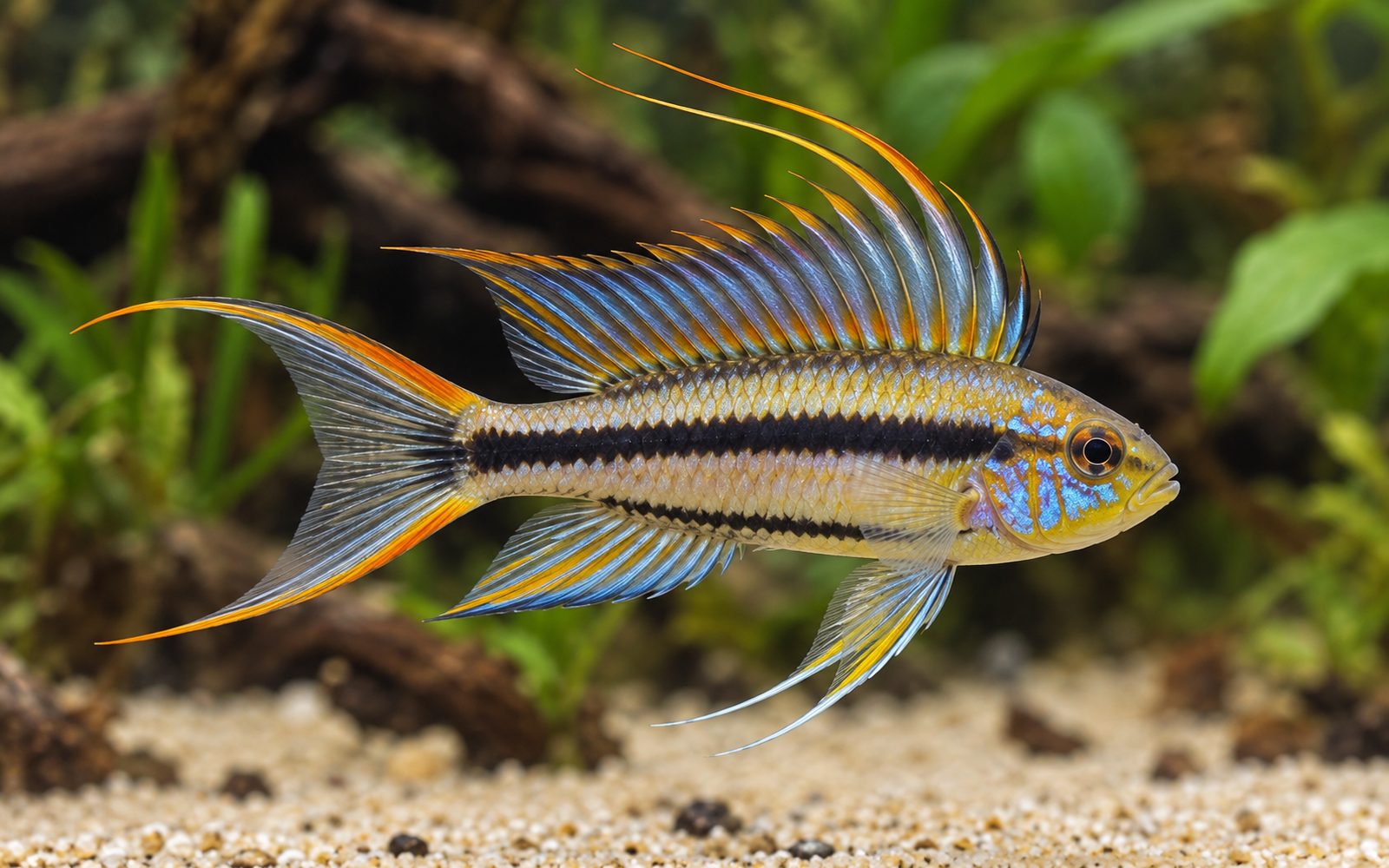
Apistogramma bitaeniata takes its name ("two-banded") from the two dark stripes on its body: one runs from the middle of the flank and the other from the lower belly toward the tail. The front membranes of the male's dorsal fin extend into threads, giving the fin a comb-like look; with age its tail also takes on a lyre shape, with extended upper and lower tips.
Because its range is wide, there are many local forms. Peruvian forms are usually bluer, while Brazilian forms are more yellow, especially on the head. In older sources it also appears under the names A. kleei and A. klausewitzi.
Natural Habitat
It lives along the main tributaries of the Amazon, from the Marañón and Ucayali in Peru to the mouth of the Tapajós in Brazil, on shallow, leaf-filled banks in flooded forests. The water is very soft and acidic; wild fish do better at the lower end of the pH range.
Tank Setup
- Volume: at least 60 liters for one male and 2–3 females.
- Water: 25–27°C, soft and acidic (pH 5–6.5 ideal). Hard tap water should be softened with RO water.
- Decor: a cave for each female, fine sand, dried leaves, roots and dim light.
- Maintenance: a 25% water change every week; nitrate should be kept low.
Diet
Carnivorous. Make small live or frozen foods such as cyclops, brine shrimp, daphnia and fine bloodworms the staple. It accepts small granules over time.
Behavior and Compatibility
It sets up small territories on the bottom; it causes no trouble with calm fish swimming in the middle layer. Males display at each other with spread fins; in a small aquarium these displays can turn into fights. It hunts shrimplets.
Good companions: cardinal and neon tetras, pencilfish, hatchetfish, harlequin rasboras, otocinclus.
Avoid: large cichlids, fin-nipping species, fish that need hard water, shrimp breeding tanks.
Group and Colony Structure
A harem: 1 male and 2–3 females. Each female claims her own cave. Different local forms should not be mixed in the same aquarium because of the risk of hybridization.
Breeding
The female lays eggs inside the cave and takes on their care alone; the eggs hatch in 2–3 days. A female guarding fry turns bright yellow and her two stripes become even more pronounced. Soft, acidic water markedly increases breeding success. The fry are fed newly hatched brine shrimp; in a small aquarium the male may need to be removed.
Health and Common Problems
It is sensitive to deterioration in water quality and pH swings. Imported fish should be observed in quarantine for internal parasites.
Sexing
Males reach about 6 cm; their dorsal fin is tall with thread-like extensions and their tail is lyre-shaped and colorful. Females are smaller, with short fins and a rounded tail; they turn yellow during the fry period.
Tank mates
This list is calculated automatically from the species profile and grows as new species are added to the catalog. Try it in the planner for a definite answer.
Usually compatible
 Emerald Betta
 Emerald Cory
 Porthole Catfish
 Keyhole Cichlid
 Cupid Cichlid
 Buffalohead Cichlid
 Geophagus altifrons
 Geophagus surinamensis
 Rainbow Cichlid
Should not be kept together






Hobbyist notes
Things you won't find in books, learned by trial and error. The most helpful ones are on top.
Change history and contributors
- Page created · October 16, 2026