
Water parameters
Overview
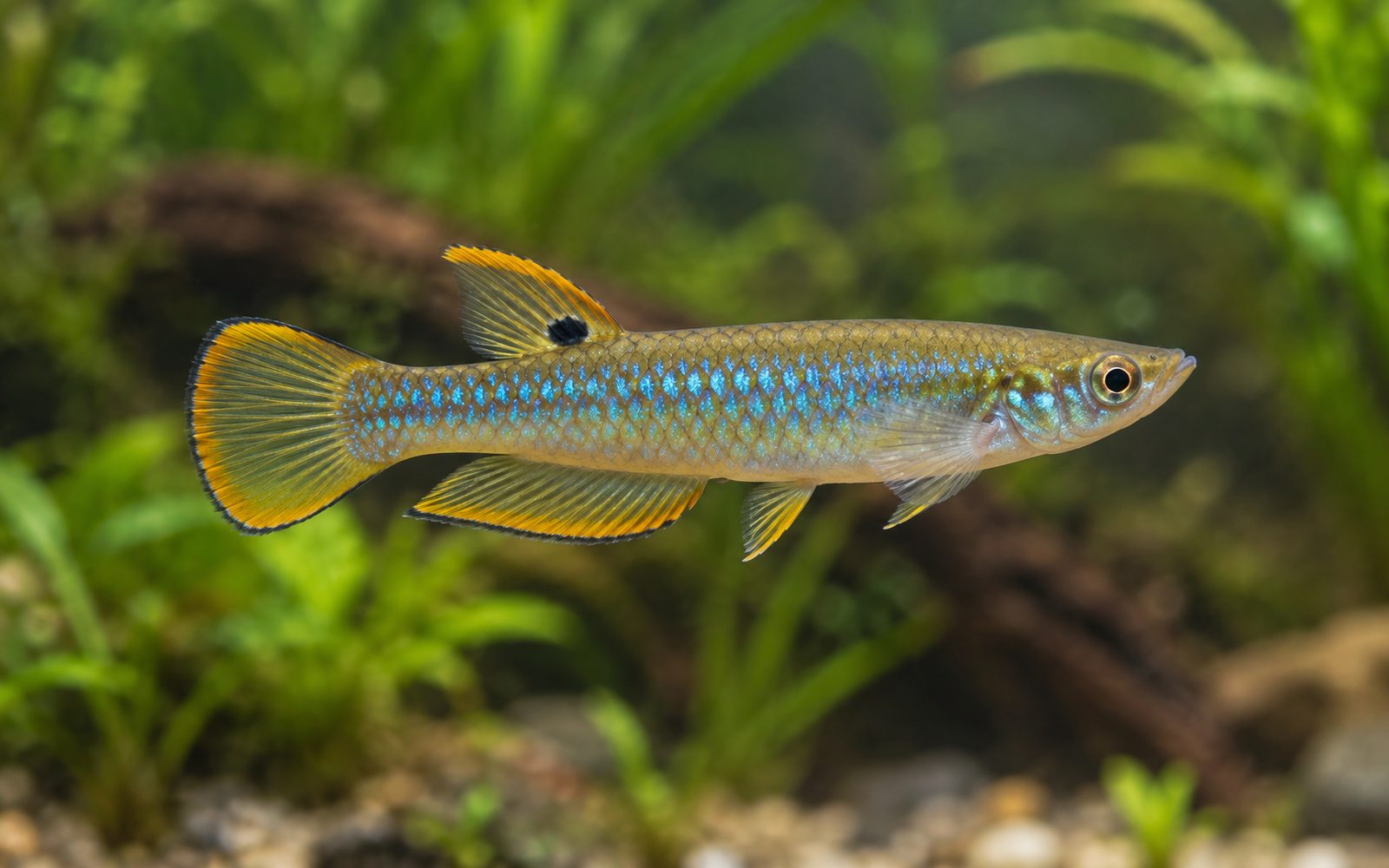
The blue panchax is one of the most widely distributed killifish in Asia. Because it lives across such a large area, its colors vary by population: some individuals are yellowish-olive, others have a distinct bluish sheen. All share the black spot at the base of the dorsal fin and the bright pale spot on top of the head.
With its long, cylindrical body, flat back and upturned mouth, it is adapted to hunting at the surface. It is tolerant of water parameters and resistant to disease, which makes it a good species for getting started with killifish.
Natural Habitat
It lives in almost every kind of still and slow water, such as rice paddies, ditches, ponds, swamps and slow-flowing streams. Near the coast it can also be found in slightly brackish water. It waits just below the surface at the edge of the vegetation and catches insects and larvae.
Tank Setup
- Volume: at least 80 liters for one male and two females; a large surface area is important.
- Lid: A tight lid is essential; it is an excellent jumper.
- Plants: Floating plants and dense planting along the edges; leave an open strip at the surface.
- Water: 24–27°C is ideal; it adapts to a wide range from soft to hard. Flow should be weak.
- Maintenance: 25% water change weekly.
Diet
Carnivorous. It takes floating granules and flakes, but its main diet should be live and frozen food: mosquito larvae, bloodworms, brine shrimp, daphnia and fruit flies. Because it hunts at the surface, it tries to catch sinking food before it reaches the bottom; it rarely picks up food left on the bottom.
Behavior and Compatibility
A calm-looking predator that lies in ambush at the surface. It usually leaves fish of its own size alone, but males chase each other with flared fins.
Good companions: medium-sized peaceful fish: gouramis, rosy barbs, large tetras, and bottom dwellers such as corydoras and bristlenose plecos.
Avoid: fish under 3–4 cm and fry, dwarf shrimp, aggressive species it would have to share the surface with.
Group and Colony Structure
Two or three females per male are recommended. If more than one male is kept, the aquarium should be large and divided with floating plants. A single individual also lives without problems.
Breeding
It lays a few eggs a day among fine-leaved plants near the surface, the roots of floating plants or a wool spawning mop; spawning continues for weeks. The eggs hatch in about 12–14 days. Because the parents prey on the fry, the eggs should be collected into a separate container. The fry can eat newly hatched brine shrimp from the first day; once size differences appear they must be separated, as they may eat each other.
Health and Common Problems
- Escape: the biggest risk in an uncovered aquarium.
- Velvet (Oodinium): common in killifish; signs are a fine gold-dust look on the body, clamped fins and rapid breathing.
- In general it is very hardy. In individuals fed only dry food, color fades and resistance drops.
Sexing
Males are more colorful; the blue sheen on the body is distinct, and the edges of the dorsal, anal and tail fins are decorated with yellow-orange and a thin dark line. Females are a plainer olive-yellow with rounded, colorless fins. The black spot on the dorsal fin is present in both sexes, so it is not used for sexing.
Tank mates
This list is calculated automatically from the species profile and grows as new species are added to the catalog. Try it in the planner for a definite answer.
Usually compatible
 Yellow Regal Peacock
Glass Tetra
Yellow Regal Peacock
Glass Tetra
 Emerald Betta
 Emerald Cory
 Porthole Catfish
 Keyhole Cichlid
 Firemouth Cichlid
 Cupid Cichlid
 Buffalohead Cichlid
 Festivum
Should not be kept together





Hobbyist notes
Things you won't find in books, learned by trial and error. The most helpful ones are on top.
Change history and contributors
- Page created · October 16, 2026