
Water parameters
Overview
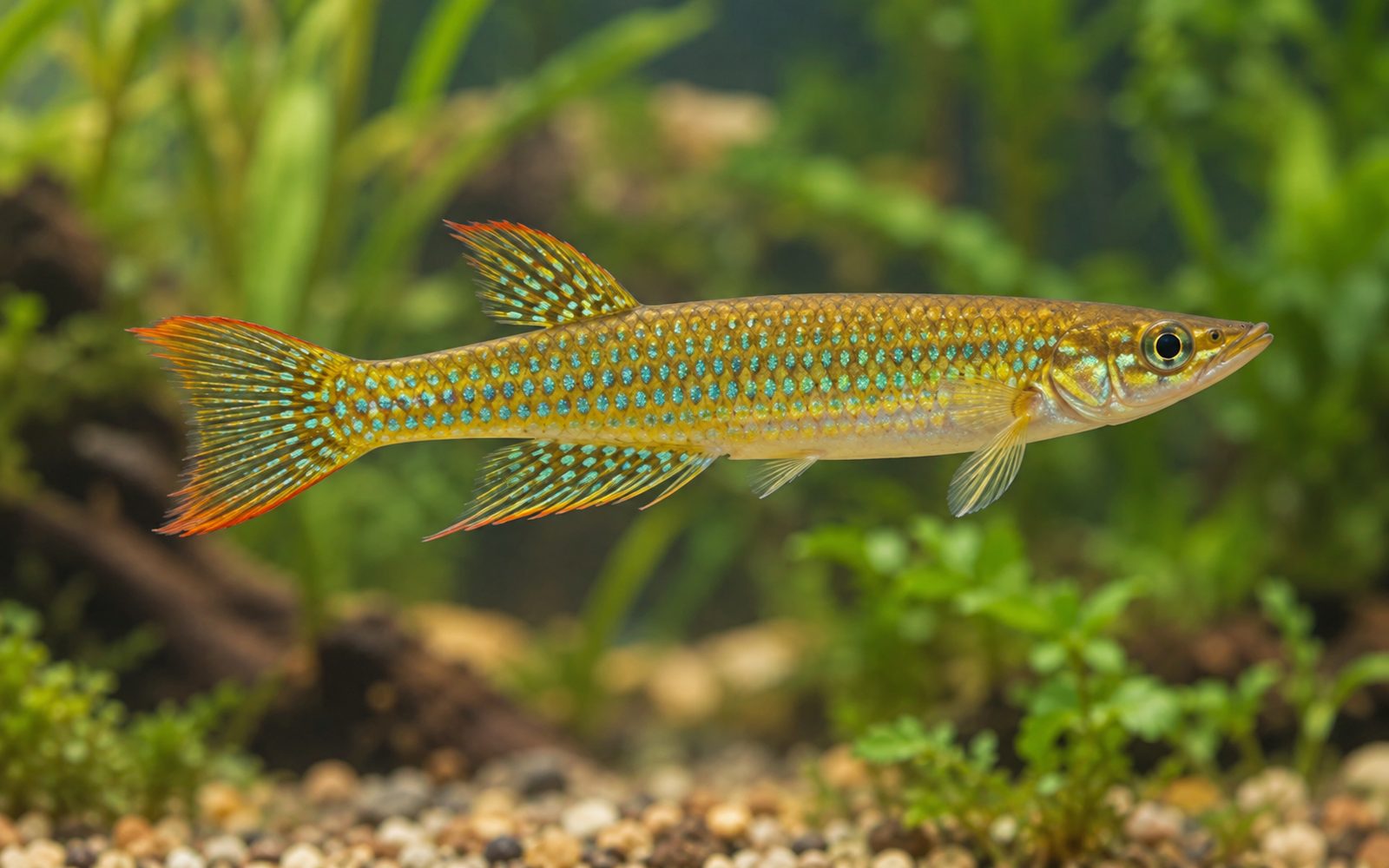
The striped panchax is one of the largest and hardiest representatives of the killifish. The wild form is decorated with rows of green-gold shimmering scales on an olive-green to brown background; in the hobby, however, the golden-yellow Golden Wonder form, bred for many years, is far more common.
With its straight back, upturned mouth and dorsal fin set far back on the body, it is a typical surface predator; it looks like a small pike. The bright, pale spot on top of its head is a shared mark of the genus Aplocheilus.
It is a species that beginners can keep too. Its only real requirements are being kept away from tankmates that would fit in its mouth and having the aquarium closed with a tight lid.
Color and Fin Varieties
- Golden Wonder (golden form): golden-yellow body and bright rows of scales; the form most often found in stores.
- Wild form: olive-green to brown background with green-gold rows of scales; the bars are more distinct in females.
Natural Habitat
It lives in slow-flowing streams, ditches, rice paddies and swamps on the plains of southern India. It is found not in seasonal waters but in waters that do not dry out during the year. It waits just below the surface in the shade of bankside plants and catches insects, larvae and small fish that fall into the water.
Tank Setup
- Volume: at least 100 liters for one male and two females; surface area matters more than depth.
- Lid: it must close tightly, and gaps for cables and hoses must also be covered. It jumps when startled.
- Plants: floating plants on the surface (Salvinia, Limnobium) and dense planting along the edges; an open swimming area in the middle.
- Water: 23–26°C is ideal; it adapts to a wide range from soft to moderately hard. Gentle flow is enough.
- Maintenance: a 25% water change every week.
Diet
Carnivorous. It accepts floating granules and flakes, but the staple should be frozen or live food: bloodworms, brine shrimp, mosquito larvae, fruit flies. Offering live food a few times a week noticeably improves its color and condition. Food should be offered at or near the surface.
Behavior and Compatibility
It spends most of the day lying in ambush just below the surface, almost motionless; when it sees food it darts out in an instant. It is generally calm toward fish its own size and larger. Males can be rough with each other.
Good companions: medium and large peaceful fish: pearl gouramis, blue gouramis, large barbs, Congo tetras; bottom dwellers such as corydoras and plecos.
Avoid: fish under 4 cm such as neon tetras, rasboras, endlers and guppies, and the fry of any species (they become prey), dwarf shrimp.
Group and Colony Structure
Two or three females per male is the most balanced setup. If two males are to be kept together, the aquarium should be large and lines of sight should be broken with floating plants; otherwise the stronger male constantly chases the weaker one. It can also live alone, but the male's display to females is the most beautiful aspect of this species.
Breeding
It breeds easily. The pair lays a few large eggs every day among fine-leaved plants near the surface or the roots of floating plants; spawning continues for weeks. The parents pay little attention to the eggs but eat the hatched fry. The safest way is to move the eggs to a separate container along with the yarn mop or plant.
At 24–25°C the eggs hatch in about two weeks. The fry can eat newly hatched brine shrimp from the first day and grow fast. As their sizes diverge, larger fry may eat smaller ones, so they should be sorted by size.
Health and Common Problems
- Escape: the most common cause of loss is jumping out of an uncovered aquarium.
- Velvet disease (Oodinium): killifish are prone to this parasite; it gives the body a golden-yellow dusty look. It can be harder to notice in the golden form; watch for gill movement and clamped fins.
- It is very hardy in mature, clean water; most problems come from poor water quality and feeding only dry food.
Sexing
Males are larger and more colorful; the tail fin is slightly pointed, and the dorsal and anal fins are longer with red-orange edges. Females are paler, with rounded, colorless fins; they carry a few dark vertical bars on the rear half of the body.
Tank mates
This list is calculated automatically from the species profile and grows as new species are added to the catalog. Try it in the planner for a definite answer.
Usually compatible
 Emerald Betta
 Keyhole Cichlid
 Firemouth Cichlid
 Cupid Cichlid
 Buffalohead Cichlid
 Festivum
 Geophagus altifrons
 Geophagus surinamensis
 Rainbow Cichlid
Should not be kept together





Hobbyist notes
Things you won't find in books, learned by trial and error. The most helpful ones are on top.
Change history and contributors
- Page created · October 16, 2026