
Water parameters
Overview
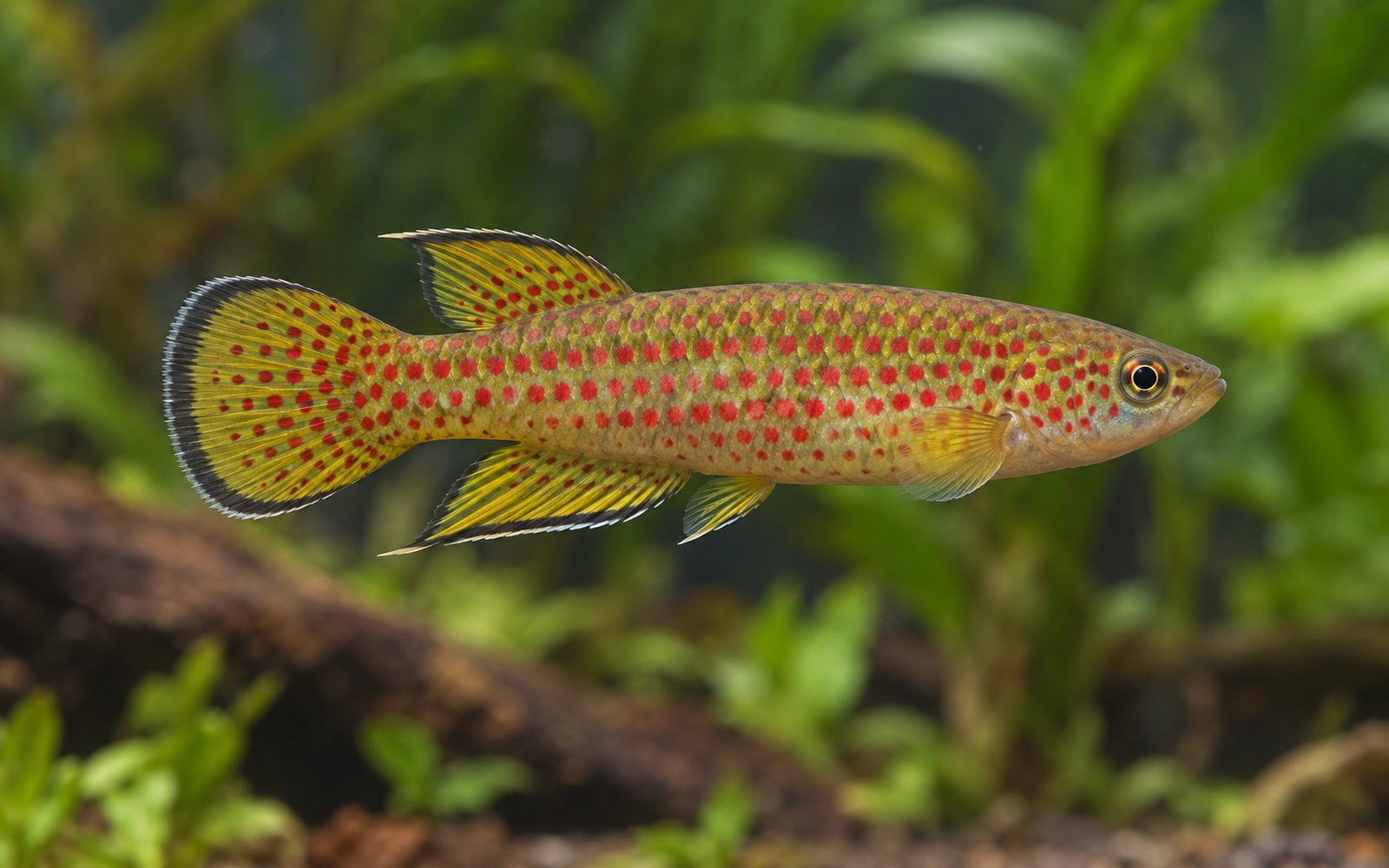
Playfair's panchax is a large, powerful killifish from the islands off the African coast. Its yellowish-olive body is covered with rows of red spots. Its most surprising feature is that in males the scales on the back stand raised: seen from above, the fish looks like a pine cone. This look increases especially in the breeding season and is normal; it should not be confused with dropsy, the belly swelling accompanied by raised scales.
It is a hardy and easy-to-keep species, but its temperament is rougher than that of Aplocheilus species. For this reason it is not suited to a general community aquarium but to keeping with large fish or in a species tank.
Natural Habitat
It lives in densely vegetated coastal streams, swamp channels and small pools in the Seychelles. Some of the populations on the East African coast and surrounding islands are thought to have been introduced by humans. The water is usually shallow, warm and slow-flowing.
Tank Setup
- Volume: at least 100 liters for one male and two to three females.
- Lid: A tight lid is essential; it jumps when startled.
- Layout: Floating plants and dense planting along the edges give the females escape areas; lines of sight should be broken with roots and branches.
- Water: 23–25°C, close to neutral, moderately hard water. Flow should be weak.
- Maintenance: 25% water change weekly.
Diet
Carnivorous and gluttonous. It should be fed live and frozen food: bloodworms, mosquito larvae, brine shrimp, mysis shrimp. It also accepts granules. Because it tends to be overfed on rich foods, feed once or twice a day, only as much as is eaten within a few minutes.
Behavior and Compatibility
A curious, bold fish that roams below the surface. Males are quarrelsome with each other and with similar-looking species; they may also chase the females hard. It sees any fish or shrimp that fits in its mouth as prey.
Good companions: calm fish of its own size or larger that can hold their own: large gouramis, rosy barbs, medium-sized cichlids such as the blue acara, plecos.
Avoid: small tetras and rasboras, guppies and endlers, dwarf shrimp, slow fish with long fins, other killifish.
Group and Colony Structure
Two to three females per male are recommended; with too few females, the male's pressure is concentrated on a single female. Two males can be kept together only in a very spacious, divided aquarium; a single male is usually the healthiest setup.
Breeding
It breeds easily. The pair lays a few eggs every day among plants or in a wool spawning mop. At 24°C the eggs hatch in about 12–14 days. Because the adults prey on the fry, the eggs should be collected into a separate container. The fry take newly hatched brine shrimp from the first day and grow fast; once size differences appear they must be separated.
Health and Common Problems
- Raised scales: normal in males. Belly swelling, loss of appetite and raised scales over the whole body, however, are signs of disease.
- Velvet (Oodinium): common in killifish; it shows as a gold-dust look and rapid breathing.
- It is very hardy in clean water.
Sexing
Males are larger and more colorful; the body has distinct rows of red spots and raised scales, and the fin edges have dark lines. Females are plainer, olive-brown; their scales lie flat against the body and they carry a black spot at the base of the dorsal fin.
Tank mates
This list is calculated automatically from the species profile and grows as new species are added to the catalog. Try it in the planner for a definite answer.
Usually compatible
 Emerald Betta
 Keyhole Cichlid
 Firemouth Cichlid
 Buffalohead Cichlid
 Festivum
 Geophagus surinamensis
 Rainbow Cichlid
 Gymnogeophagus balzanii
 Pearl Cichlid
Should not be kept together





Hobbyist notes
Things you won't find in books, learned by trial and error. The most helpful ones are on top.
Change history and contributors
- Page created · October 16, 2026