
Water parameters
Overview
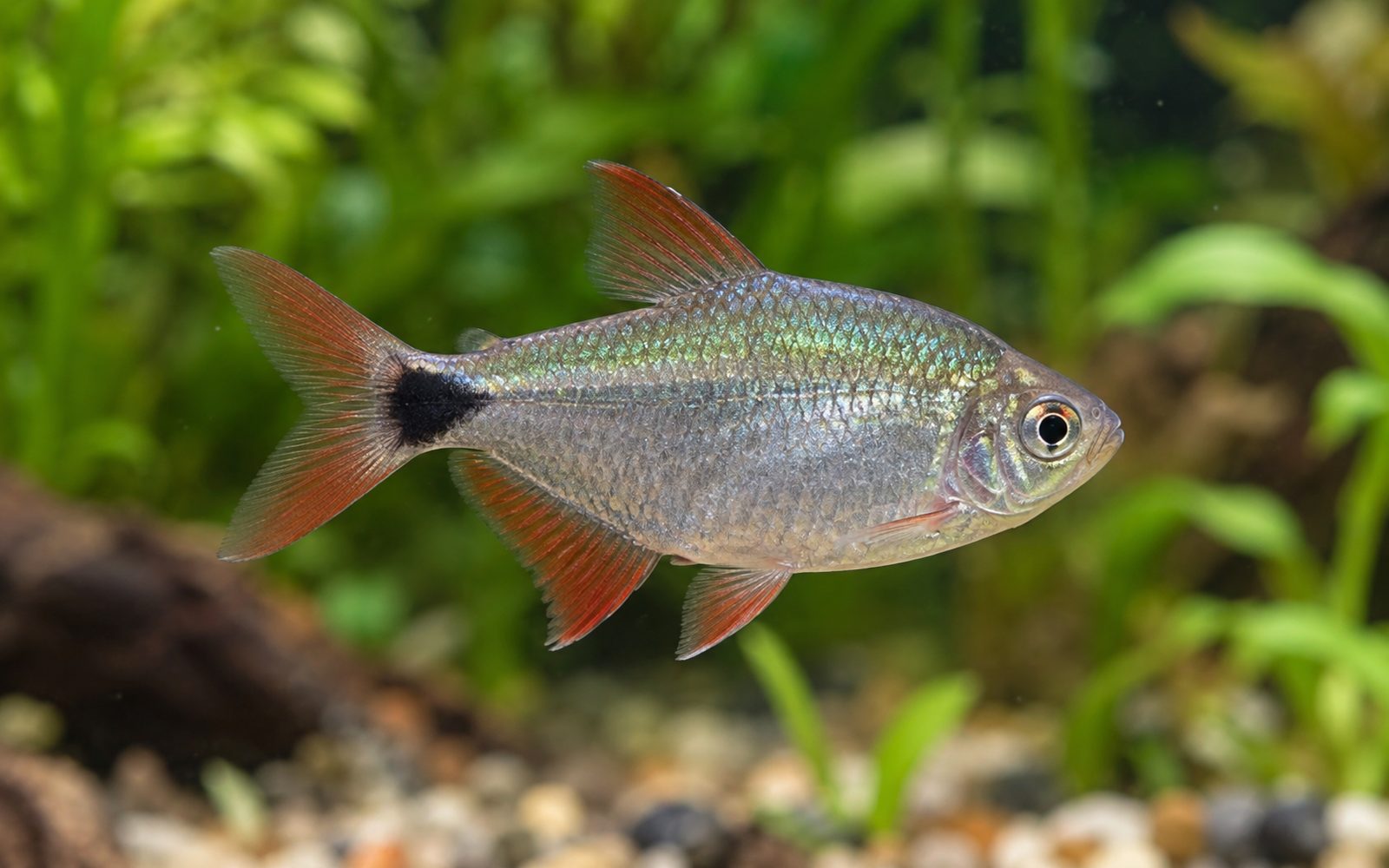
The Buenos Aires tetra is recognized by its silver body with bluish-green reflections, its reddish fins and the black, arrowhead-shaped mark extending from the tail base to the middle of the tail. It is a sturdily built tetra that grows up to 7 cm. An albino form is also widely sold.
It is very hardy and has a big appetite, and it adapts to a wide temperature range. However, it has two important traits: it eats soft-leaved plants and in a small group it nips fins. For this reason it is not suitable for every community aquarium.
Natural Habitat
It lives in lakes, swamps and slow-flowing shoreline areas of the Paraná and La Plata river systems in Argentina, Paraguay and southern Brazil. Because it comes from a subtropical region, it is used to seasonal temperature changes.
Tank Setup
- Volume: at least 100 liters for a group of 6–8; a length of 80 cm or more.
- Water: 20–26°C; it can also live in unheated rooms. pH 6–8, soft to hard water.
- Plants: soft-leaved plants are eaten quickly. Hard-leaved plants such as Anubias, Java fern and Bolbitis, or artificial plants, should be preferred.
- Lid: it is an active species; a covered aquarium is recommended.
Diet
Omnivorous and needs plant-based food. Flakes and granules containing spirulina, blanched spinach or lettuce leaves and zucchini slices reduce its interest in plants. Provide protein with frozen bloodworms, brine shrimp and mysis shrimp.
Behavior and Compatibility
Active and energetic. It constantly chases within its own group; in a small group this energy turns toward other fish and becomes fin nipping. It hunts small shrimp and shrimplets.
Good companions: fast, robust species of similar size: large barbs, danios, Congo tetras, medium-sized cichlids such as convicts and acaras, plecos, large corydoras.
Avoid: long-finned species (betta, angelfish, fancy guppies), very small and slow fish, dwarf shrimp, planted tanks with soft plants.
Group and Colony Structure
At least 6, ideally 8 or more individuals are recommended. In a large group the chasing is spread out within the school; when kept in small numbers, aggression increases. The sex ratio does not matter.
Breeding
It breeds easily. In a separate tank it lays a large number of eggs on fine-leaved plants or a spawning mop. The parents must be removed because they eat the eggs. The eggs hatch in 1–2 days; the fry become free-swimming a few days later and are fed first infusoria, then newly hatched brine shrimp.
Health and Common Problems
- Hardiness: it is very resistant to disease.
- White spot (ich): may appear after sudden, large temperature changes.
- Nutritional deficiency: fish that are not given plant-based food eat plants faster; a balanced menu also matters for health.
Sexing
Males are more slender and have more intense red on their fins. Females are larger with a plumper belly.
Tank mates
This list is calculated automatically from the species profile and grows as new species are added to the catalog. Try it in the planner for a definite answer.
Usually compatible
 Yellow Regal Peacock
Glass Tetra
Yellow Regal Peacock
Glass Tetra
 Emerald Betta
 Emerald Cory
 Porthole Catfish
 Keyhole Cichlid
 Firemouth Cichlid
 Cupid Cichlid
 Buffalohead Cichlid
 Geophagus altifrons
Should not be kept together







Hobbyist notes
Things you won't find in books, learned by trial and error. The most helpful ones are on top.
Change history and contributors
- Page created · October 16, 2026