
Water parameters
Overview
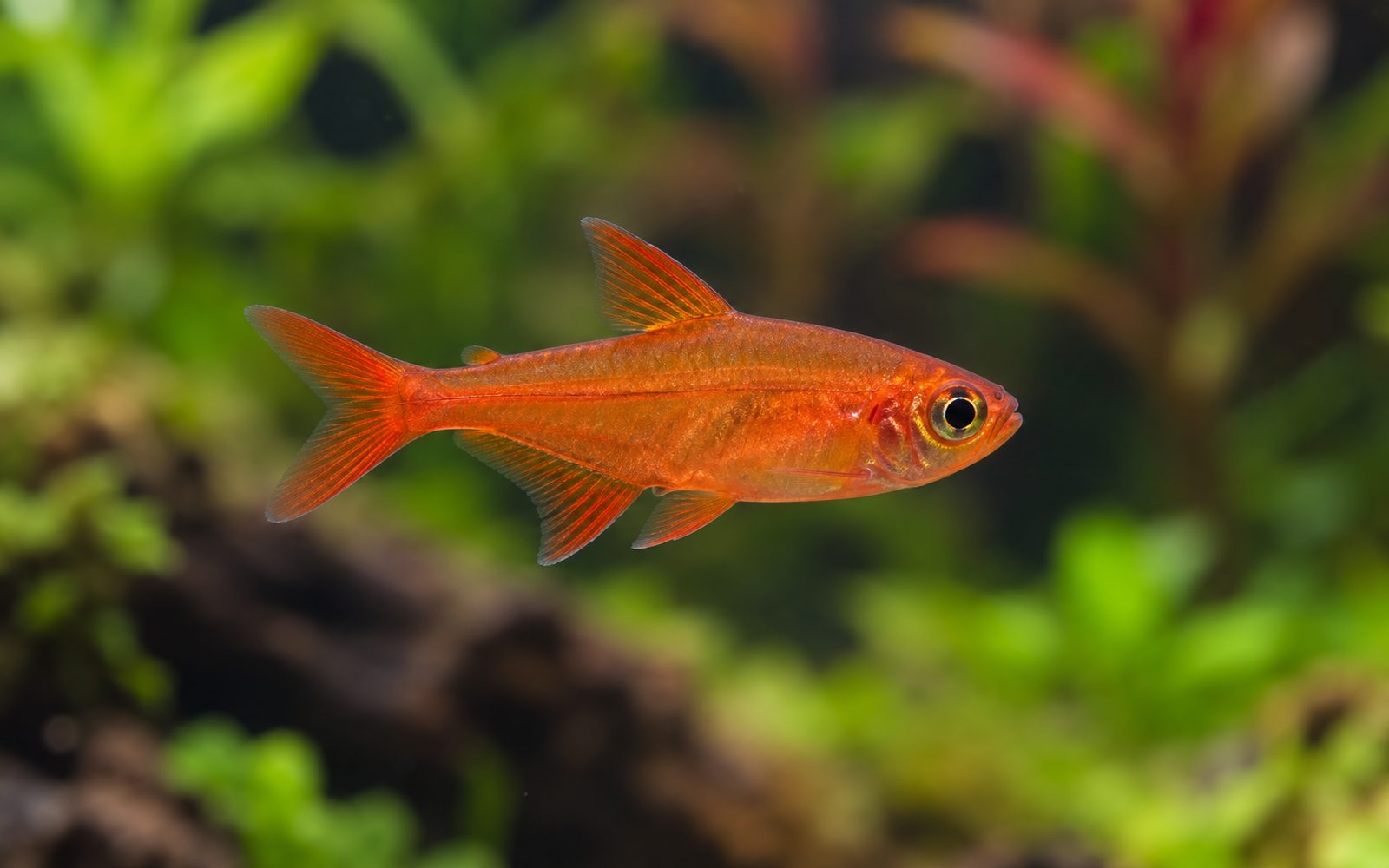
The ember tetra takes its name from its orange-red color, reminiscent of glowing embers. Its adult size is only about 2 cm, making it one of the smallest tetras. It has no distinct pattern, but in a dimly lit, planted aquarium the whole school takes on a warm orange glow. The species was named in honor of Amanda Bleher of the Bleher family.
Because it is hardy, peaceful and tiny, it is one of the most popular fish for nano aquariums and shrimp tanks. Fish that look pale in the store color up within a few weeks in a mature aquarium.
Natural Habitat
It lives in slow-flowing tributaries, ponds and planted swampy areas of the Araguaia River basin in central Brazil. The water is soft and slightly acidic; the bottom is usually covered with plants and leaf litter.
Tank Setup
- Volume: 30 liters or more is enough for a school of 10–20; 54–60 liters for larger schools.
- Water: 24–27°C, pH 6–7.5, soft to moderately hard water.
- Decor: dense plants, moss, roots and floating plants. A dark substrate brings out the orange color.
- Filter: gentle flow is enough; fitting a sponge over the filter intake is a good idea so small fish do not get sucked in.
Diet
Omnivorous, but its mouth is very small. Micro granules, flakes crushed to a powder and small frozen foods (cyclops, daphnia, newly hatched brine shrimp) are suitable. Feed very small amounts 1–2 times a day; leftover food quickly spoils the water in a small tank.
Behavior and Compatibility
Very peaceful and bothers no other species. It can be shy; it is bolder in a large group and in a densely planted setting. It does not harm adult shrimp but may occasionally catch shrimplets.
Good companions: dwarf shrimp (Neocaridina, Caridina), Boraras and other micro rasboras, pygmy and habrosus corydoras, otocinclus, small snails.
Avoid: any medium or large fish that could fit it in its mouth; active, robust species such as tiger barbs and large tetras.
Group and Colony Structure
It is a mini schooling fish: at least 10, ideally 20 or more individuals. Large schools both move more naturally and create a much more noticeable color effect in the aquarium. The sex ratio does not matter.
Breeding
In a mature, planted aquarium it occasionally spawns on its own; a few fry may survive among moss and fine plants. For planned breeding, a separate tank with soft, slightly acidic water and a spawning mop or moss is used, and the parents are removed after spawning. The fry are very small and need to be fed infusoria in the first days.
Health and Common Problems
- Food size: fish given food that is too large cannot feed properly and become thin.
- Water quality: values deteriorate quickly in small tanks; do not skip the weekly water change.
- White spot (ich): may appear after transport; quarantine is recommended.
Sexing
Males are slimmer and a more intense orange-red. Females are paler with a plumper belly; the difference is best seen by comparing individuals side by side in a mature group.
Tank mates
This list is calculated automatically from the species profile and grows as new species are added to the catalog. Try it in the planner for a definite answer.
Usually compatible
 Flame Tetra
 Blackfin Corydoras
 Polystictus Corydoras
 Emerald Cory
 Porthole Catfish
 Keyhole Cichlid
 Cupid Cichlid
 Geophagus altifrons
 Geophagus surinamensis
 Cryptocoryne Parva
Should not be kept together





Hobbyist notes
Things you won't find in books, learned by trial and error. The most helpful ones are on top.
Change history and contributors
- Page created · October 16, 2026