
Water parameters
Overview
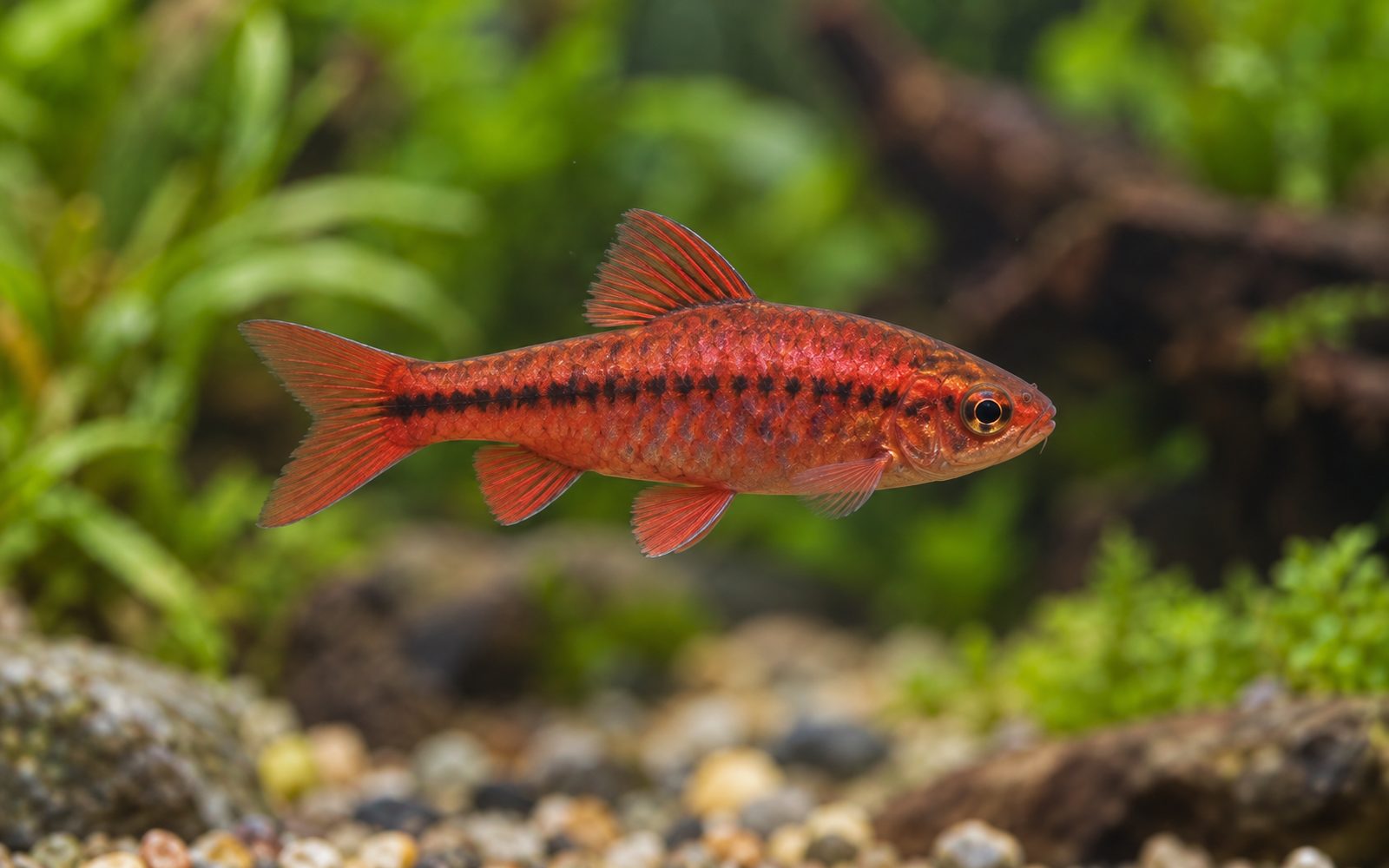
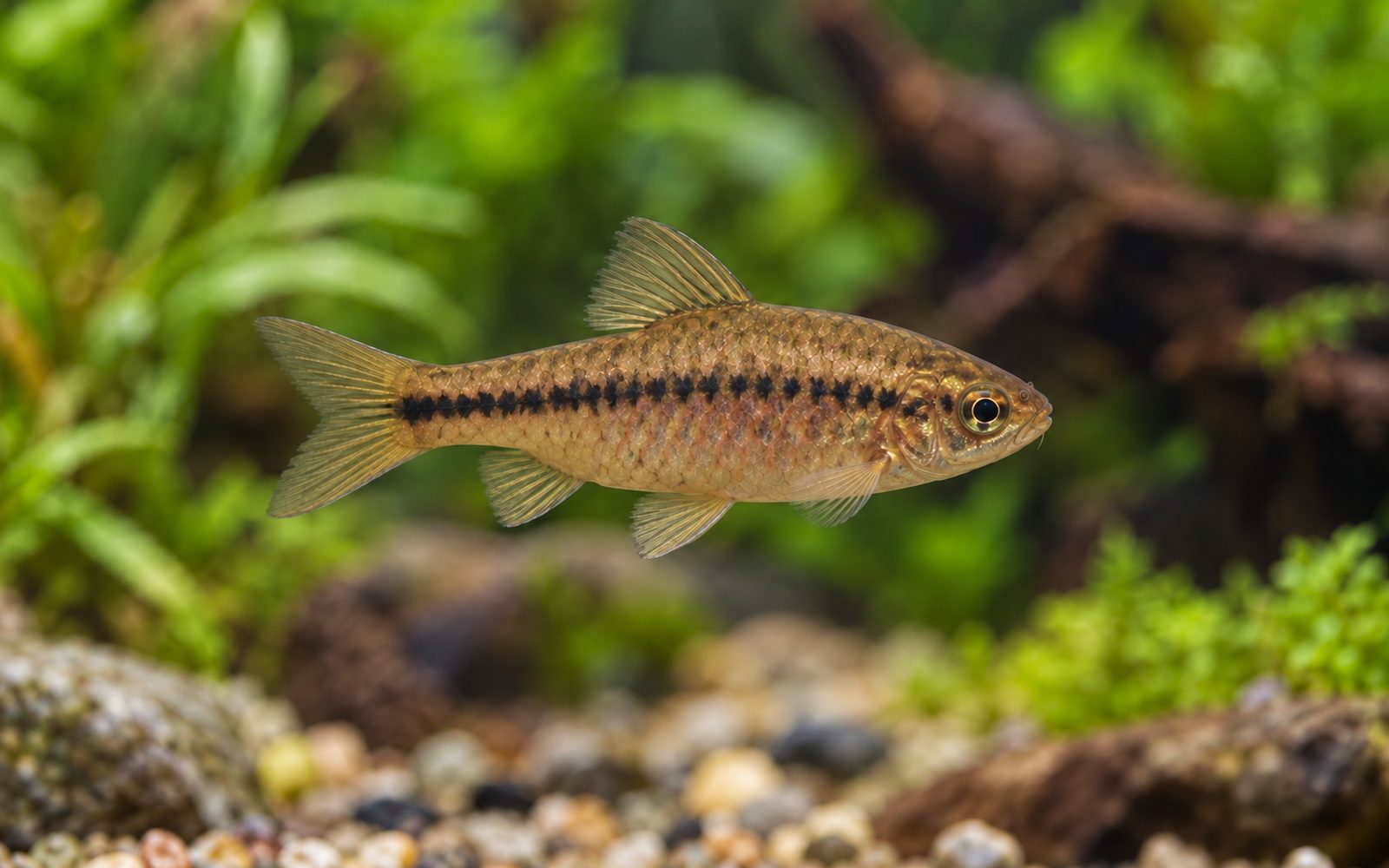
The cherry barb is a small barb endemic to Sri Lanka. As males mature, especially while displaying to females, they turn deep red from head to tail; females stay beige to brown, with a clearly visible dark stripe along the flanks. Unlike its relatives such as the tiger barb or rosy barb, it is a calm fish with no habit of nipping fins.
Almost all specimens sold today are farm-bred. Its hardiness, small size and gentle nature make it a good choice for beginners as well.
Natural Habitat
It lives in shaded, slow-flowing forest streams of southwestern Sri Lanka. The bottom is covered with leaf litter and roots; the water is soft and slightly acidic. Marginal plants and overhanging branches give the fish places to hide.
Tank Setup
- Volume: at least 60 liters and 60 cm in length for a group of 6–10.
- Water: 24–26°C is ideal; it adapts to soft through moderately hard water. A 25% weekly water change is enough.
- Decor: densely planted edges and dim corners. Floating plants and a dark substrate make the males' red stand out.
- Flow: gentle flow is enough; break up a strong filter outlet with plants.
Diet
Omnivorous. Small granules and flakes can be the staple; frozen and live foods (brine shrimp, daphnia, small bloodworms) boost both color and breeding drive. Also provide plant matter with spirulina food. Feed 1–2 times a day, only as much as is eaten within a few minutes.
Behavior and Compatibility
Peaceful and somewhat shy; it hides in a bare, very bright tank and grows bolder in a planted one. Males display to each other and to females; these displays are harmless, and the colors are at their best during them. It moves through the middle and lower levels among the plants. It leaves adult dwarf shrimp alone but may eat newly hatched shrimplets.
Good companions: small tetras, rasboras, dwarf gouramis, corydoras, otocinclus, red cherry and other dwarf shrimp.
Avoid: large or aggressive fish, big species that could fit it in their mouths, and fin-nipping barbs that keep the tank in constant motion.
Group and Colony Structure
Keep at least 6, ideally 10 or more. The cherry barb does not form a tight school; the group spreads loosely among the plants, but seeing its own kind puts it at ease. A female-heavy group (1 male : 2 females) prevents females from being chased constantly and turns the rivalry between males into a more colorful display.
Breeding
Breeds easily. Spawning usually begins in the morning and lasts a few hours; the female deposits her sticky eggs on fine-leaved plants, Java moss or a spawning mop. The parents eat eggs and fry; move the eggs to a separate container or leave them in a tank with dense moss. The eggs hatch in 24–48 hours; the fry become free-swimming after a few days and are fed first infusoria and then baby brine shrimp (Artemia nauplii).
Health and Common Problems
Hardy. White spot may appear in newly arrived fish; quarantining new fish for 2–3 weeks is a good habit. Fin rot can develop in poor water conditions. The most common cause of pale color is stress: newly arrived males may look brownish for the first few days and turn red as they settle in.
Sexing
Males are slimmer and red; in the breeding season they turn deep cherry red and their fins redden too. Females have a fuller belly, are beige to brown, and the dark stripe along their flanks is clearly visible; their fins are yellowish or clear.
Tank mates
This list is calculated automatically from the species profile and grows as new species are added to the catalog. Try it in the planner for a definite answer.
Usually compatible
 Flame Tetra
 Blackfin Corydoras
 Polystictus Corydoras
 Emerald Cory
 Porthole Catfish
 Keyhole Cichlid
 Cupid Cichlid
 Geophagus surinamensis
 Cryptocoryne Parva
 Gold Spot Pleco (L001)
Should not be kept together






Hobbyist notes
Things you won't find in books, learned by trial and error. The most helpful ones are on top.
Change history and contributors
- Page created · October 16, 2026