
Water parameters
Overview
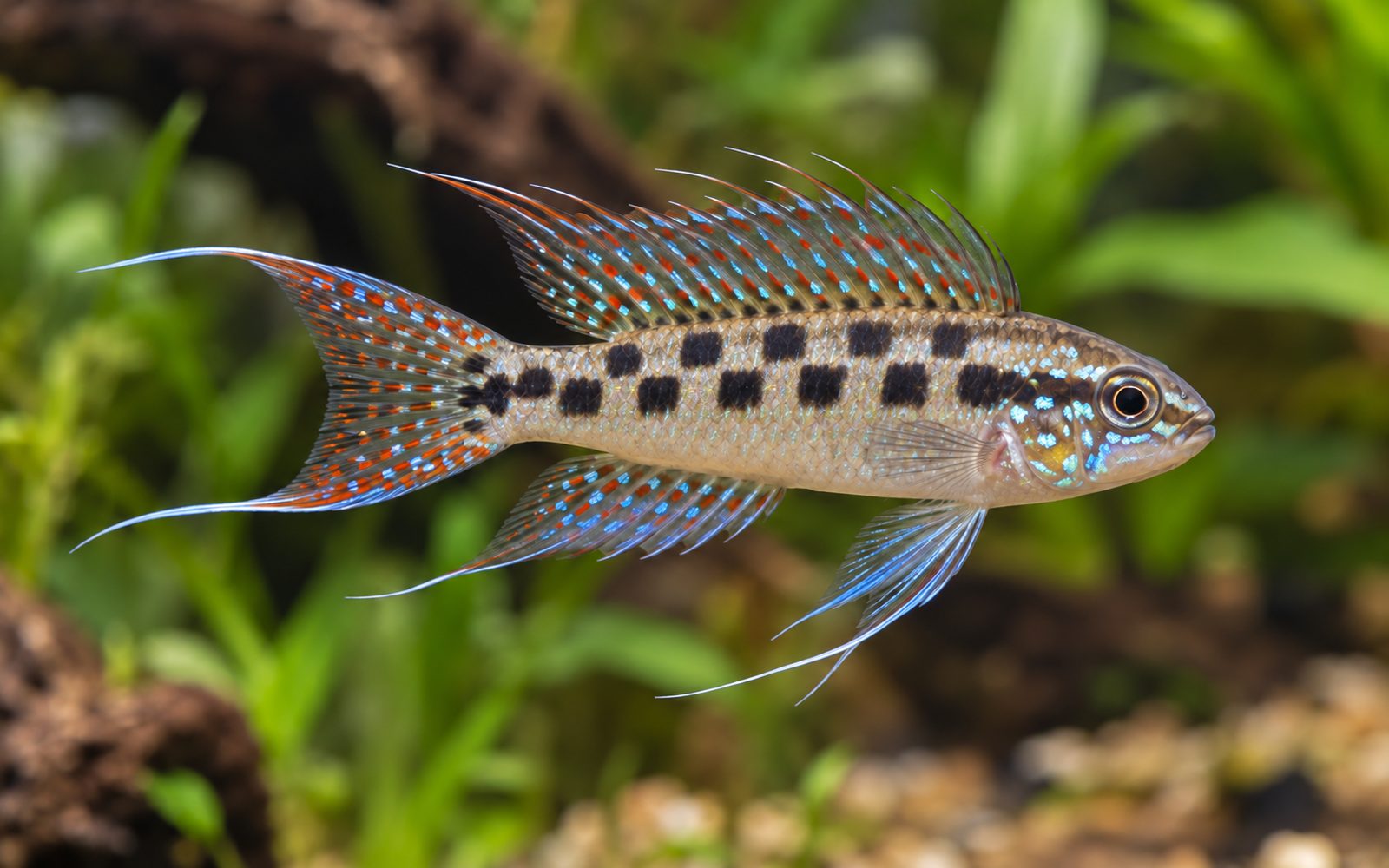
Dicrossus filamentosus is instantly recognized by its chessboard-like pattern of black squares lined up along both sides of its body. The male has a blue sheen on its face and red and blue dots on its fins; the upper and lower tips of its tail extend into fine filaments, giving it a lyre shape. Females are smaller, plainer and have a rounded tail.
It used to be placed in the genus Crenicara. Despite its elegant appearance, it is a delicate species: it needs very soft, acidic and warm water and withdraws in crowded, busy aquariums. It is one of the most beautiful choices for a calm blackwater aquarium.
Natural Habitat
It lives in the upper Orinoco (Inírida, Atabapo) in Colombia and Venezuela and in some tributaries of the Rio Negro in Brazil. It prefers sandy, slow-flowing blackwater and clearwater streams covered with leaf litter; the water contains almost no minerals.
Tank Setup
- Volume: at least 80 liters for one male and two females; a large footprint is preferred.
- Water: 26–28°C, pH 5–6.5, GH 1–4. With most tap water, RO water is mandatory; dried leaves and roots acidify the water slightly.
- Substrate and decor: fine sand, a layer of dried leaves, dense plants and broad-leaved plants; dim light and floating plants.
- Maintenance: small, regular weekly changes with water prepared to the same values; keeping values stable is very important.
Diet
Carnivorous. Small live or frozen foods such as daphnia, cyclops, brine shrimp and fine bloodworms should be the staple. It may be slow to accept dry food. Live food is especially beneficial for breeding condition.
Behavior and Compatibility
Shy and peaceful; it mostly stays near the bottom among plants and leaves. Males display at each other by spreading their tails and fins; serious fighting is rare. Next to busy or domineering fish it hides and cannot feed properly. Its long tail tips are a target for fin-nipping species; it eats shrimplets.
Good companions: cardinal tetras, rummy-nose tetras, pencilfish, hatchetfish, otocinclus, small Corydoras (those suited to soft, warm water).
Avoid: fin-nipping barbs and tetras, large or domineering cichlids, species that need hard water.
Group and Colony Structure
Kept as a harem: 1 male and 2 females. Each female chooses a spawning site for herself; the male moves between these sites and displays. A single pair also works. Two males should only be kept in a large, well-divided aquarium.
Breeding
It is an open-substrate spawner: the female usually lays her eggs on a broad leaf or a flat stone and takes on their care. Very soft, acidic water is required for the eggs to hatch; above pH 6 the eggs usually do not develop. The fry are very small; in the first days they are fed infusoria, then newly hatched brine shrimp.
Health and Common Problems
It is very sensitive to poor water quality, hardness and pH swings; under these conditions bacterial infections develop quickly. Transport and acclimation to a new aquarium should be done slowly.
Sexing
Sexing is easy. Males reach around 8 cm and have colorful fins and a lyre tail with filament tips. Females are smaller and plainer, with a rounded tail.
Tank mates
This list is calculated automatically from the species profile and grows as new species are added to the catalog. Try it in the planner for a definite answer.
Usually compatible
 Polystictus Corydoras
 Emerald Betta
 Emerald Cory
 Porthole Catfish
 Keyhole Cichlid
 Cupid Cichlid
 Geophagus altifrons
 Geophagus surinamensis
 Cryptocoryne Parva
 African Glass Catfish
Should not be kept together







Hobbyist notes
Things you won't find in books, learned by trial and error. The most helpful ones are on top.
Change history and contributors
- Page created · October 16, 2026