
Water parameters
Overview
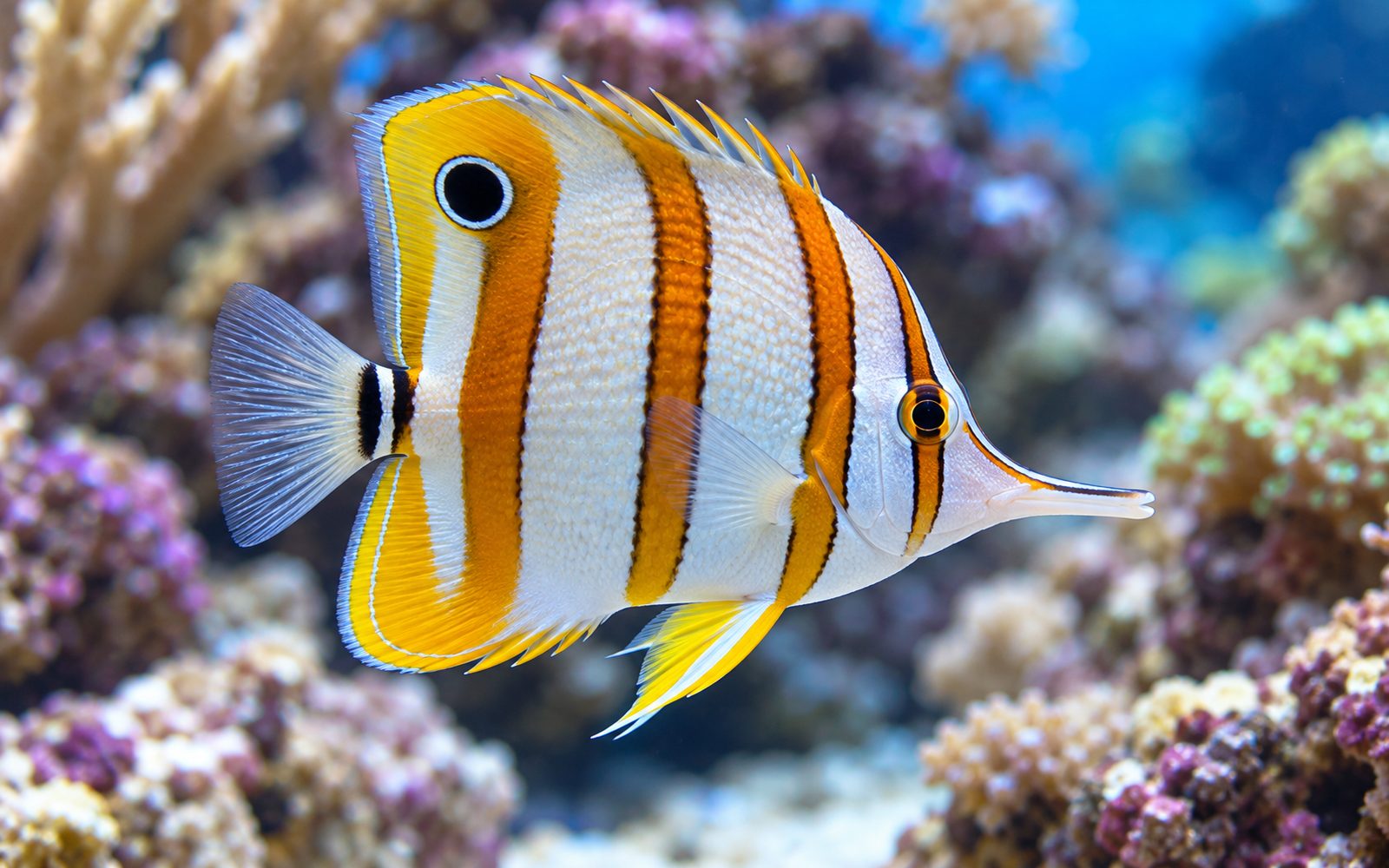
With four copper-colored bands crossing its flat white body vertically, the copperband butterflyfish is one of the most elegant fish in the marine aquarium. The white-ringed black spot at the rear of the dorsal fin acts as a false eye and misleads predators. Its long, thin snout evolved for plucking small creatures out of rock crevices.
In the hobby it is often bought because it eats the pest Aiptasia (glass anemone); however, not every individual does so. All individuals are wild-collected; because of shipping stress and the difficulty of switching to prepared food, losses are high during the first weeks. Do not buy one without seeing it eat frozen food in the store.
Natural Habitat
It lives singly or in pairs on shallow coastal reefs, in estuaries and in rocky areas of the Indo-West Pacific. It picks small worms and crustaceans out of rock and coral crevices.
Tank Setup
- Volume: at least 400 liters and 150 cm of length.
- Maturity: an aquarium that has been running for at least 6 months, with live rock full of copepods and small worms; in a new aquarium it finds no natural food.
- Water: salinity 1.023–1.026 specific gravity, pH 8.1–8.4, temperature 24–27°C; stable, very clean water.
- Environment: moderate flow and shaded rock overhangs to hide under. Since it is a nervous fish, sudden movements in front of the aquarium and frequent rearranging stress it.
- Reef compatibility: reef safe with caution. It is one of the most reef-friendly butterflyfish, but it may pick at tube worms (fanworms) and some LPS corals and zoanthids.
Diet
Carnivorous. In the first days, live foods (enriched brine shrimp, freshwater bloodworms) or a half-opened mussel stimulate the appetite. Over time it should be switched to frozen mysis, chopped mussel, bloodworms and fish roe. Small amounts 3–4 times a day. Fast, greedy tankmates may snatch the share of this slow eater.
Behavior and Compatibility
Peaceful and nervous. It may be territorial toward other butterflyfish and its own kind. It does best in a calm environment with non-aggressive companions.
Good companions: clownfish, cardinalfish, gobies, anthias, calm tangs, fairy wrasses.
Avoid: aggressive damsels, dottybacks, triggerfish, large fast wrasses; a second copperband (except those sold as a pair).
Group and Colony Structure
Keep a single individual in the aquarium. In the wild it is seen in pairs; if a compatible pair is found, they can be kept together in a very large aquarium.
Breeding
A pelagic spawner. It does not breed in home aquariums.
Health and Common Problems
- Starvation and wasting: the most common cause of death; a sunken belly is an early warning.
- Marine ich and velvet: it is sensitive; quarantine is recommended, but copper treatment can kill its appetite.
- Stress: fierce competition for food and aggressive tankmates wear the fish down quickly.
Sexing
The sexes cannot be told apart externally.
Tank mates
This list is calculated automatically from the species profile and grows as new species are added to the catalog. Try it in the planner for a definite answer.
Should not be kept together



Hobbyist notes
Things you won't find in books, learned by trial and error. The most helpful ones are on top.
Change history and contributors
- Page created · October 16, 2026