
Water parameters
Overview
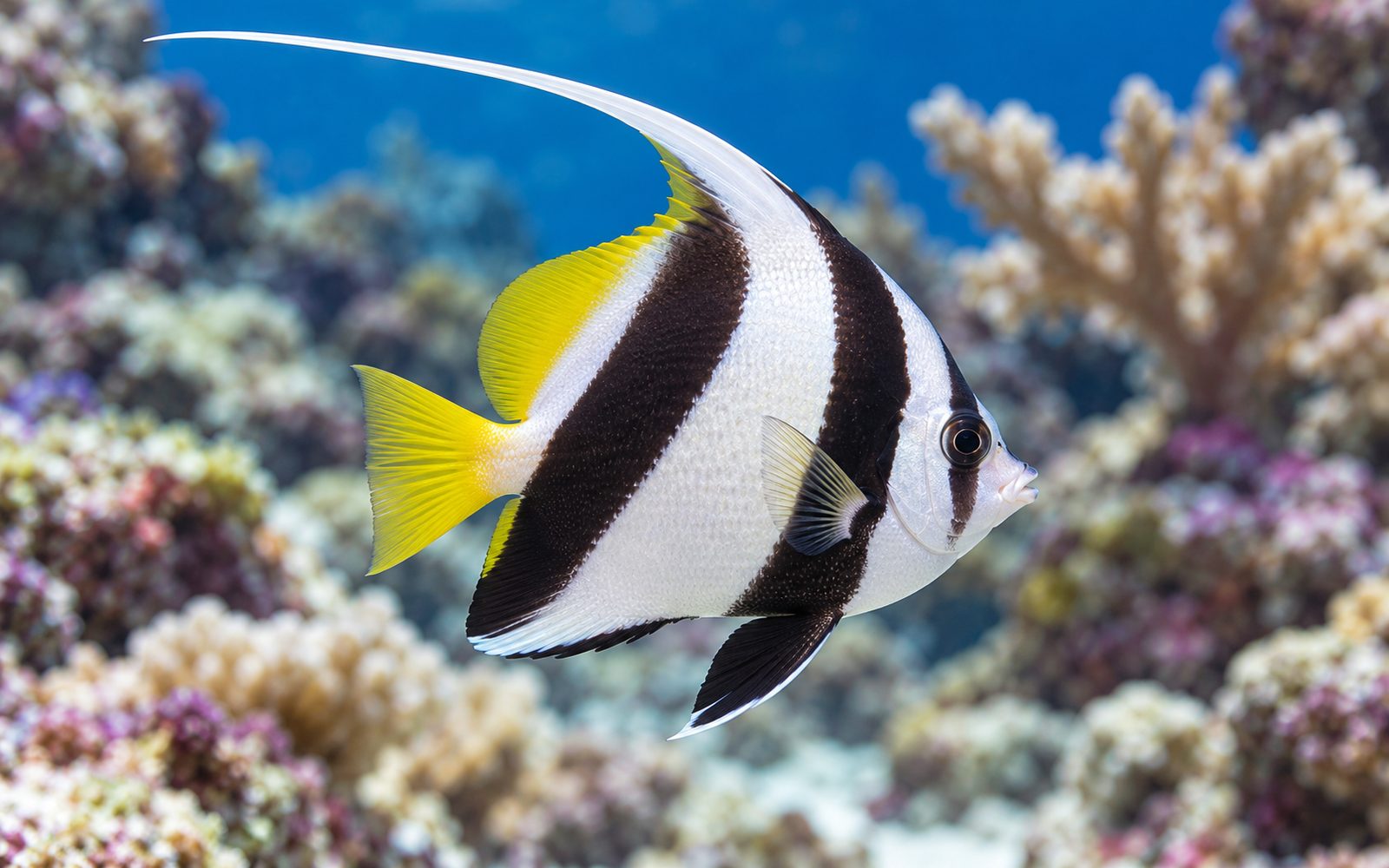
Heniochus diphreutes is recognized by two black bands crossing its white body diagonally, a yellow tail and a dorsal fin spine that extends into a white pennant. Because of its appearance it is likened to the Moorish idol, which is very hard to keep; but it is much easier to care for.
In stores it is confused with its very similar relative Heniochus acuminatus. H. diphreutes is the species that picks plankton in schools in open water and adapts to the aquarium more easily; H. acuminatus feeds more from the reef bottom and is more inclined to pick at corals. Ask which species it is when buying. Individuals are wild-collected.
Natural Habitat
It lives in the Indo-Pacific in large schools, mostly on outer slopes and in open waters of subtropical reefs. It feeds on zooplankton in the water column.
Tank Setup
- Volume: at least 400 liters for a single fish; 500 liters or more and 180 cm of length for a small school of 3.
- Water: salinity 1.023–1.026 specific gravity, pH 8.1–8.4, temperature 23–27°C.
- Decor: large open swimming space above, rock structures below to shelter in.
- Maintenance: a 10% water change weekly or 20% every two weeks; keep nitrate low. If kept as a school, the bioload must be taken into account and the filter and protein skimmer chosen accordingly.
- Reef compatibility: reef safe with caution. Since it is a plankton feeder, it does not touch most corals; some individuals may taste tube worms and soft corals.
Diet
Omnivorous. It readily accepts frozen mysis, brine shrimp, copepods, chopped seafood, marine fish granules and flakes. Feed small amounts 2–3 times a day. Since in the wild it constantly picks plankton, small, frequent meals suit it better than one large meal; they maintain its colors and condition.
Behavior and Compatibility
A peaceful, calm fish. There are small pecking-order squabbles within the group, which do no serious harm. It gets along well with other species.
Good companions: tangs, dwarf and large angelfish (in a fish-focused aquarium), anthias, wrasses, foxface, clownfish.
Avoid: fin-nipping species, aggressive triggerfish, lionfish (for small individuals).
Group and Colony Structure
A schooling fish. A single individual also lives healthily in the aquarium, but 3–5 individuals added at the same time to a large aquarium make a much more natural and impressive display.
Breeding
A pelagic spawner; in the wild, pairs spawn within the school. It does not breed in home aquariums.
Health and Common Problems
- Marine ich and velvet: sensitive like other butterflyfish; quarantine is recommended.
- Fin damage: the long dorsal pennant gets torn off if it is kept with fin-nipping species.
- HLLE: may appear with a monotonous diet.
Sexing
The sexes cannot be told apart externally.
Tank mates
This list is calculated automatically from the species profile and grows as new species are added to the catalog. Try it in the planner for a definite answer.
Should not be kept together



Hobbyist notes
Things you won't find in books, learned by trial and error. The most helpful ones are on top.
Change history and contributors
- Page created · October 16, 2026