
Water parameters
Overview
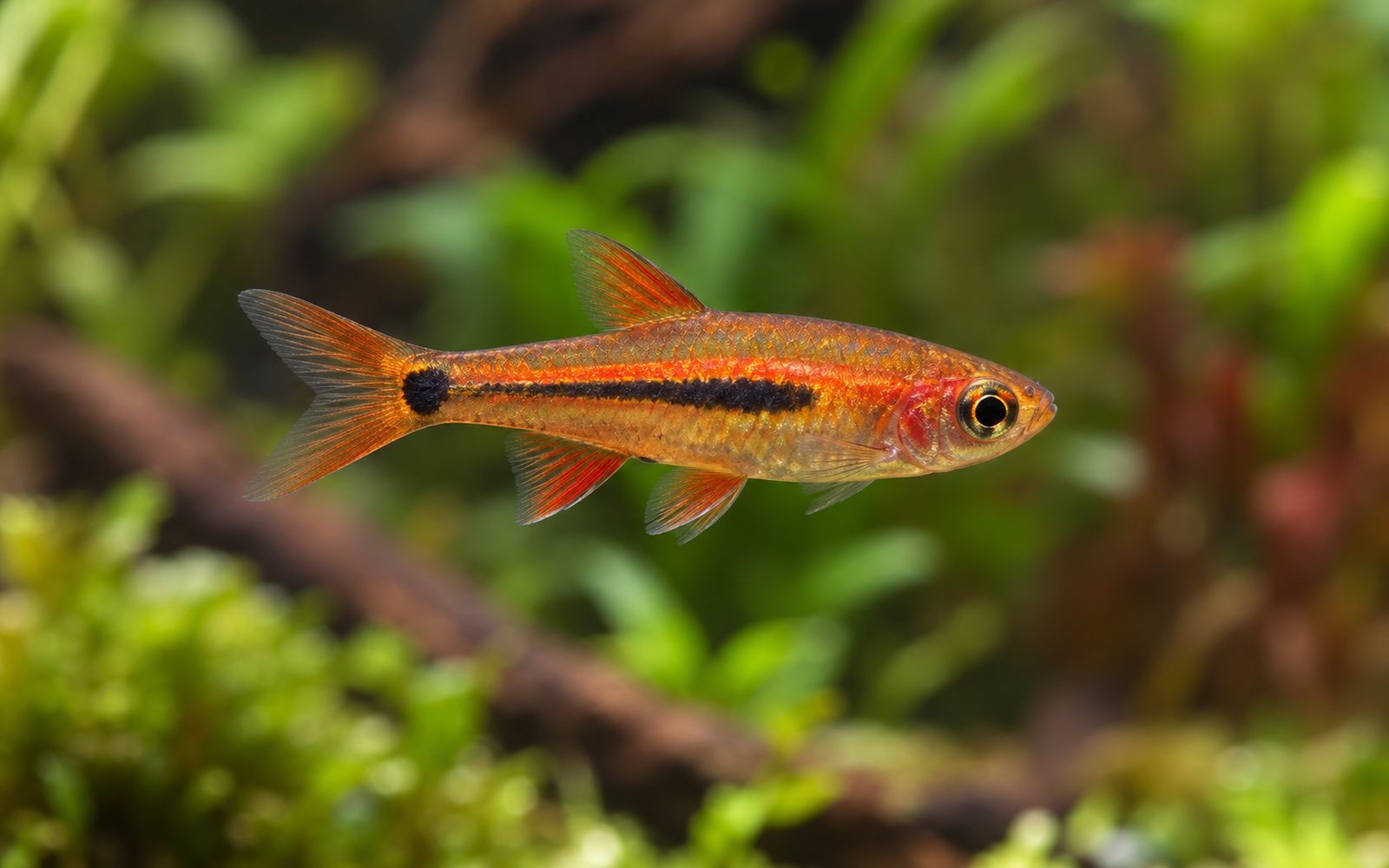
The exclamation point rasbora is one of the smallest members of the genus Boraras; adults reach about 1.5 cm. Its golden-orange or brownish body has a dark stripe running from the middle to the tail, with a distinct dot on the caudal peduncle at the end of the stripe. Together, the stripe and the dot resemble an exclamation point lying on its side. Males show a bright reddish-gold line above the stripe and red-orange fins.
It adapts to a somewhat wider range of water values than the Borneo species of the genus, which makes it a species that beginners can also keep successfully in nano aquariums. Even so, it needs a mature, calm aquarium.
Natural Habitat
It lives in the lowlands of Indochina, in shallow, heavily vegetated swamps, ponds, ditches and rice paddies. The water is still or very slow-flowing and usually soft and slightly acidic. Dense aquatic plants provide both shelter and a food source.
Tank Setup
- Volume: at least 20 liters for a group of 10–15.
- Water: 23–27°C, pH 6–7, soft to moderately hard water.
- Plants: very dense planting, moss and floating plants; leave a small open area at the front.
- Flow: weak; a sponge filter is ideal.
- Tankmates: only species as small and calm as itself.
Diet
It is a micropredator with a very small mouth. It accepts micro granules and flakes ground to powder; supplement with newly hatched brine shrimp, cyclops and microworms. Giving small portions two or three times a day is better than giving a lot of food at once.
Behavior and Compatibility
Peaceful and calm. It moves among the plants in loose groups; males display to each other by flaring their fins and may hold small territories. The squabbles are harmless.
Good companions: Neocaridina and Caridina shrimp, other Boraras species, celestial pearl danios, otocinclus, small snails.
Avoid: any fish with a mouth big enough to swallow it; medium-sized and active species, including bettas; fast schooling fish that outcompete it for food.
Group and Colony Structure
At least 10, ideally 15 or more individuals. In a large group the males show more color and the fish come out into the open. The male-to-female ratio is not critical; having slightly more females spreads out the males' displays.
Breeding
It deposits its eggs among moss and fine-leaved plants, and sometimes on the underside of leaves. In a mature aquarium with moss, fry may appear on their own. For controlled breeding, soft water, plenty of moss and a small container are enough; the adults are removed after spawning. The fry are fed infusoria for the first days, then newly hatched brine shrimp.
Health and Common Problems
- Starvation: the most common problem is not offering food that is small enough.
- Water quality: in a small volume, values change quickly; do 20–30% water changes weekly.
- Acclimation: acclimate new fish slowly and in dim light.
Sexing
Males are slimmer; the reddish-gold line above the stripe and the red-orange fins are prominent. Females are plumper, with paler, yellowish colors.
Tank mates
This list is calculated automatically from the species profile and grows as new species are added to the catalog. Try it in the planner for a definite answer.
Usually compatible
 Flame Tetra
 Blackfin Corydoras
 Polystictus Corydoras
 Emerald Cory
 Porthole Catfish
 Keyhole Cichlid
 Cupid Cichlid
 Geophagus altifrons
 Geophagus surinamensis
 Cryptocoryne Parva
Should not be kept together




Hobbyist notes
Things you won't find in books, learned by trial and error. The most helpful ones are on top.
Change history and contributors
- Page created · October 16, 2026