
Water parameters
Overview
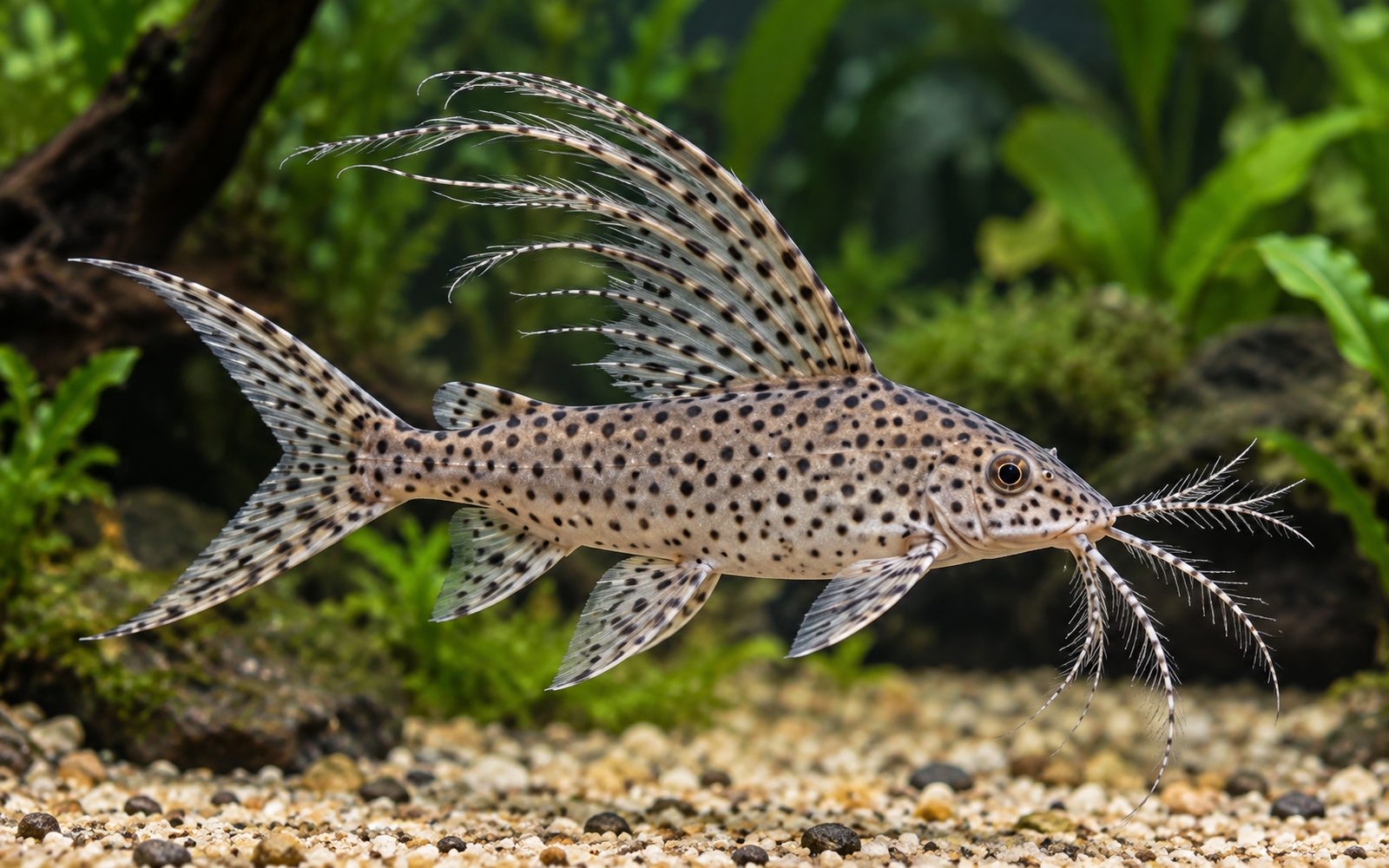
Eupterus takes its name from a Greek root meaning "beautiful fin": in adults the rays of the dorsal fin lengthen and wave like feathers. Its gray-beige body is covered with small dark spots, and the barbels on the lower jaw also have a branched, feathery structure. The dorsal fin extensions are not yet present in juveniles and develop as the fish matures.
Juveniles of 4–6 cm are sold in stores. Adults reach 18–20 cm and can live more than 15 years, so it is a long-term responsibility. Thanks to its hardiness and tolerance of a wide range of water conditions, it is one of the easiest Synodontis for large-fish aquariums.
Natural Habitat
It lives in the savanna rivers of West and Central Africa — in the White Nile, Lake Chad, Niger and Volta basins. The water of these rivers becomes turbid and its parameters change with the seasons; for this reason the species adapts to varied water conditions. During the day it hides among sunken trees and roots, and at night it forages on the bottom.
Tank Setup
- Volume: at least 250 liters and 120 cm of length for one adult; a much larger aquarium for more than one.
- Decor: large roots, rock caves or pipes; a hiding place of its own.
- Substrate: soft sand or rounded fine gravel.
- Water: 23–27°C, pH 6.5–7.8; it adapts to a wide range, but keeping the values stable is important.
- Lighting: dim corners and floating plants make it easier for it to come out during the day too.
Diet
Omnivorous. Offer sinking granules and tablets, frozen bloodworms, mysis, pieces of shrimp and spirulina tablets. Doing the main feeding after the lights go out ensures this nocturnal species eats enough. It quickly finds food that reaches the bottom, so avoid overfeeding.
Behavior and Compatibility
It is generally peaceful toward other species; it hides during the day and roams the aquarium at night. At times it turns upside down to probe the undersides of leaves and roots. As it ages it becomes territorial toward its own kind and similar large bottom dwellers. It may eat small neon-sized fish sleeping at night and shrimp.
Good companions: medium to large peaceful fish: large tetras, barbs, rainbowfish, calm species of American and African cichlids, large plecos.
Avoid: very small fish such as neons and rasboras, dwarf shrimp; a second large Synodontis in a cramped tank.
Group and Colony Structure
It is mostly kept as a single individual. In large (400 liters or more) aquariums with plenty of caves, 3 or more individuals can live together; in that case each needs its own hiding place. When only two are kept, one is sometimes under constant pressure.
Breeding
Breeding in home aquariums has been reported only very rarely. The fish in stores are either wild-caught or produced on commercial farms with hormone treatment.
Health and Common Problems
- It is a hardy species; the main problems are poor water quality and barbel damage from sharp substrate.
- Its scaleless skin is sensitive to copper and strong medications.
- The dorsal and pectoral spines get caught in nets; catch it with a container and watch out for the spines when handling it.
Sexing
Males have a pointed, prominent genital papilla behind the vent; in females it is blunt and rounded. Mature females look wider and plumper when viewed from above.
Tank mates
This list is calculated automatically from the species profile and grows as new species are added to the catalog. Try it in the planner for a definite answer.
Usually compatible
 Porthole Catfish
 Keyhole Cichlid
 Firemouth Cichlid
 Cupid Cichlid
 Buffalohead Cichlid
 Festivum
 Geophagus surinamensis
 Rainbow Cichlid
 Gymnogeophagus balzanii
Should not be kept together





Hobbyist notes
Things you won't find in books, learned by trial and error. The most helpful ones are on top.
Change history and contributors
- Page created · October 16, 2026