
Water parameters
Overview
Synodontis multipunctatus is famous for the way it breeds. It slips in while mouthbrooding cichlids are spawning, eats some of their eggs and lays its own. The female cichlid takes the catfish eggs into her mouth too, mistaking them for her own. The catfish eggs hatch first, and the fry grow inside the cichlid's mouth by feeding on her eggs. This is where the cuckoo comparison comes from.
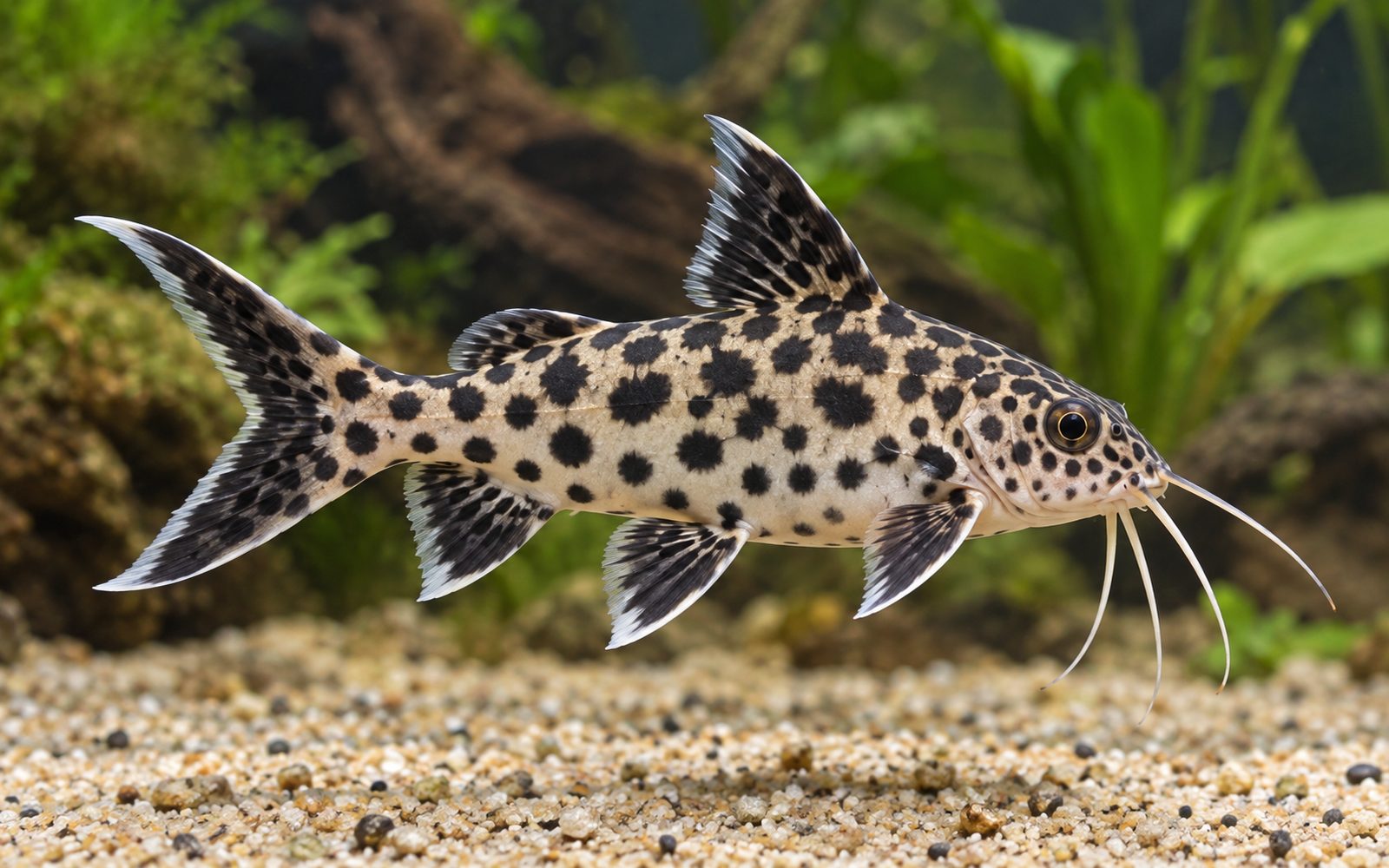
With its large black spots on a pale background, deeply forked tail and big eyes, it is easily distinguished from the petricola. Juveniles of 5–7 cm are sold in stores; adults reach 12–15 cm, and older individuals can grow even larger.
Natural Habitat
It ranges over the rocky and sandy areas of Lake Tanganyika, from waters near the shore down to deeper zones. It lives in the lake's stable, hard and alkaline water. In the wild, snails and other small invertebrates make up a large part of its diet.
Tank Setup
- Volume: at least 250 liters and 120 cm of length for a group of 4–6. It is an active species and needs a large bottom area.
- Decor: caves made from rock piles, with open sandy areas between them.
- Water: 24–27°C, pH 7.8–9.0, hard water; suitable for Tanganyika and Malawi aquariums.
- Filter: strong filtration and good oxygenation; a 25–30% water change every week.
Diet
Omnivorous and a hearty eater. Sinking granules and tablets, frozen bloodworms, mysis shrimp, brine shrimp and small snails are suitable. Compared with many Synodontis, it also comes out to feed during the day; still, when it shares food with cichlids, make sure enough reaches the bottom.
Behavior and Compatibility
Peaceful and active; it roams the bottom in a group and is often seen during the day. It does not attack other fish. When kept with mouthbrooding cichlids it eats their eggs and tries to lay its own; for anyone breeding pure cichlid lines this is a significant drawback.
Good companions: Malawi mbuna and Aulonocara, Tanganyika cichlids (Cyprichromis, Neolamprologus, Tropheus), other Tanganyika Synodontis.
Avoid: dwarf shrimp and small snails; tanks intended for pure breeding of mouthbrooding cichlids; species that need soft water.
Group and Colony Structure
Group bonds are strong: at least 4, ideally 6 or more individuals. A larger group behaves more boldly and also spreads out the jostling between individuals. Kept as one or two fish, it becomes shy and hides. The sex ratio does not matter.
Breeding
In the aquarium it breeds only in the presence of mouthbrooding cichlids; Malawi or Tanganyika mouthbrooders are usually used for this. The catfish join the cichlid pair's spawning and lay their own eggs. At the end of the incubation period, only catfish fry may emerge from the female cichlid's mouth. Those who want to raise fry move the holding cichlid female to a separate tank and grow the fry there. Because this method causes unwanted cichlid losses, it should be planned carefully.
Health and Common Problems
- It is hardy with suitable water and diet; it is sensitive to sudden drops in pH.
- Barbels: they wear down on sharp substrate and a dirty bottom; use fine sand.
- Medications: because of its scaleless skin it is sensitive to strong medications and copper.
- Its spines get caught in nets; catch it with a container.
Sexing
Males have a pointed genital papilla behind the vent; in females this projection is blunt and rounded. Mature females are plumper and usually larger.
Tank mates
This list is calculated automatically from the species profile and grows as new species are added to the catalog. Try it in the planner for a definite answer.
Usually compatible
 Yellow Regal Peacock
 Firemouth Cichlid
 Rainbow Cichlid
 Red Hump Eartheater
 Egyptian Mouthbrooder
 Yellow Tail Acei
Amazon Molly
Yellow Tail Acei
Amazon Molly
 Butterfly Goodeid
American Flagfish
Anatolian Killifish
Butterfly Goodeid
American Flagfish
Anatolian Killifish
Should not be kept together






Hobbyist notes
Things you won't find in books, learned by trial and error. The most helpful ones are on top.
Change history and contributors
- Page created · October 16, 2026