
Water parameters
Overview
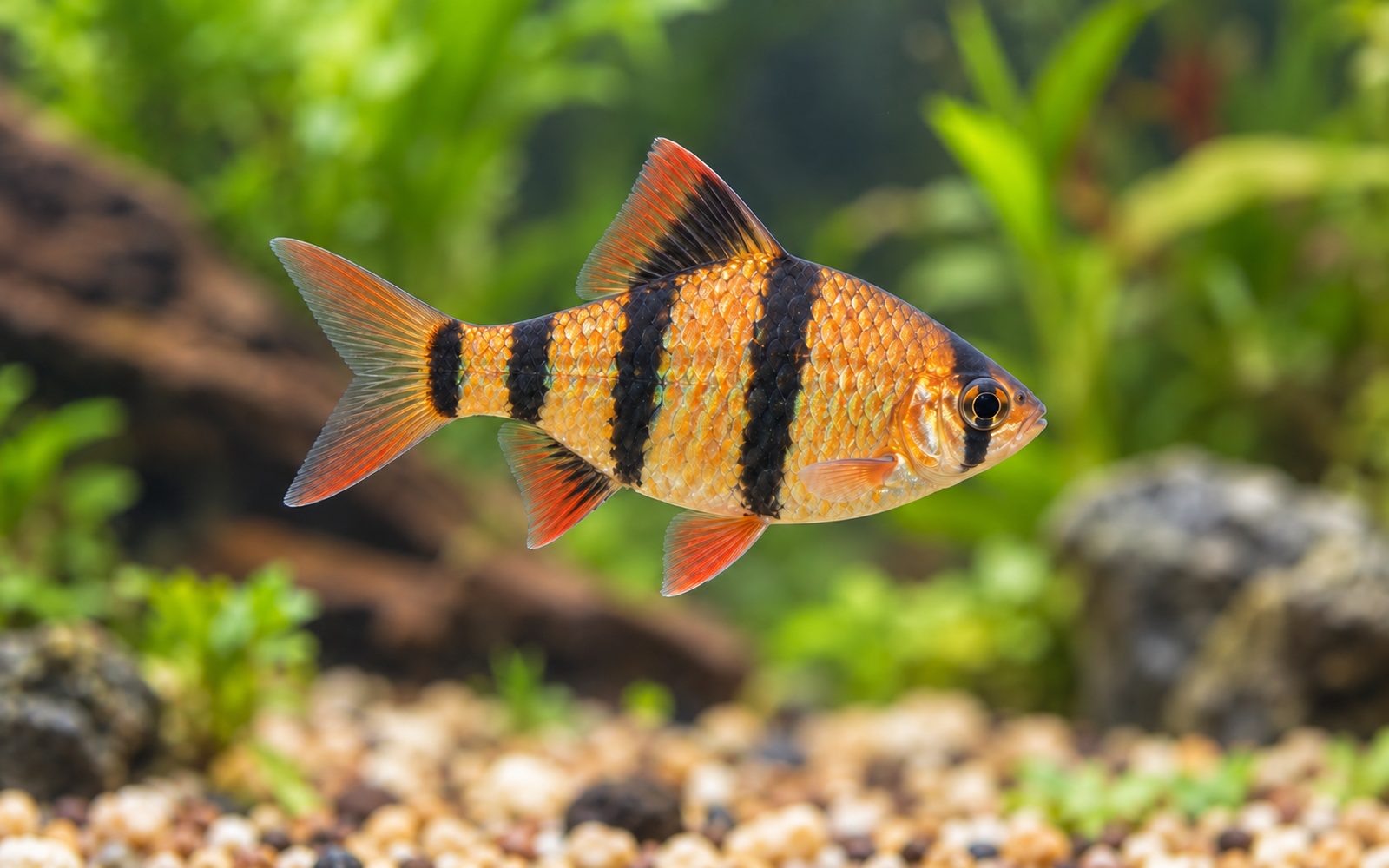
At first glance the five-banded barb resembles the tiger barb, but its body has five black vertical bands instead of four: one passes through the eye, one is on the caudal peduncle and three are on the body. The body color is orange–gold and the fins are reddish.
Unlike the tiger barb, it is calm and peaceful and does not nip fins. On the other hand, because it comes from blackwater, it is more sensitive to water quality; it does well in a mature, stable aquarium.
Natural Habitat
It lives in slow-flowing streams and swamps in the peat swamp forests of the Malay Peninsula and Borneo. These waters are tea-colored from tannins, very soft and acidic. The bottom is covered with leaf litter and the light is filtered by the forest canopy.
Tank Setup
- Volume: at least 60 liters and 60 cm of length for a group of 8–12.
- Water: 24–27°C; soft, acidic water (pH 5.5–6.5 is ideal). Stable values are important.
- Decor: a dark substrate, roots, dried catappa (Indian almond) leaves and densely planted edges; dim light with floating plants.
- Maintenance: a 20–25% water change weekly; avoid sudden changes in values. It should not be added to a newly set-up aquarium.
Diet
Omnivorous. It accepts small granules and flakes; frozen and live foods (brine shrimp, daphnia, cyclops, small bloodworms) noticeably improve its health and color.
Behavior and Compatibility
A peaceful, somewhat shy schooling fish. It swims in the middle layer near plants. It gains confidence in a large group in a calm setting; next to noisy, fast species it stays in the background.
Good companions: small species that like blackwater: harlequin rasbora, small tetras, pencilfish, dwarf gouramis, corydoras, otocinclus, dwarf shrimp.
Avoid: active, dominant barbs such as the tiger barb, large or aggressive fish.
Group and Colony Structure
Kept with at least 8, ideally 12 or more individuals. In a large group the school structure becomes distinct and the fish stop hiding. The sex ratio is of no particular importance.
Breeding
Harder to breed than other barbs; soft, acidic water is required. It scatters its eggs over fine-leaved plants or moss; the parents eat the eggs. A separate, dim breeding tank and removing the adults after spawning are recommended.
Health and Common Problems
Its immunity weakens in hard water and with fluctuating values; white spot and bacterial infections can appear. A long quarantine and slow acclimation reduce losses in the first weeks. Fish from stores have often been kept in hard water; they need to be moved to soft water gradually over a few days, using the drip method. Faded color and clamped fins usually indicate that the water values are not right.
Sexing
Males are slimmer, and their fins and body color are more red–orange. Females are plumper and slightly paler.
Tank mates
This list is calculated automatically from the species profile and grows as new species are added to the catalog. Try it in the planner for a definite answer.
Usually compatible
 Flame Tetra
 Blackfin Corydoras
 Polystictus Corydoras
 Emerald Cory
 Porthole Catfish
 Keyhole Cichlid
 Cupid Cichlid
 Geophagus altifrons
 Geophagus surinamensis
 Cryptocoryne Parva
Should not be kept together






Hobbyist notes
Things you won't find in books, learned by trial and error. The most helpful ones are on top.
Change history and contributors
- Page created · October 16, 2026