
Water parameters
Overview
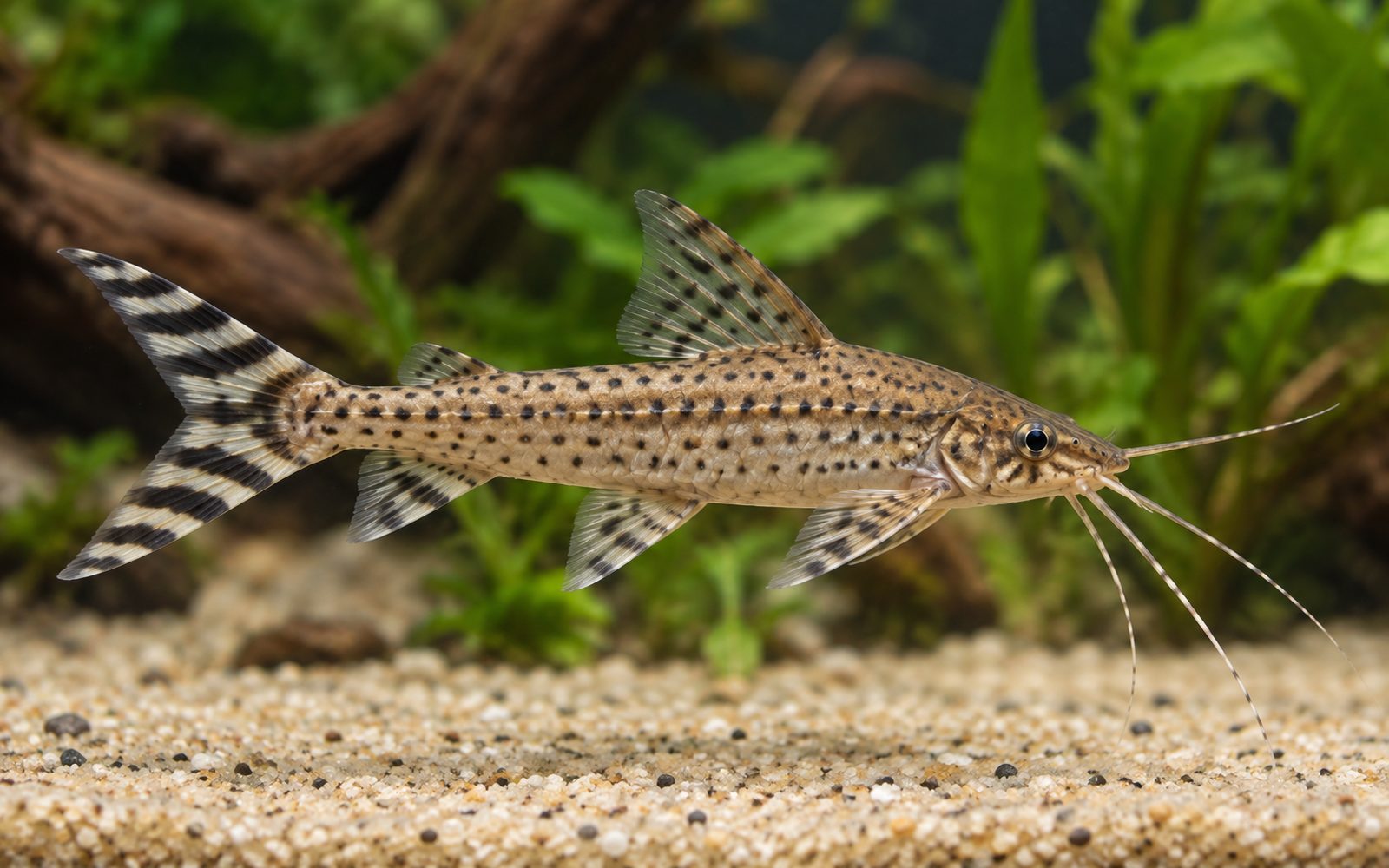
Dianema urostriatum is a member of the armored catfish family that is quite different from corydoras. Its light brown, slender and elongated body is decorated with small dark spots; its most striking feature, however, is the horizontal black and white stripes on the tail fin. Its scientific name also means "striped tail". The long barbels around its mouth extend forward.
Its most important difference from corydoras is its behavior: it spends most of its time not on the bottom but hovering almost motionless in midwater as a school. Adults reach 10–11 cm. It should not be confused with its close relative Dianema longibarbis, whose tail is plain and unstriped.
Natural Habitat
It lives around Manaus in still, vegetated waters with leaf litter near the lower Rio Negro and the main Amazon channel. In these habitats it stays in small groups in dim light among roots and plants.
Tank Setup
- Volume: at least 150 liters for a group of 4–6; a length of 100 cm or more.
- Swimming space: open areas in midwater where it can hover, surrounded by hiding places such as roots and plants.
- Light: light softened by floating plants; in a bright, bare aquarium it becomes shy.
- Water: 22–27°C; soft to moderately hard, clean water. It does not like strong flow.
- Lid: it comes to the surface to gulp air; a covered aquarium is recommended.
Diet
Omnivorous. Sinking granules and tablets, frozen bloodworms, brine shrimp, mosquito larvae and daphnia are eaten eagerly. It looks for food both in midwater and on the bottom; if it is competing with greedy midwater fish, give extra food in the evening.
Behavior and Compatibility
Peaceful and calm; it spends most of its time hovering in midwater together with its group. It can be a shy fish; a large group and hiding places increase its confidence. It may eat shrimp fry small enough to fit in its mouth.
Good companions: medium-sized peaceful tetras, pencilfish, angelfish, dwarf cichlids, corydoras, peaceful gouramis.
Avoid: aggressive or fin-nipping species, very small fish that would fit in its mouth, very active and fast fish.
Group and Colony Structure
A schooling fish; at least 4, ideally 6 or more individuals are recommended. Kept alone, it becomes very shy, hides and its colors fade. In a large group, the behavior of hovering together in midwater is at its most beautiful.
Breeding
It rarely breeds in the aquarium. In successful attempts the male has been reported to build a bubble nest under floating leaves or another surface, with the eggs laid in this nest. The fry can be fed freshly hatched brine shrimp.
Health and Common Problems
- It is hardy; most problems stem from sudden water changes and nitrate buildup.
- Stress and a lack of hiding places can lead to loss of appetite.
- Be careful with salt and copper-based medications.
Sexing
Sexing is difficult. Viewed from above, mature females look plumper; males are slightly slimmer.
Tank mates
This list is calculated automatically from the species profile and grows as new species are added to the catalog. Try it in the planner for a definite answer.
Usually compatible
 Flame Tetra
Glass Tetra
Flame Tetra
Glass Tetra
 Blackfin Corydoras
 Polystictus Corydoras
 Emerald Betta
 Emerald Cory
 Emerald Dwarf Rasbora
 Porthole Catfish
 Keyhole Cichlid
 Cupid Cichlid
Should not be kept together






Hobbyist notes
Things you won't find in books, learned by trial and error. The most helpful ones are on top.
Change history and contributors
- Page created · October 16, 2026