
Water parameters
Overview
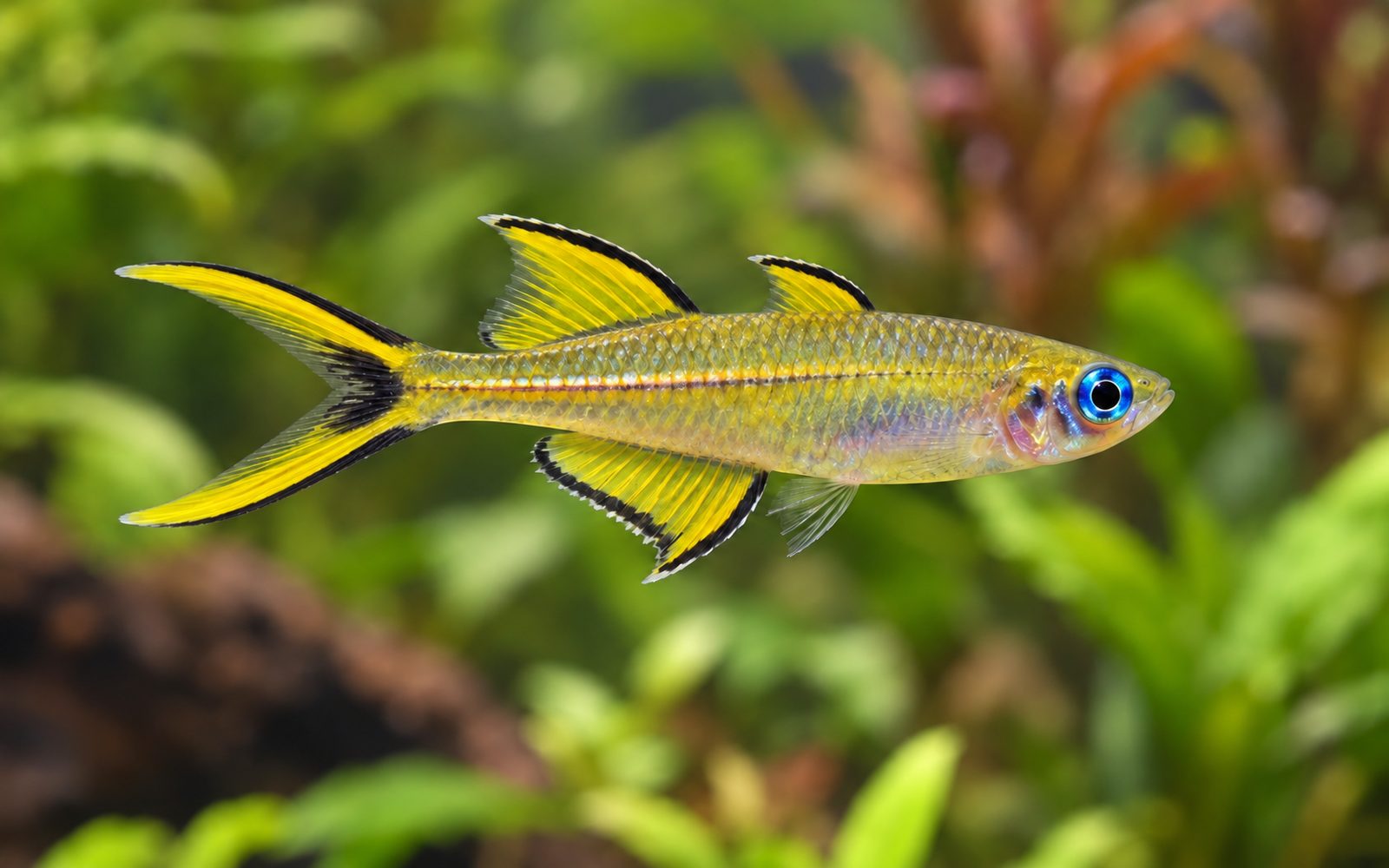
The forktail blue-eye is the best-known and most widely available species of the genus Pseudomugil. Its bright blue eyes, lemon-yellow fins and deeply forked tail with yellow edges and black inner stripes give it a lively look. It grows to 5–6 cm.
Blue-eyes are a small family (Pseudomugilidae) closely related to the rainbowfish. This species is often chosen for planted tanks thanks to its adaptability to the aquarium, its peaceful nature and its getting along with shrimp. It is short-lived; it lives 2–3 years, so renewing the group with fry is a good idea.
Natural Habitat
It lives on the east coast of Papua New Guinea, in clear, gently flowing streams running through the rainforest. The fish move in groups near shaded banks, around plants and submerged branches, in water close to the surface.
Tank Setup
- Volume: at least 60 liters and 60 cm in length for a school of 6–10.
- Water: 24–26°C, around neutral, soft to moderately hard water. It needs clean, oxygen-rich water.
- Plants: Dense plants and floating plants, with open swimming space in the middle.
- Flow: It enjoys gentle to moderate flow.
- Lid: It can jump; use a lid.
Diet
Omnivorous. It accepts micro granules and fine flakes; vary the diet with frozen and live brine shrimp, cyclops, daphnia and small bloodworms. Its mouth is small, and it takes food mostly from the surface and in midwater. Feed small amounts 2–3 times a day.
Behavior and Compatibility
Peaceful and lively; it moves constantly in the layer near the surface. Males display to each other and to females by spreading their fins, and there are short chases. It does not touch adult shrimp and may only eat very small shrimplets.
Good companions: Neocaridina and Caridina shrimp, otocinclus, dwarf corydoras, small rasboras, neon dwarf rainbowfish, nerite snails.
Avoid: large, fast rainbowfish, fin-nipping barbs, aggressive fish; if you plan to breed, other Pseudomugil species.
Group and Colony Structure
At least 6, ideally 10 or more individuals. Because males chase females often, set up a group with 2 females per male. Having several males increases display behavior and prevents a single female from becoming the target.
Breeding
A continuous-spawning egg scatterer. Females lay a few large eggs every day on fine-leaved plants, moss or a wool spawning mop; the eggs attach with sticky threads. Because the parents may eat the eggs, move the mop to a separate container. Depending on temperature, the fry hatch in about 10–20 days; since they are relatively large, they can be fed micro food and, soon after, newly hatched brine shrimp.
Hybridization: It can hybridize with other Pseudomugil species, especially similar-looking relatives from the same region. For a pure line, breed the species separately and do not pass hybrid fry on as the pure species.
Health and Common Problems
- Short lifespan: losing fish at 2–3 years old is natural; renew the group with fry.
- Velvet and white spot: can appear after the stress of transport; quarantine new fish.
- Water quality: it may react to poor water with fin rot.
- In good conditions it is hardy and has a good appetite.
Sexing
Males have larger, brighter yellow fins; the first dorsal fin is larger, and the yellow-and-black pattern on the tail is more distinct. Females are slightly smaller and plumper, with paler, smaller fins.
Tank mates
This list is calculated automatically from the species profile and grows as new species are added to the catalog. Try it in the planner for a definite answer.
Usually compatible
 Flame Tetra
 Blackfin Corydoras
 Polystictus Corydoras
 Emerald Cory
 Porthole Catfish
 Keyhole Cichlid
 Cupid Cichlid
 Geophagus surinamensis
 Cryptocoryne Parva
 Gold Spot Pleco (L001)
Should not be kept together






Hobbyist notes
Things you won't find in books, learned by trial and error. The most helpful ones are on top.
Change history and contributors
- Page created · October 16, 2026