
Water parameters
Overview
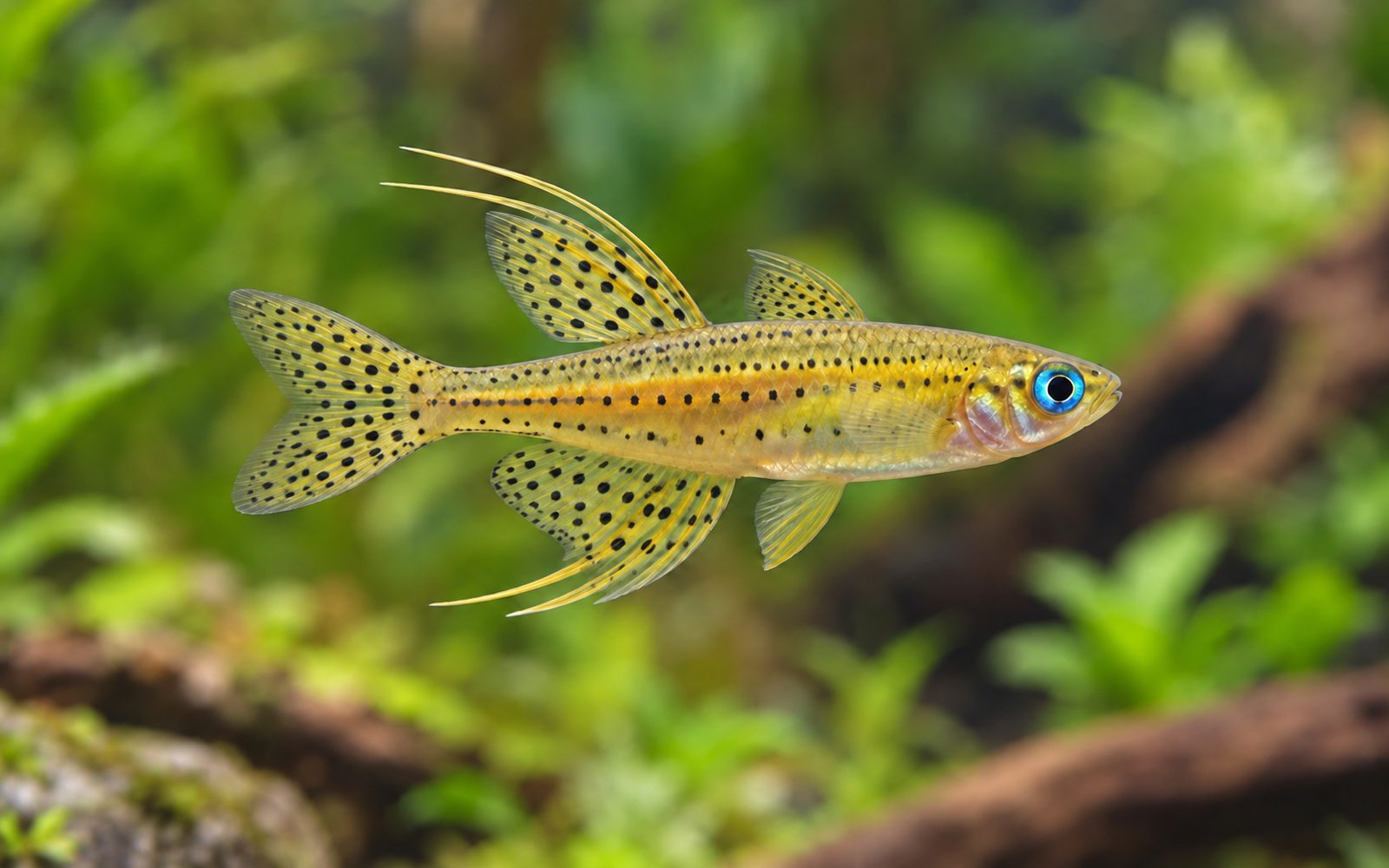
At 3–4 cm, the spotted blue-eye is one of the smallest relatives of the rainbowfish. The males' golden-yellowish body, blue eyes and the black spots scattered over the long rays of the second dorsal and anal fins create an extremely elegant sight up close.
Because it is spread over a wide area, it has different populations; forms originating from the Aru Islands are especially sought after in the hobby. It is short-lived, but in a suitable nano aquarium it breeds on its own and the group can renew itself.
Natural Habitat
It lives in northern Australia, southern New Guinea and the Aru Islands, in densely vegetated swamps, shallow ponds and along the edges of slow-flowing streams. These waters are soft and mostly slightly acidic; they may be tea-tinted from tannins.
Tank Setup
- Volume: at least 40 liters for a group of 6–10.
- Water: 25–27°C; soft, slightly acidic to neutral water is ideal; avoid very hard water.
- Plants: Dense plants, moss and floating plants; dried leaves and roots give a natural look.
- Flow: Should be weak.
- Lid: Despite its small size, it can jump.
Diet
Omnivorous, but its mouth is very small. It is fed micro granules, flakes ground into a fine powder, newly hatched brine shrimp, cyclops and daphnia. Small live and frozen foods noticeably improve condition and color. Feed very small amounts several times a day.
Behavior and Compatibility
Peaceful and delicate; it moves near the water surface. Males constantly display to each other and to females by spreading their fins. It does not harm shrimp; it may only eat newborn shrimplets.
Good companions: Neocaridina and Caridina shrimp, otocinclus, dwarf corydoras, Boraras and small rasboras, threadfin rainbowfish, nerite snails.
Avoid: any fish that could fit it in its mouth, large and fast species, fin nippers; if you plan to breed, other Pseudomugil species.
Group and Colony Structure
At least 6, ideally 10 or more individuals. Because males chase females often, set up a group with 2–3 females per male. In a larger group the fish become bolder and the males' displays are seen more often.
Breeding
A continuous-spawning egg scatterer: females lay a few eggs every day on moss, fine-leaved plants or a wool mop. In a tank with dense moss some fry survive on their own; for more fry, move the eggs to a separate container. Depending on temperature, the fry hatch in about 10–20 days; start with infusoria and micro food, then move on to newly hatched brine shrimp.
Hybridization: It can hybridize with other Pseudomugil species; different populations (e.g. of Aru and Australian origin) should not be mixed either. Pass on the fry with information on their origin.
Health and Common Problems
- Short lifespan: most individuals live 1–2 years; renew the group with fry.
- Starvation: if the food is too large or it is kept with fast fish, it cannot feed enough.
- Water quality: sensitive to sudden changes and dirty water; do small, frequent water changes.
Sexing
Males have long-rayed second dorsal and anal fins covered in dense black spots; their bodies are golden-yellowish. Females are smaller and plainer: their fins are short, colorless and unspotted, and their bodies are silvery-yellowish.
Tank mates
This list is calculated automatically from the species profile and grows as new species are added to the catalog. Try it in the planner for a definite answer.
Usually compatible
 Flame Tetra
 Blackfin Corydoras
 Polystictus Corydoras
 Emerald Cory
 Porthole Catfish
 Keyhole Cichlid
 Cupid Cichlid
 Geophagus altifrons
 Geophagus surinamensis
 Cryptocoryne Parva
Should not be kept together







Hobbyist notes
Things you won't find in books, learned by trial and error. The most helpful ones are on top.
Change history and contributors
- Page created · October 16, 2026