
Water parameters
Overview
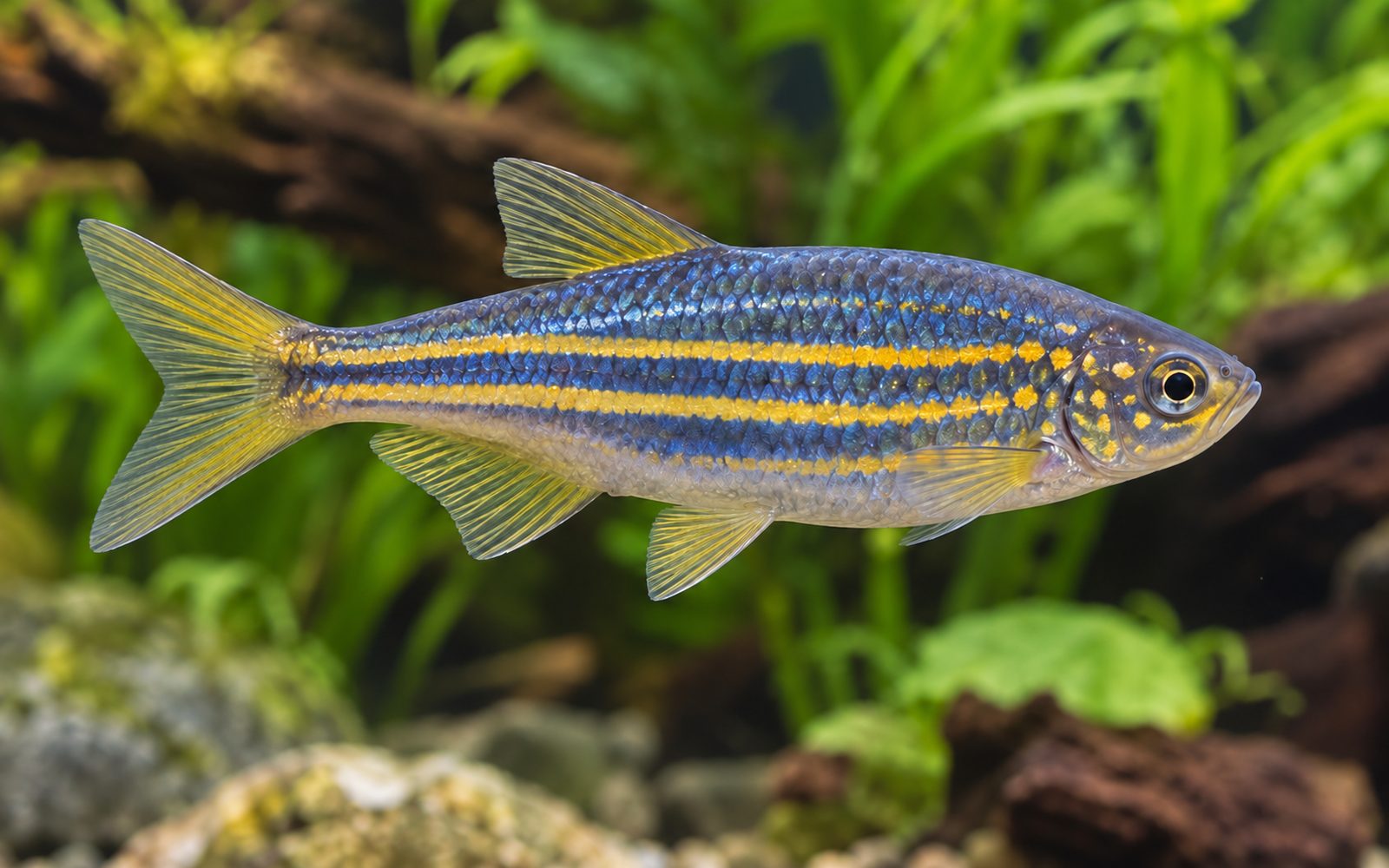
The giant danio is one of the largest danios kept in aquariums; adults reach about 10 cm. Its laterally compressed, fairly deep body is steel blue, with two or three golden-yellow stripes running along it; towards the head these stripes break up into short bars and spots. Its fins range from clear to yellowish.
Its taxonomy is confused: some of the fish sold in the trade as "giant danio" may be the Malabar danio (Devario malabaricus) or related species. Their care is almost identical. Thanks to its hardiness and speed, it is often used as a schooling fish to liven up the open water in medium-sized cichlid aquariums.
Natural Habitat
It lives in clear, fast-flowing, oxygen-rich streams and small rivers in the hilly regions of South Asia. The bottom is gravel and stone; the species hunts insects that fall onto the water in the areas near the surface.
Tank Setup
- Volume: at least 200 liters and 100–120 cm in length for a school of 6–8; long swimming space is essential.
- Water: 21–25°C, pH 6.5–7.5; it adapts to a wide range of values.
- Flow: it likes strong current and high oxygen levels; a circulation pump is useful.
- Layout: gravel substrate, a few stones and roots, sturdy plants at the back and sides; keep the middle and top open.
- Lid: an excellent jumper; a tight-fitting lid is essential.
Diet
Omnivorous with a big appetite. Use quality flakes and granules as the staple; vary the diet with frozen and live brine shrimp, mosquito larvae, bloodworms and mysis shrimp. It snaps food quickly from the surface; make sure slower-feeding tankmates also get their share.
Behavior and Compatibility
Peaceful but very active and boisterous. As a school it constantly patrols the upper layer. It eats small fish that fit in its mouth, fish fry and dwarf shrimp. Its speed and restlessness stress slow, long-finned species.
Good companions: not-too-aggressive medium-sized cichlids (such as the blue acara), barbs, rainbowfish, loaches, large corydoras species, plecos, scissortail rasboras.
Avoid: small fish such as neons and Boraras, dwarf shrimp, bettas and long-finned guppy forms, shy and slow species.
Group and Colony Structure
At least 6, ideally 8 or more individuals. In a large school the males' chasing is spread out and the fish swim more calmly. Kept in small numbers, dominant individuals constantly chase the others and also disturb other species.
Breeding
It scatters its eggs among gravel and plants; there is no parental care and the eggs are eaten quickly. For breeding, coarse gravel or an egg grid is placed on the bottom of a long aquarium, and a well-fed group spawns with the morning light. The adults must be removed immediately. The fry become free-swimming within a few days and are fed infusoria, then newly hatched brine shrimp.
Health and Common Problems
Very hardy. It becomes stressed in a cramped aquarium and in warm, oxygen-poor water. Losses from jumping are common in tanks without a lid. Weekly water changes of 25–30% and strong filtration are sufficient.
Sexing
Males are slimmer, and the contrast between the blue base color and the golden stripes is more pronounced. Females are larger, deeper-bodied and have a fuller belly; the central blue stripe may curve slightly upward towards the tail.
Tank mates
This list is calculated automatically from the species profile and grows as new species are added to the catalog. Try it in the planner for a definite answer.
Usually compatible
 Blackfin Corydoras
 Emerald Betta
 Emerald Cory
 Porthole Catfish
 Keyhole Cichlid
 Geophagus surinamensis
 Cryptocoryne Parva
 Gold Spot Pleco (L001)
 Egyptian Mouthbrooder
Should not be kept together






Hobbyist notes
Things you won't find in books, learned by trial and error. The most helpful ones are on top.
Change history and contributors
- Page created · October 16, 2026