
Water parameters
Overview
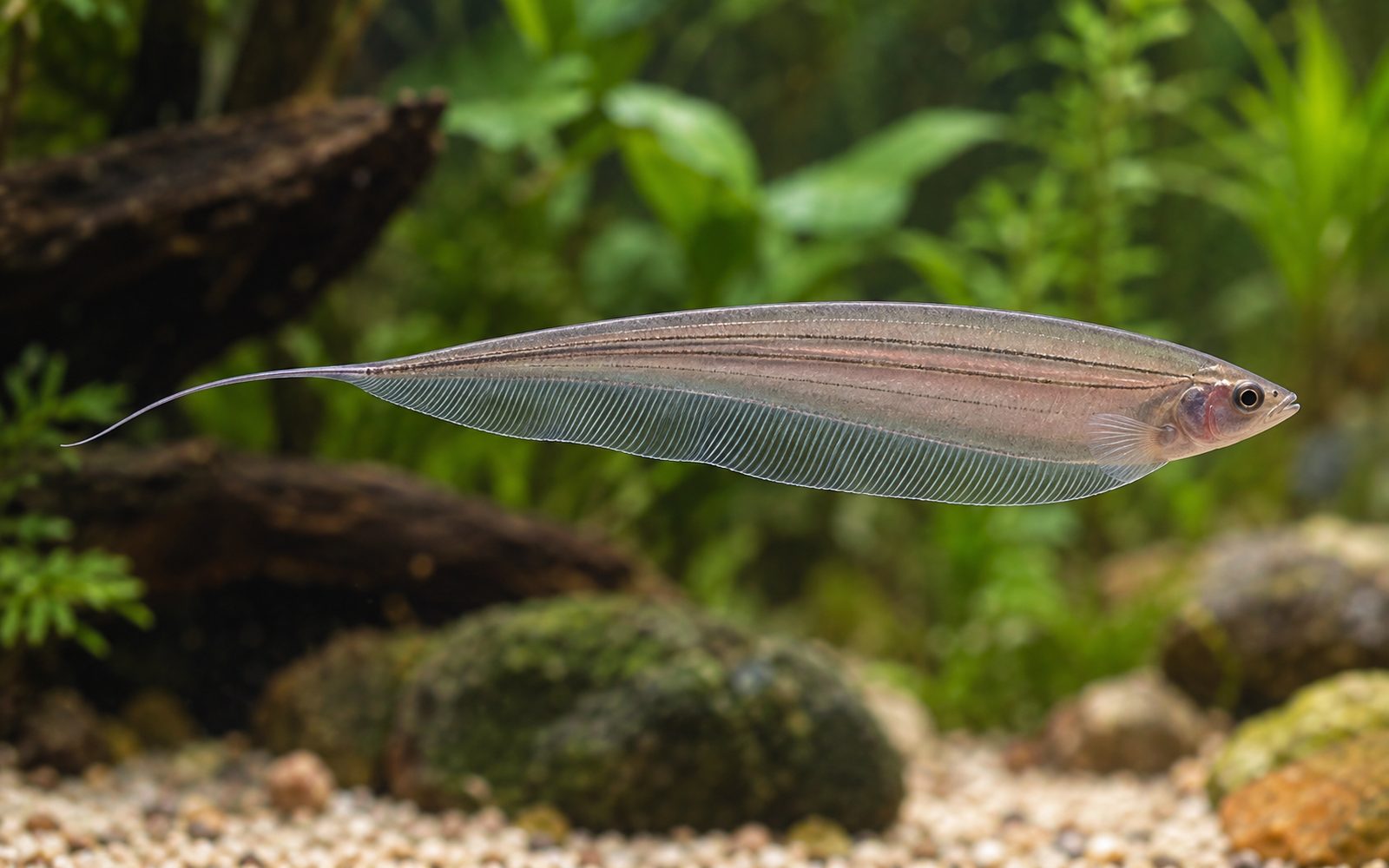
The glass knifefish is a South American fish with a pinkish-gray body so transparent that some of its internal organs are visible. Like other knifefish it has no dorsal fin; it glides back and forth by rippling the fin that runs along its belly.
It constantly produces a weak electric signal with an organ in its tail. Nearby individuals shift their frequencies away from each other so their signals do not interfere; this behavior has been studied in neuroscience research for years. Unlike the black ghost, it lives in groups and can also be seen during the day.
Natural Habitat
It lives in groups over a wide area of South America, along vegetated, slow-flowing riverbanks among the roots of floating plants. During the day it rests among these roots, and in the late afternoon it comes out into the open to feed on small insect larvae.
Tank Setup
- Volume: at least 400 liters and 150 cm length for a group of 4–6. Males grow noticeably larger than females.
- Cover: roots, pipes and densely planted corners; dim areas created with floating plants.
- Water: clean, well-oxygenated, soft to moderately hard; gentle flow.
- Substrate: sand or fine gravel.
Diet
Carnivorous. Frozen bloodworms, brine shrimp, daphnia, mysis and small worms. Over time it gets used to sinking granules. Its mouth is small; offer food in small pieces.
Behavior and Compatibility
A peaceful fish attached to its group. A hierarchy forms within the group and brief scuffles occur, but serious fights are rare. It may eat very small fish fry and dwarf shrimp.
Good companions: calm, medium-sized species: large tetras, angelfish, gouramis, Corydoras, plecos, calm cichlids.
Avoid: aggressive cichlids, fin-nipping barbs, other knifefish such as the black ghost, dwarf shrimp.
Group and Colony Structure
Keep at least 4, ideally 6 or more together. A glass knifefish kept alone becomes timid and hides constantly.
Breeding
It has been bred in the aquarium: to simulate the rainy season, the conductivity of the water is gradually lowered and "rain" is sprinkled onto the surface. The eggs are laid on the roots of floating plants. It is rare in the home aquarium.
Health and Common Problems
- White spot: common because of its delicate skin; use medications at a low dose.
- Water quality: sensitive to ammonia and nitrite; a mature aquarium is required.
Sexing
Adult males are much longer than females (females stay around 20 cm) and have larger heads. During the breeding season the females' bellies fill out.
Tank mates
This list is calculated automatically from the species profile and grows as new species are added to the catalog. Try it in the planner for a definite answer.
Usually compatible
 Flame Tetra
Glass Tetra
Flame Tetra
Glass Tetra
 Blackfin Corydoras
 Polystictus Corydoras
 Emerald Betta
 Emerald Cory
 Porthole Catfish
 Keyhole Cichlid
 Firemouth Cichlid
 Cupid Cichlid
Should not be kept together



Hobbyist notes
Things you won't find in books, learned by trial and error. The most helpful ones are on top.
Change history and contributors
- Page created · October 16, 2026