
Water parameters
Overview
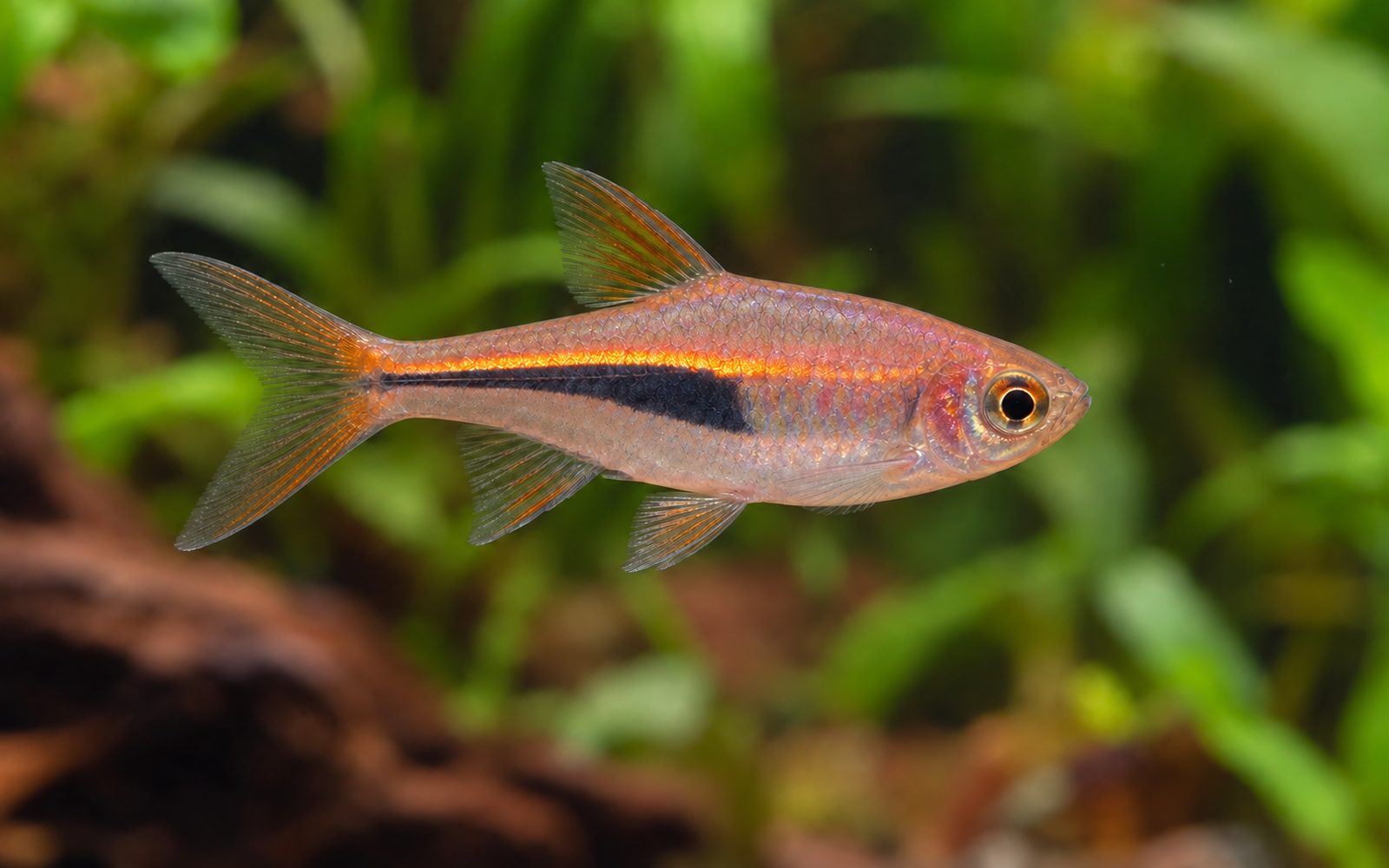
The glowlight rasbora is the smallest and most delicate-looking member of the genus Trigonostigma. The rear half of its pink-orange, semi-transparent body bears a thin black wedge; directly above this wedge is an orange band that glows as it catches the light. This glow is why it is called "glowlight" in English.
It is more slender than the harlequin and lambchop rasboras and wants slightly softer water. Kept as a large group in a calm, planted, dimly lit aquarium, the orange bands shimmer as the group moves.
Natural Habitat
It lives in the lowland swamps of Sumatra and Borneo, in slow-flowing blackwater streams running through forested areas. The water is tea-colored from tannins, very soft and acidic, with dense vegetation and overhanging roots along the banks.
Tank Setup
- Volume: at least 40 liters for a group of 10; a 60 cm aquarium is more comfortable.
- Water: 24–27°C, pH 5.5–6.8, soft water. Dried leaves and roots and slightly tannin-stained water bring out its colors.
- Plants: broad-leaved plants such as Cryptocoryne and Anubias, floating plants and moss.
- Light: dim, or diffused by floating plants; colors fade under bright light.
- Flow: gentle.
Diet
Omnivorous. It readily accepts fine flakes and micro granules; supplement with frozen cyclops, daphnia and newly hatched brine shrimp. Keep the food small and feed little and often.
Behavior and Compatibility
Peaceful and calm. It swims as a group in the middle layer, close to the plants; when startled the whole group retreats into the plants together. Males spread their fins while courting females, and their orange bands glow even brighter.
Good companions: other small rasboras, Boraras species, small tetras, otocinclus, dwarf corydoras species, shrimp, nerite snails.
Avoid: large, active fish, any species with a mouth big enough to swallow it, fin nippers.
Group and Colony Structure
At least 8, ideally 12 or more individuals. In a large group the fish come out into the open and wheel around as a school; kept in small numbers they remain shy. The male-to-female ratio is not critical.
Breeding
Like the other members of the genus, it attaches its eggs to the underside of broad leaves: the pair turns upside down beneath the leaf, deposits a few eggs and repeats this many times. Breeding requires very soft (GH below 3), acidic water and dim light. The parents may eat the eggs; removing them after spawning is recommended. The fry are fed infusoria, then newly hatched brine shrimp.
Health and Common Problems
- Hard water: in hard, alkaline water its colors fade and its lifespan shortens.
- Stress: in an open, unplanted aquarium it hides and becomes prone to disease.
- Water quality: a 25% weekly water change and stable values are sufficient.
Sexing
Males are slimmer; the front tip of the black wedge is more pointed and the orange band above it is brighter. Females have a fuller belly and are slightly paler.
Tank mates
This list is calculated automatically from the species profile and grows as new species are added to the catalog. Try it in the planner for a definite answer.
Usually compatible
 Flame Tetra
 Blackfin Corydoras
 Polystictus Corydoras
 Emerald Cory
 Porthole Catfish
 Keyhole Cichlid
 Cupid Cichlid
 Geophagus altifrons
 Geophagus surinamensis
 Cryptocoryne Parva
Should not be kept together






Hobbyist notes
Things you won't find in books, learned by trial and error. The most helpful ones are on top.
Change history and contributors
- Page created · October 16, 2026