
Water parameters
Overview
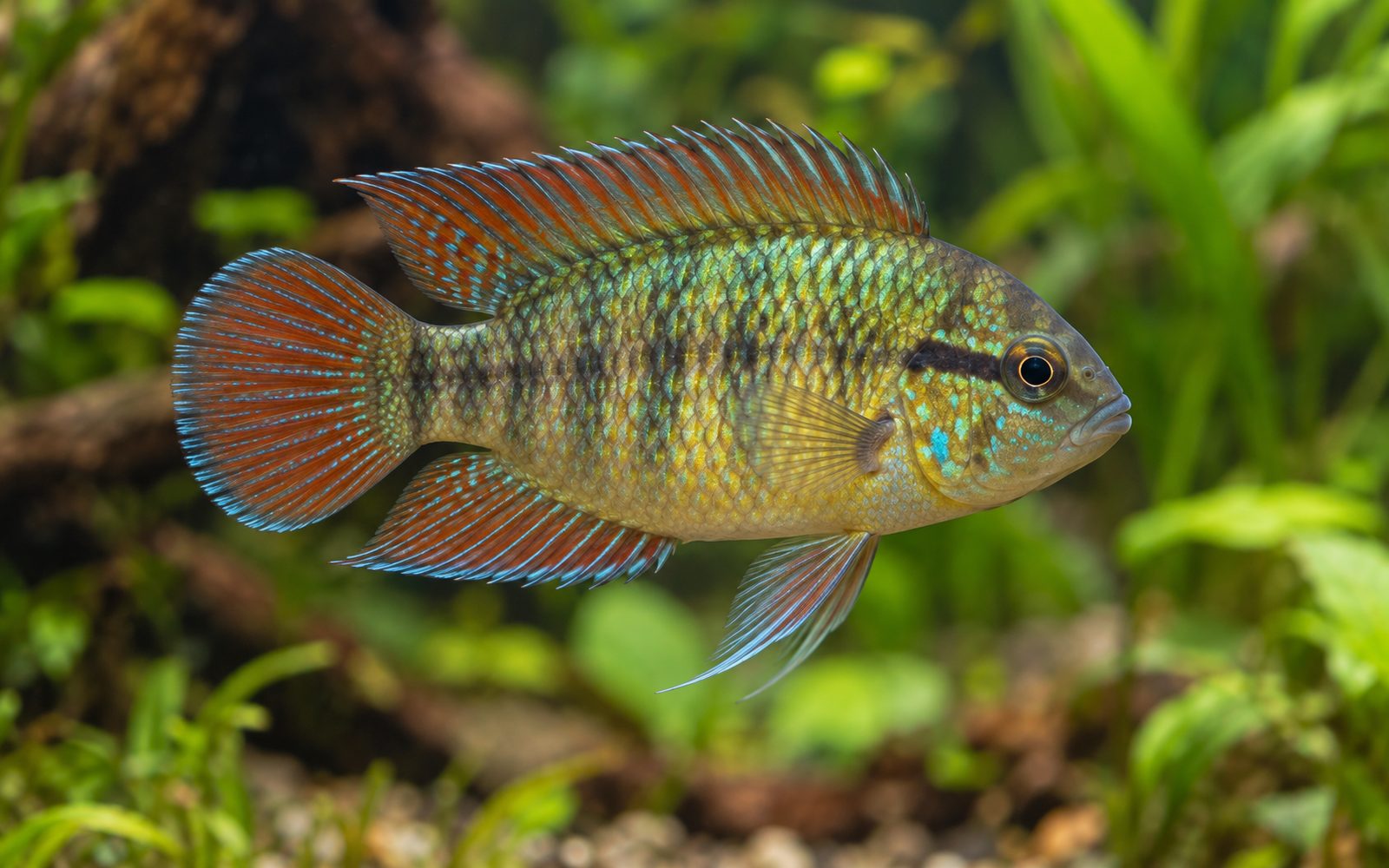
Nannacara anomala is a stocky dwarf cichlid from the coasts of Guyana. Depending on the angle of the light, the male's scales shine in green, gold and blue tones; its fins have light blue and reddish edges. The female is small and yellowish, but while guarding fry her body takes on a black-and-yellow checkerboard pattern.
Most fish on the market are bred on farms in the Far East and Eastern Europe, so it is tolerant of a range of water values. Its easy breeding and the way the female "talks" to her fry through body language make it a good species for getting started with dwarf cichlids.
Natural Habitat
It lives in flooded meadows and swampy streams on the low coastal plains, from the Aruka River in Guyana to the lower Marowijne in Suriname. These waters are shallow, planted and usually soft.
Tank Setup
- Volume: at least 80 liters for one male and two females; each female claims an area of about 40×40 cm on the bottom.
- Decor: roots, stones, caves and dense plants; obstacles that break lines of sight.
- Substrate: fine sand or soft gravel; dried leaves can be scattered on top.
- Water: 23–26°C, pH 6–7.5. Soft water is preferred, but it also adapts to moderate hardness. A 25% water change every week.
Diet
Omnivorous, but it prefers animal-based foods. It feeds on sinking granules, frozen bloodworms, brine shrimp, daphnia and mysis. A varied diet increases the male's shine and the urge to breed.
Behavior and Compatibility
Mostly calm in a community aquarium; the real toughness comes during the fry period. A female guarding fry becomes very aggressive and chases not only other fish but also the male. It hunts shrimp.
Good companions: tetras, rasboras, pencilfish, hatchetfish, bristlenose plecos.
Avoid: fish that constantly roam the bottom such as Corydoras (in a small aquarium they get chased during the fry period), large cichlids, shrimp.
Group and Colony Structure
Kept as a harem or a pair. The most balanced arrangement is 1 male and 2 females; the male's attention is split between the females. More than one male is not recommended in an aquarium under 120 cm. An interesting behavior: a subordinate male next to a dominant male may take on the color and size of a female to avoid attack; if the dominant male is removed, it becomes a full male within a few weeks.
Breeding
The female lays her eggs on a flat stone or root or inside a cave. After spawning the female takes on their care and drives the male away from the area; if the male has nowhere to hide, he must be removed. The female guides the fry using her checkerboard pattern and fin movements. The fry are fed newly hatched brine shrimp.
Health and Common Problems
Hardy. Bacterial infections and fin rot can occur with poor water quality. The aquarium should be large enough that the male is not injured during the fry period.
Sexing
Sexing is easy: males are 8–9 cm, with metallic scales and long fins. Females are 4–5 cm, yellowish with a dark lateral stripe; the checkerboard pattern appears during the fry period.
Tank mates
This list is calculated automatically from the species profile and grows as new species are added to the catalog. Try it in the planner for a definite answer.
Usually compatible
 Emerald Betta
 Emerald Cory
 Porthole Catfish
 Keyhole Cichlid
 Firemouth Cichlid
 Cupid Cichlid
 Buffalohead Cichlid
 Festivum
 Geophagus surinamensis
Should not be kept together





Hobbyist notes
Things you won't find in books, learned by trial and error. The most helpful ones are on top.
Change history and contributors
- Page created · October 16, 2026