
Water parameters
Overview
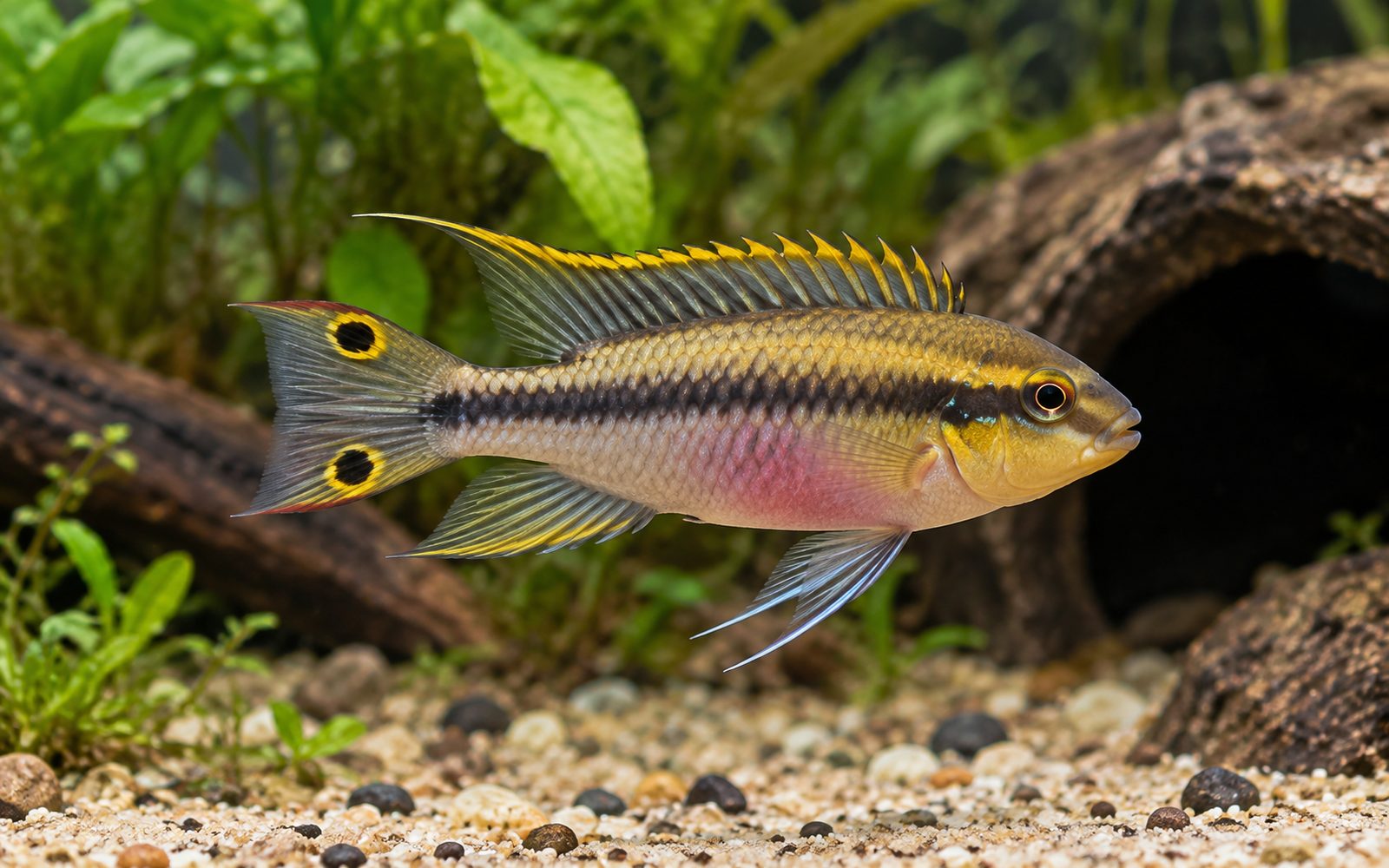
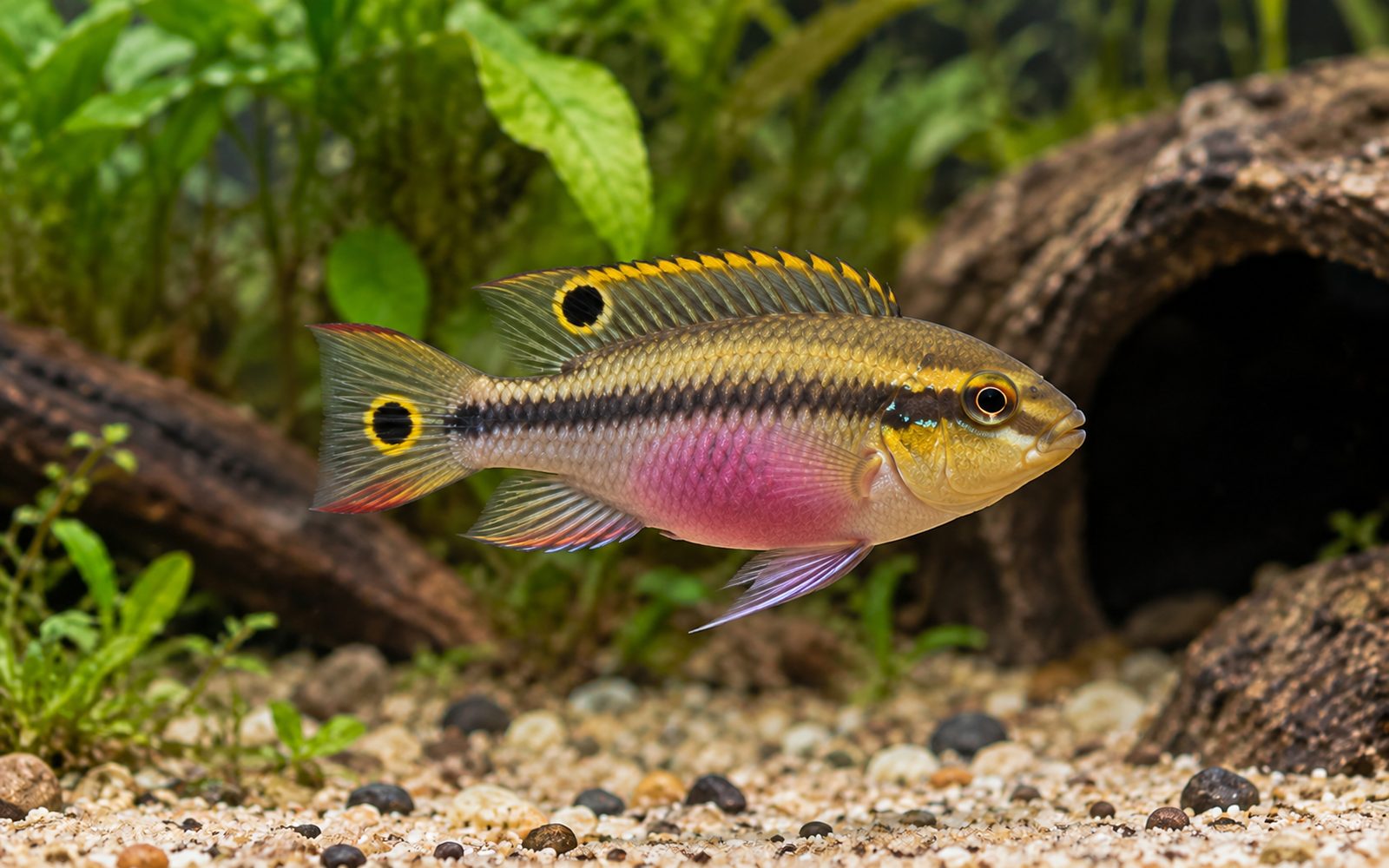
The kribensis is recognized by the dark stripe running along its yellowish–gray body, the yellow edge on its dorsal fin and its eyespots; the females, by their bright cherry-purple bellies during breeding. It is one of the hardiest dwarf cichlids and breeds readily in the aquarium.
Natural Habitat
It lives on the coastal plains of West Africa, in the slow-flowing, planted, soft-water channels of the Niger delta; some populations live in brackish water.
Tank Setup
- Volume: at least 80 liters for a pair.
- Cave: an upturned flowerpot, coconut shell or stone cave is essential; the pair breed here.
- Substrate: fine sand; kribensis love to dig and enlarge the space under the cave.
- Water: 24–27°C; soft to moderately hard. pH can affect the sex ratio of the fry.
Diet
Omnivorous. Sinking granules and tablets, frozen bloodworms, brine shrimp, daphnia; vegetables now and then. It feeds from the bottom.
Behavior and Compatibility
Peaceful most of the time; during breeding it fiercely defends the area around its cave and chases bottom dwellers. It eats fry and shrimp.
Good companions: schooling fish that swim in the middle layer (tetras, rasboras, danios), bristlenose plecos (with enough caves).
Avoid: bottom dwellers such as corydoras and kuhli loaches (they get chased during breeding), shrimp, other dwarf cichlid pairs (in a small aquarium), large aggressive cichlids.
Group and Colony Structure
The kribensis is kept as a pair; the male and female set up a territory together and raise the fry together. To get a pair, buy several juveniles and wait for them to pair off, or buy a bonded pair. One pair per aquarium; in 200 liters or more, with two separate cave areas, a second pair.
Breeding
The female curves her body to show off her purple belly and invite the male into the cave. The eggs are laid on the ceiling of the cave; the female stays in the cave while the male guards the outside. Once the fry start swimming, the parents lead them around as a school. The fry are fed newly hatched brine shrimp.
Health and Common Problems
Hardy. Bacterial infections can occur with poor water and a monotonous diet.
Sexing
Males are larger, with long, pointed dorsal and anal fins, and may have eyespots on the tail. Females are smaller and rounder; their bellies are a distinct cherry-purple, their dorsal fins are edged in gold and usually carry an eyespot.
Tank mates
This list is calculated automatically from the species profile and grows as new species are added to the catalog. Try it in the planner for a definite answer.
Usually compatible
 Emerald Betta
 Porthole Catfish
 Keyhole Cichlid
 Firemouth Cichlid
 Cupid Cichlid
 Buffalohead Cichlid
 Festivum
 Geophagus altifrons
 Geophagus surinamensis
Should not be kept together





Hobbyist notes
Things you won't find in books, learned by trial and error. The most helpful ones are on top.
Change history and contributors
- Page created · October 16, 2026