
Water parameters
Overview
Labeotropheus trewavasae, like its relative L. fuelleborni, is an mbuna adapted to scraping algae off rocks: the snout projects forward and the mouth opens on the underside of the body. It is slimmer and longer in build than the fuelleborni and also stays somewhat smaller.
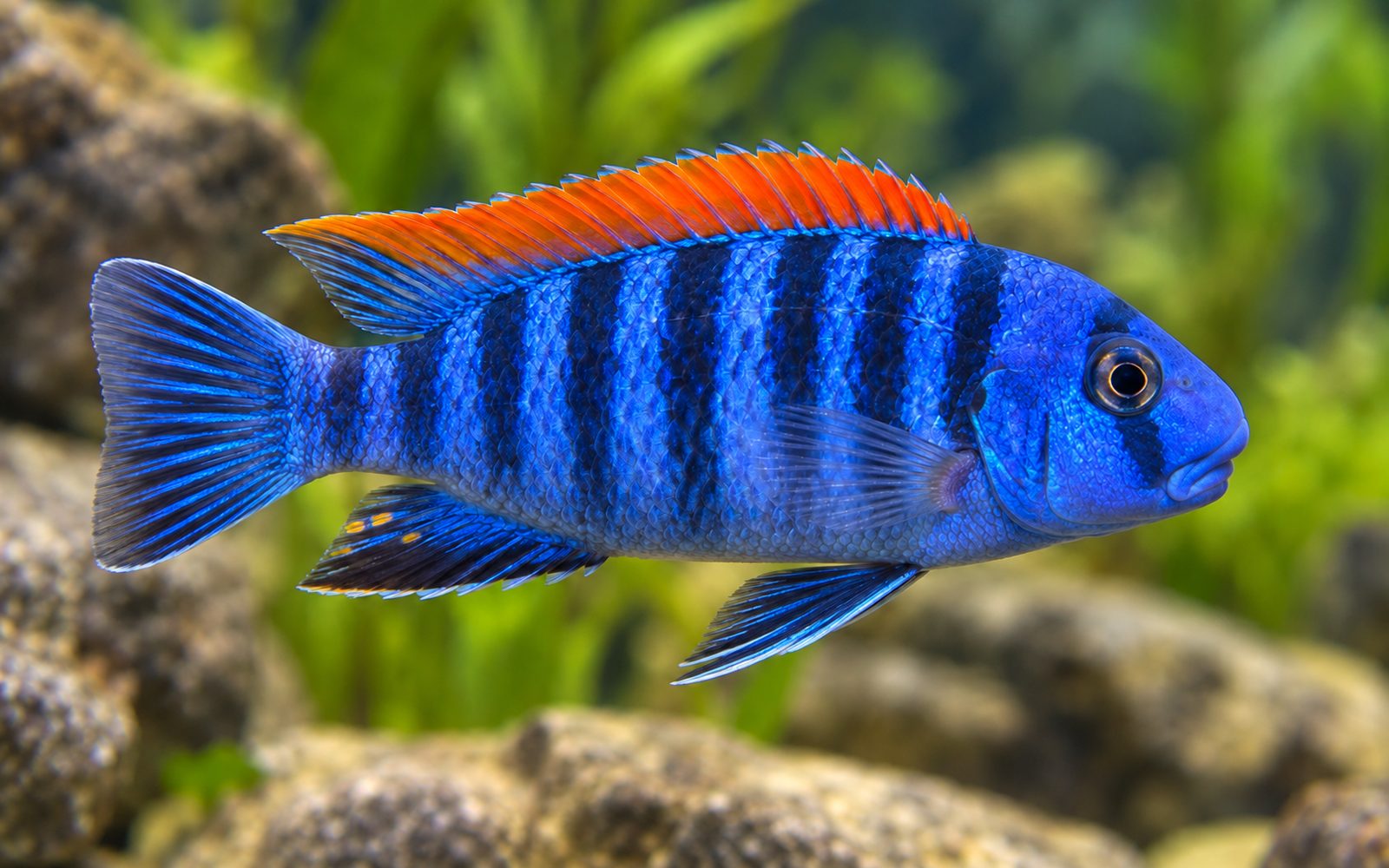
The most popular forms in the hobby are the "red top" forms, in which the males combine a blue body with a red or orange dorsal fin. Females, meanwhile, mostly have an orange pattern with black blotches (OB). In temperament it is a typical mbuna: males defend their territory fiercely.
Natural Habitat
It lives on the rocky shores of Lake Malawi, in somewhat deeper areas than the fuelleborni and on steep rock faces. It feeds by scraping the algae layer on the rocks with its underslung mouth. There are many local forms with different colors in different parts of the lake.
Tank Setup
- Volume: at least 300 liters and 120–150 cm in length.
- Rockwork: Rocks with broad surfaces and caves between them; the rocks should sit firmly on the bottom glass.
- Water: Hard and alkaline (pH 7.8–8.5), strong water movement and good oxygenation.
- Maintenance: Strong filtration, weekly 30–50% water changes.
Diet
Herbivorous. A spirulina-rich sinking mbuna food, vegetables and nori should be the staple. Because of the structure of its mouth, it may struggle to take food from the surface. Bloodworms and high-protein foods lead to Malawi bloat.
Behavior and Compatibility
Males claim a rock surface and chase especially fish with blue and red tones. Females are calmer but establish a ranking among themselves. It should be kept with sturdy mbuna of different colors.
Good companions: mbuna of different colors such as red zebra, yellow lab, yellow-tail acei and auratus females, Synodontis catfish suited to hard water.
Avoid: Labeotropheus fuelleborni (hybridization), very small and calm mbuna, Aulonocara and haps, community fish, shrimp and snails.
Group and Colony Structure
- Harem: 1 male and 3–4 females; a single male in the aquarium is recommended.
- Mixing forms: It hybridizes easily with different local forms and with the fuelleborni; if a pure line is wanted, a single form is kept.
- A crowded mbuna community and plenty of rocks spread out the male's pressure.
Breeding
A mouthbrooder. The male courts on a rock surface or in front of a cave; the female picks up the eggs in her mouth and they are fertilized with the help of the egg spots on the male's anal fin. The female carries 15–35 eggs for about 3 weeks, not eating during this time. Once free, the fry hide in rock crevices.
Health and Common Problems
- Malawi bloat: protein-rich food and stress are the most common causes.
- Mouth injuries: mouth locking can occur during fights.
- Lack of oxygen: with weak water movement the fish breathe rapidly near the surface.
Sexing
Mature males have a blue body, in most forms with a red-orange dorsal fin, and carry prominent egg spots on the anal fin. Females are mostly orange with black blotches (OB) or a plain brownish gray. Because OB males can also occur in some forms, fin shape and the genital papilla are also checked for sexing.
Tank mates
This list is calculated automatically from the species profile and grows as new species are added to the catalog. Try it in the planner for a definite answer.
Usually compatible
 Banded Jewel Cichlid
 Spotted Tilapia
 Demasoni Cichlid
 Jack Dempsey
 Redhead Cichlid
 Red Devil Cichlid
 Red Terror Cichlid
 Convict Cichlid
 Pundamilia nyererei
 Pundamilia pundamilia
Should not be kept together








Hobbyist notes
Things you won't find in books, learned by trial and error. The most helpful ones are on top.
Change history and contributors
- Page created · October 16, 2026