
Water parameters
Overview
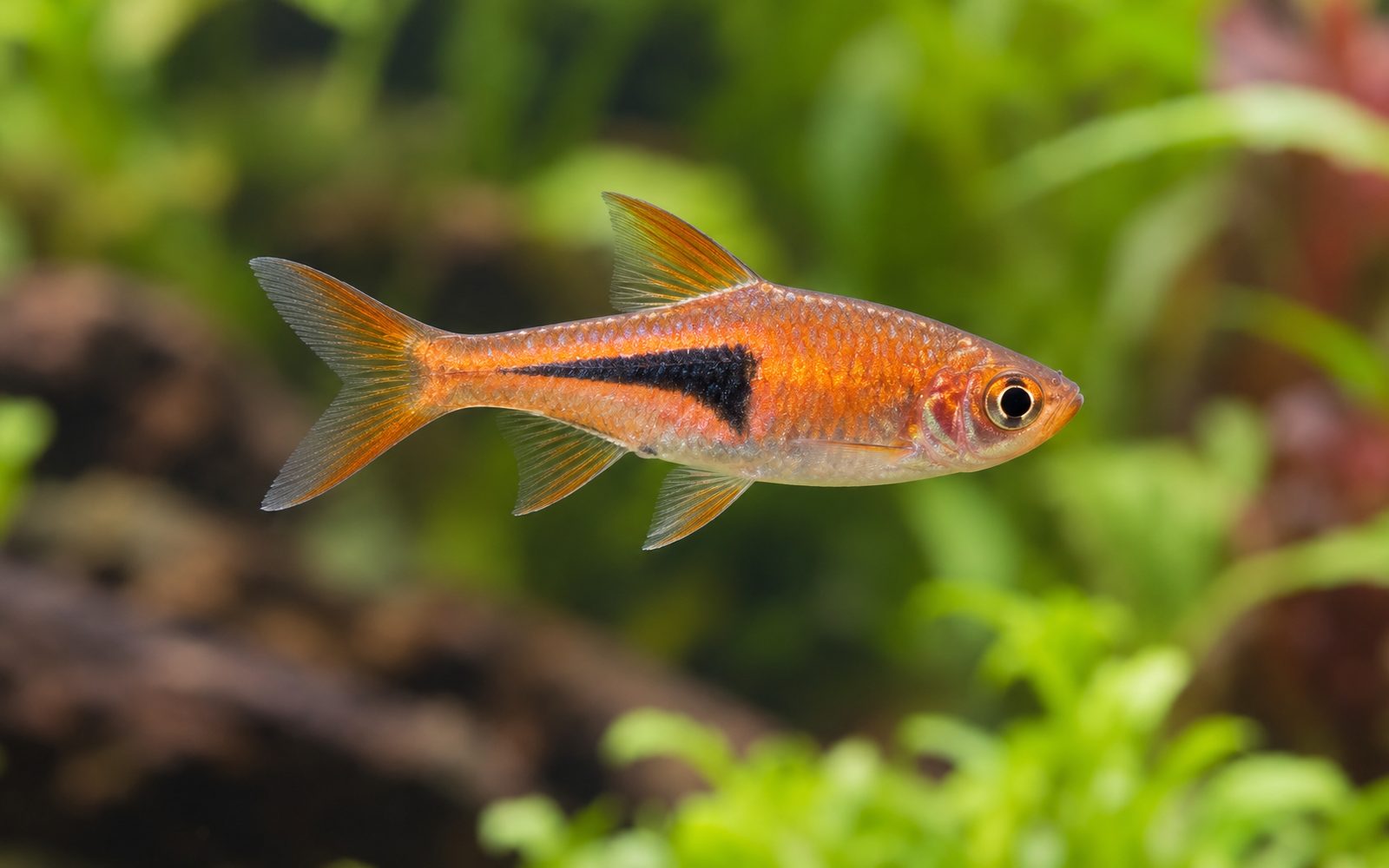
The lambchop rasbora is a close relative of the harlequin rasbora and was long confused with it. Its body is more slender and more orange; instead of the harlequin's broad triangle, the black marking on the rear half is a thin wedge or lamb chop shape. It also takes its hobby name from this marking.
Adults reach about 3 cm. It is a hardy, calm fish that is very harmonious in a large group; in planted community aquariums, especially in front of a dark substrate, it creates a warm mass of color. Both wild and farm-bred fish are available in the trade; farm-bred fish are used to a wider range of water values.
Natural Habitat
It lives in the coastal basins of southeastern Thailand and in Cambodia, in slow-flowing forest streams, swamp margins and vegetated still waters. The water is usually soft, slightly acidic and in places tannin-stained, with abundant aquatic plants and submerged branches.
Tank Setup
- Volume: at least 54–60 liters and 60 cm in length for a group of 10.
- Water: 24–27°C, pH 6–7, soft to moderately hard water. A dark substrate and floating plants bring out its colors.
- Plants: broad-leaved plants such as Cryptocoryne, Anubias and Echinodorus; they are also used for spawning.
- Layout: dense plants along the sides, open swimming space in the middle.
- Flow: gentle to moderate.
Diet
Omnivorous. Small granules and flakes can be the staple; vary the diet with frozen brine shrimp, daphnia, cyclops and small bloodworms. Its mouth is small; keep the food fine.
Behavior and Compatibility
Peaceful, social and curious. It moves as a group in the middle layer, staying close together. Males court females by deepening their colors in front of them; small chases occur during this time.
Good companions: harlequin and other rasboras, small tetras, corydoras, kuhli loaches, otocinclus, dwarf gouramis, shrimp.
Avoid: large and aggressive fish, any species with a mouth big enough to swallow it, large cichlids.
Group and Colony Structure
At least 8, ideally 12 or more individuals. In a large group the fish grow bolder and swim in the open; kept in small numbers they become shy and retreat to the plants. The male-to-female ratio is not critical. It can be kept with the harlequin rasbora, but each species' own group should be large enough.
Breeding
It shows the typical behavior of the genus Trigonostigma: the pair turns upside down beneath a broad leaf and attaches its eggs to the underside of the leaf. Breeding requires very soft (GH below 4), acidic water, dim light and broad-leaved plants. The eggs hatch in about a day; since the parents may eat the eggs, removing them after spawning is recommended. The fry are fed infusoria, then newly hatched brine shrimp.
Health and Common Problems
A hardy species. Poor water quality and sudden temperature drops can lead to white spot and columnaris. A short quarantine for store-bought fish and a 25% weekly water change are sufficient.
Sexing
Males are slimmer and a more intense orange; the front tip of the black marking is sharper and longer. Females have a fuller belly and are slightly paler; their markings are shorter.
Tank mates
This list is calculated automatically from the species profile and grows as new species are added to the catalog. Try it in the planner for a definite answer.
Usually compatible
 Flame Tetra
 Blackfin Corydoras
 Polystictus Corydoras
 Emerald Cory
 Porthole Catfish
 Keyhole Cichlid
 Cupid Cichlid
 Geophagus altifrons
 Geophagus surinamensis
 Cryptocoryne Parva
Should not be kept together






Hobbyist notes
Things you won't find in books, learned by trial and error. The most helpful ones are on top.
Change history and contributors
- Page created · October 16, 2026