
Water parameters
Overview
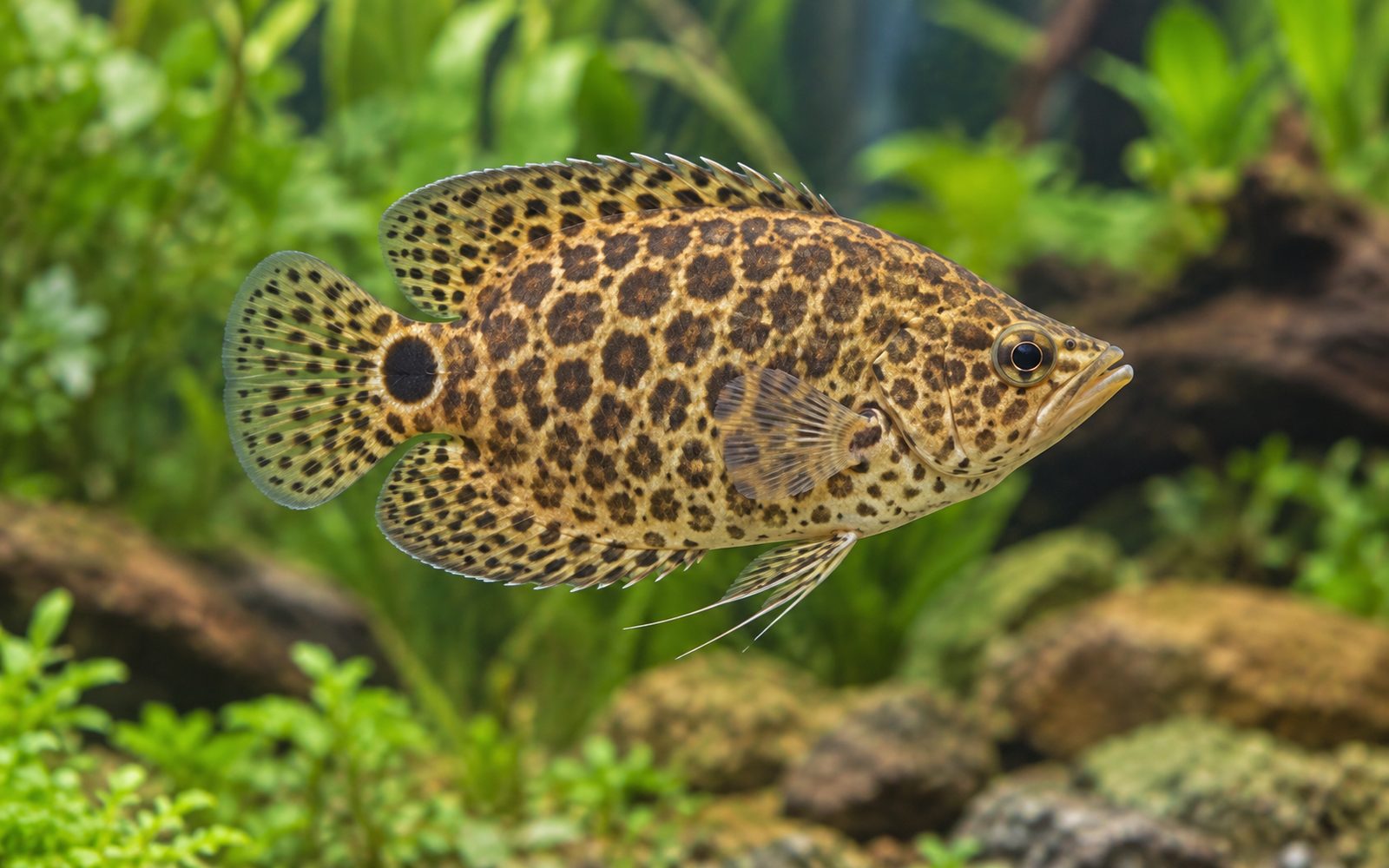
The leopard bushfish is the most commonly kept member of Anabantidae, Africa's labyrinth fish family. With its laterally compressed oval body, pointed snout and wide mouth it resembles a leaf; it carries irregular dark spots on a light brown to golden background. It reaches 12–15 cm in the aquarium.
It is an ambush predator: it waits motionless among plants and roots, approaches its prey slowly and swallows it in an instant. It is docile toward fish larger than itself, so with the right tankmates it is a calm and interesting aquarium fish. Thanks to its labyrinth organ it also breathes air from the surface.
Natural Habitat
It lives in slow-flowing, vegetated and shaded forest stretches of the Congo River basin. The water is generally soft, slightly acidic and warm; the banks are full of roots, fallen trees and overhanging plants.
Tank Setup
- Volume: at least 150 liters for a single fish or a small group, with a length of 100 cm or more.
- Water: 24–27°C, pH 6–7.5, soft to moderately hard water.
- Decor: roots, branches, caves and dense plants; light dimmed with floating plants.
- Flow: gentle; use a strong filter with a soft outlet.
- Lid: because it breathes air from the surface, warm air should remain between the lid and the water.
Diet
Carnivorous. Frozen bloodworms, shrimp, mussels and brine shrimp, live mosquito larvae and worms are the best foods. Some fish accept meat-based granules over time but usually refuse flakes. Food is taken more eagerly in the late afternoon, as the light fades. Feeder fish are not necessary and are not recommended because of the risk of carrying disease.
Behavior and Compatibility
Calm, slow and somewhat shy; it hides during the day and becomes more active in the evening. It hunts fish and shrimp that fit in its mouth; it leaves calm fish larger than or the same size as itself alone. It can live in harmony with its own species in a large aquarium.
Good companions: Congo tetra, adult angelfish, large corydoras and plecos, calm African and South American species, large barbs, pearl gourami.
Avoid: small fish such as neon tetras, rasboras and guppies; dwarf shrimp; aggressive cichlids that would chase it.
Group and Colony Structure
It lives comfortably on its own. In a large aquarium (200 liters or more), a group of 3–4 can also be kept; choose fish of the same size, because a noticeably smaller one may be seen as prey. The fish in a group establish a mild hierarchy, but serious fighting is rare.
Breeding
Breeding in the aquarium is very rare and information about it is limited. It is reported not to build a bubble nest, to produce free eggs that rise to the surface, and to provide no parental care. Most fish sold in the trade are collected from the wild.
Health and Common Problems
Wild-caught fish may carry parasites and bacterial infections; a quarantine of 2–3 weeks is recommended. In poor water quality, loss of appetite and fin rot occur. Fish fed only live food carry a disease risk; getting them used to frozen food is important for their health.
Sexing
It is very hard to tell apart from the outside. Mature males are reported to carry patches of spiny scales behind the eye and on the caudal peduncle, while females look fuller when carrying eggs.
Tank mates
This list is calculated automatically from the species profile and grows as new species are added to the catalog. Try it in the planner for a definite answer.
Usually compatible
 Emerald Betta
 Emerald Cory
 Porthole Catfish
 Keyhole Cichlid
 Firemouth Cichlid
 Cupid Cichlid
 Buffalohead Cichlid
 Festivum
 Geophagus altifrons
Should not be kept together







Hobbyist notes
Things you won't find in books, learned by trial and error. The most helpful ones are on top.
Change history and contributors
- Page created · October 16, 2026