
Water parameters
Overview
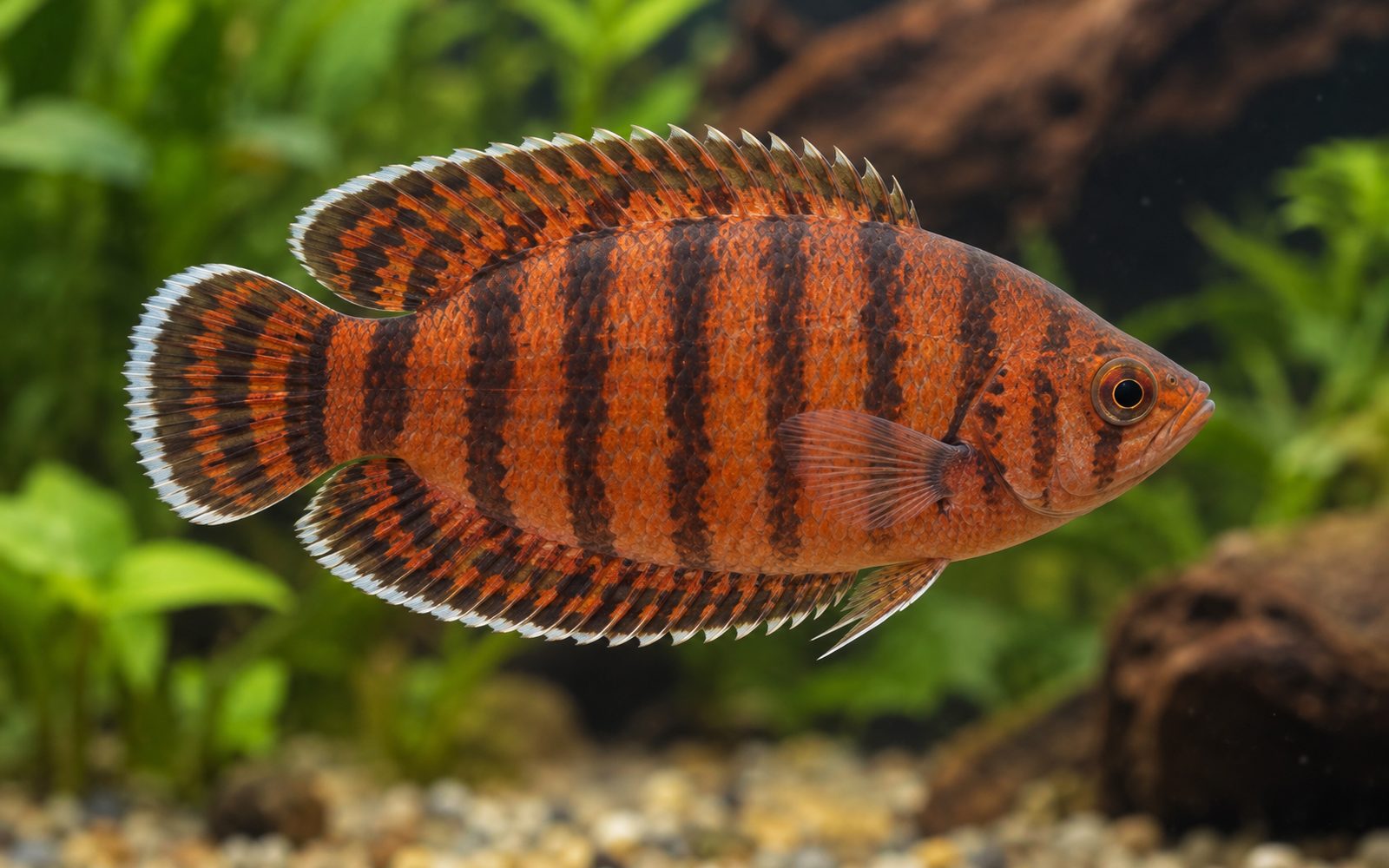
The ornate ctenopoma is one of the most colorful small members of Anabantidae, Africa's labyrinth fish family. The males' orange to brick-red body is crossed by 6–7 dark vertical bands; the broad dorsal and anal fins and the edge of the caudal fin are lined with white. It grows to about 7 cm. Because it was formerly placed in the genus Ctenopoma, it is also sold under that name.
Unlike the leopard bushfish, it is a small species and not a fish-eater. It is shy and more active in the evening and at night; in a dim, planted aquarium it gradually comes out and shows its colors. Like its Asian relatives, it builds a bubble nest.
Natural Habitat
It lives in forest streams of the Congo basin and its surroundings, in slow-flowing, shaded and vegetated stretches. The water is soft, slightly acidic and lightly stained by tannins; the bottom is covered with leaf litter.
Tank Setup
- Volume: at least 60 liters for a small group.
- Water: 25–27°C, pH 6–7, soft water. Dried leaves and roots tint the water slightly.
- Setup: dense plants, roots, caves and light dimmed by floating plants.
- Flow: weak; a sponge filter is ideal.
- Lid: warm air should remain between the surface and the lid.
Diet
Carnivorous. Live or frozen bloodworms, brine shrimp, daphnia, cyclops and mosquito larvae should be the staple. It often accepts dry food reluctantly; feeding frozen food is more reliable. It eats more eagerly in the evening when the lights are dimmed.
Behavior and Compatibility
Peaceful and timid. It hides among plants during the day and becomes more visible in the late afternoon. Males defend the area around the nest in the breeding season. It may eat fish fry and shrimplets that fit in its mouth; it does not harm adult fish.
Good companions: Congo tetra, small African tetras, pencilfish, calm rasboras, corydoras, kuhli loach, dwarf cichlids.
Avoid: fast, greedy fish, fin nippers, large and aggressive species; crowded schools that would outcompete it at feeding time.
Group and Colony Structure
It lives alone or as a pair, but in an aquarium of 60 liters or more a group of 3–4 behaves more naturally. Having more females than males in the group reduces tension in the breeding season. If there is more than one male, each should have a hiding place of his own.
Breeding
The male builds a bubble nest under floating plants and his colors darken. The eggs released during the embraces rise to the surface and are gathered into the nest; the male guards the nest. The female should be removed after spawning. The fry are very small and need infusoria in the first days. Breeding requires soft, acidic water and a quiet tank.
Health and Common Problems
Because mostly wild-collected fish are sold, it carries a risk of parasites and bacterial infections; a quarantine of 2–3 weeks is recommended. In hard, dirty water its colors fade and its appetite drops. Clean, soft water and frozen food are the foundation of its health.
Sexing
Males are orange-red with distinct bands and white-edged fins; their dorsal and anal fins are larger. Females are pale beige-brown with weak bands and colorless fins.
Tank mates
This list is calculated automatically from the species profile and grows as new species are added to the catalog. Try it in the planner for a definite answer.
Usually compatible
 Flame Tetra
 Blackfin Corydoras
 Polystictus Corydoras
 Emerald Betta
 Emerald Cory
 Porthole Catfish
 Keyhole Cichlid
 Cupid Cichlid
 Geophagus altifrons
 Geophagus surinamensis
Should not be kept together






Hobbyist notes
Things you won't find in books, learned by trial and error. The most helpful ones are on top.
Change history and contributors
- Page created · October 16, 2026