
Water parameters
Overview
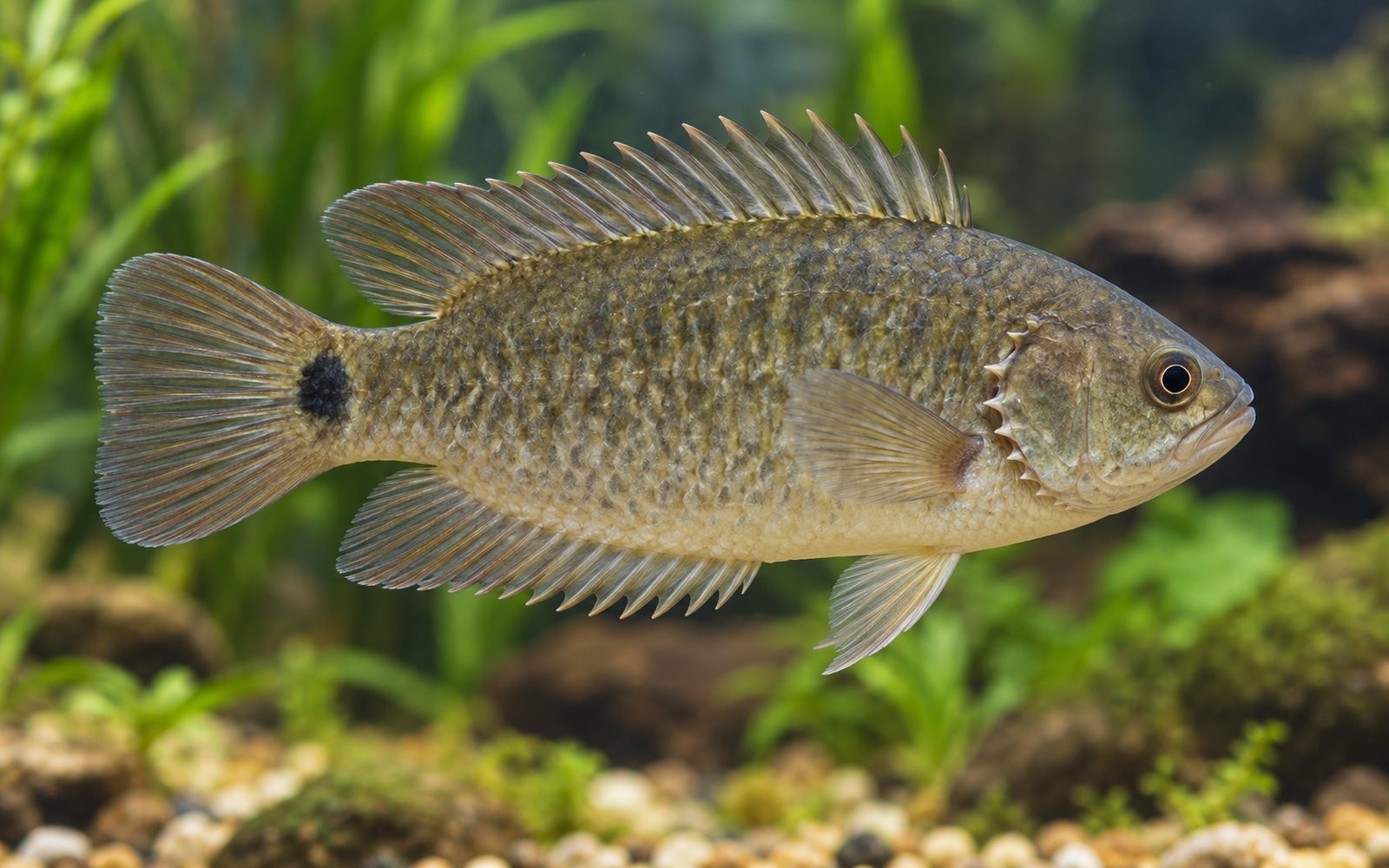
The climbing perch is named for its ability to move on land: bracing itself on the spines of its gill covers and its fins, it flexes its body and can cross wet ground from one pool to another. Thanks to its labyrinth organ it can survive out of water for a long time in a humid environment. Old tales of it climbing trees, however, are an exaggeration.
It has a sturdy, olive-gray, perch-like body and reaches 15–20 cm in the aquarium. It is an important food fish in many Asian countries. Because it harms the native fauna as an invasive species on some islands and in some regions, it must never be released into the wild.
Natural Habitat
It lives over a very wide area of South and Southeast Asia, in almost every kind of fresh water: rivers, lakes, swamps, rice paddies and ditches. Being able to leave drying pools and move to new water is a great advantage in seasonal wetlands. It tolerates low-oxygen, turbid water.
Tank Setup
- Volume: at least 200 liters for an adult, with a length of 100 cm or more.
- Water: 24–28°C is ideal; it adapts to pH 6.5–8 and a wide range of hardness.
- Lid: a tightly closing lid is a must; every gap, including cable and hose openings, must be covered. An escaped fish can crawl away across the room.
- Decor: roots, rocks and sturdy plants; a layout that can withstand digging and uprooting.
- Filter: a strong filter and weekly water changes of 25–30%.
Diet
Omnivorous and very greedy. It readily accepts granules and pellets, frozen shrimp, bloodworms, worms and vegetables. In the wild it feeds on insects, crustaceans, small fish and plant matter. Feed in moderation once a day.
Behavior and Compatibility
It is grumpy toward its own species and similar fish, and predatory toward small fish. It hunts fish and shrimp that fit in its mouth. It can be kept with robust fish close to its size, but it does best in a species tank or with carefully chosen large tankmates.
Good companions: robust fish larger than or the same size as itself: large barbs, large plecos, snakeskin gourami, large, calm Asian species.
Avoid: small fish and shrimp, slow long-finned species, aggressive cichlids that would chase it constantly.
Group and Colony Structure
It is usually kept singly. Several fish can live in a large aquarium, but shoving and chasing among them are common. If a group is kept, choose fish of the same size and provide plenty of hiding places.
Breeding
It does not build a nest and does not care for its young. The eggs are free eggs that rise to the surface; since the parents may eat the eggs and fry, they should be separated. Breeding in the aquarium is rare and requires a large tank; commercial breeding is done in ponds.
Health and Common Problems
Extremely hardy. Problems are mostly injuries from escape attempts and bacterial infections linked to poor water quality. A fish that has escaped and begun to dry out should be put back in water immediately, even if time has passed; it can often be saved.
Sexing
It is hard to tell apart from the outside. Mature females become noticeably fuller in the belly when carrying eggs; males are generally slimmer.
Tank mates
This list is calculated automatically from the species profile and grows as new species are added to the catalog. Try it in the planner for a definite answer.
Usually compatible
 Yellow Regal Peacock
Glass Tetra
Yellow Regal Peacock
Glass Tetra
 Firemouth Cichlid
 Buffalohead Cichlid
 Chocolate Cichlid
 Demasoni Cichlid
 Discus
 Festivum
 Geophagus altifrons
 Geophagus surinamensis
Should not be kept together






Hobbyist notes
Things you won't find in books, learned by trial and error. The most helpful ones are on top.
Change history and contributors
- Page created · October 16, 2026