
Water parameters
Overview
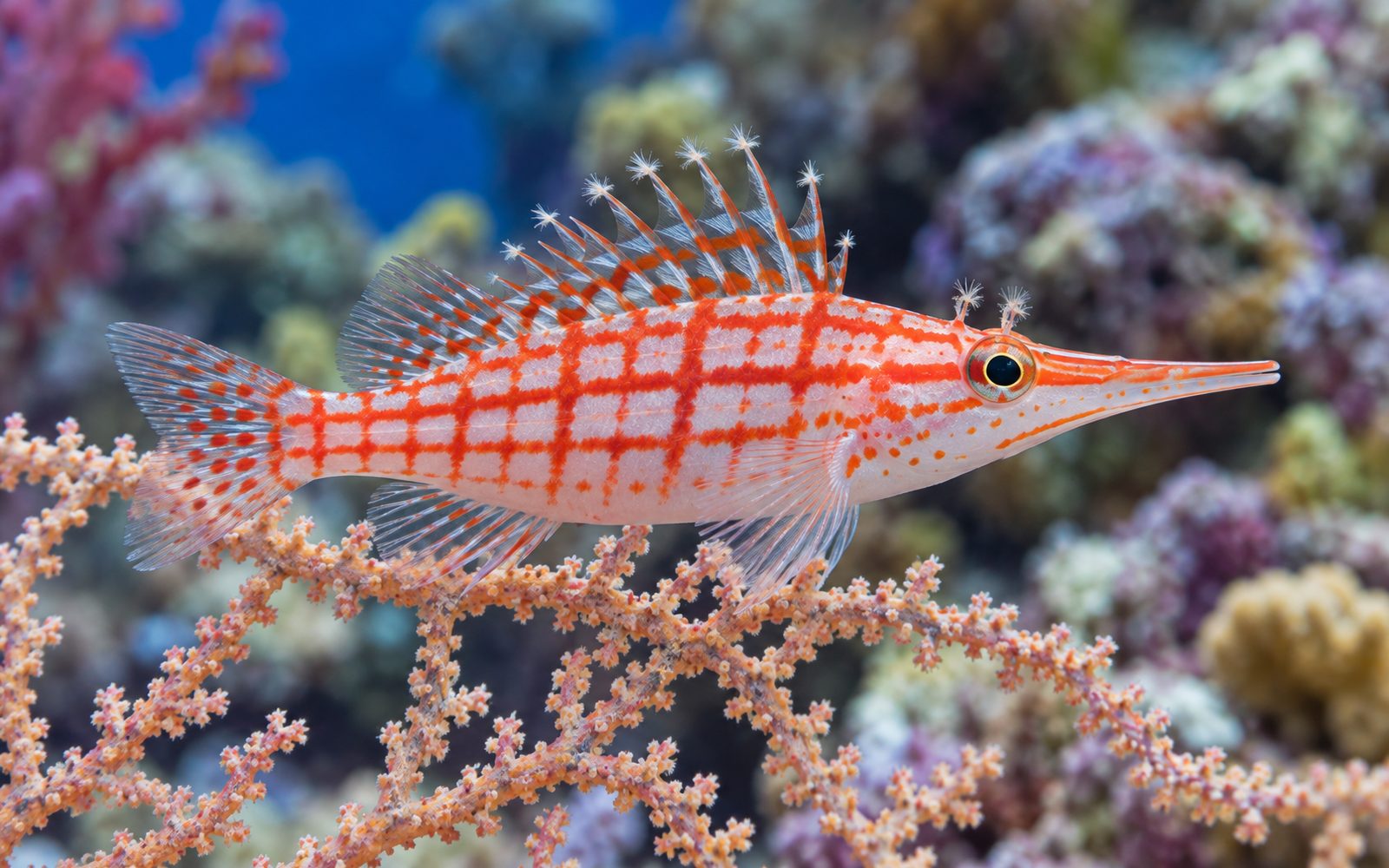
With the red tartan (checkered) pattern covering its white body and its long, pointed snout, the longnose hawkfish is one of the quirkiest and most charming fish in the aquarium. Like other hawkfish it has no swim bladder; it perches on branches and rocks propped on its pectoral fins, waits for its prey and catches it with a short lunge.
It is usually calm towards fish and hardy. However, its long snout is tailor-made for plucking small shrimp from between the rocks; for this reason it should not be kept with small ornamental shrimp.
Natural Habitat
It lives in the Indo-Pacific and Eastern Pacific, usually on steep reef slopes below 10 meters. It perches on the branches of gorgonians (sea fans) and black corals; hiding among the branches, it hunts small crustaceans that pass by.
Tank Setup
- Volume: At least 110 liters.
- Water: Salinity specific gravity 1.023–1.026, pH 8.1–8.4, temperature 24–27°C.
- Reef compatibility: Reef-safe with caution. It does not eat corals, but it hunts small ornamental shrimp; large cleaner shrimp are usually safe.
- Layout: High points where it can perch: rock tops, branching corals or gorgonians. Leave open areas where the fish can move around on top of the rocks.
- Flow: Moderate to strong flow.
Diet
Carnivorous. Offer frozen mysis, brine shrimp, krill and small granules; since its mouth is small, food pieces should be tiny. Twice a day. It snaps up food with a short lunge as it passes in front of its perch; if it is kept with fast, greedy fish, watch that it manages to get food.
Behavior and Compatibility
Peaceful towards fish; it may hunt very small fish (fry, tiny gobies). It is territorial towards its own kind and other hawkfish. It is curious and watches movements in front of the glass.
Good companions: Clownfish, chromis, tangs, dwarf angelfish, royal gramma, larger blennies.
Avoid: Small ornamental shrimp, other hawkfish, fish small enough to fit in its mouth, aggressive damselfish and dottybacks.
Group and Colony Structure
Kept as a single specimen. In a large aquarium a mated pair can live together; two unpaired individuals, however, squabble. With other hawkfish species in the same aquarium there is constant competition for perches, so they are not kept together.
Breeding
A pelagic spawner: at dusk the pair rises into the water and releases eggs and sperm, and the eggs drift with the current. Spawning has been observed in the aquarium, but raising fry is very rare.
Health and Common Problems
- A hardy species; with suitable water and a varied diet it can live for many years.
- Marine white spot and velvet: Use quarantine.
- Its thin snout can be injured by bumping and rubbing; avoid decor with sharp edges.
Sexing
Some hawkfish species are known to start as females and later change into males. There is no reliable external difference; the male is usually larger.
Tank mates
This list is calculated automatically from the species profile and grows as new species are added to the catalog. Try it in the planner for a definite answer.
Should not be kept together


Hobbyist notes
Things you won't find in books, learned by trial and error. The most helpful ones are on top.
Change history and contributors
- Page created · October 16, 2026