
Water parameters
Overview
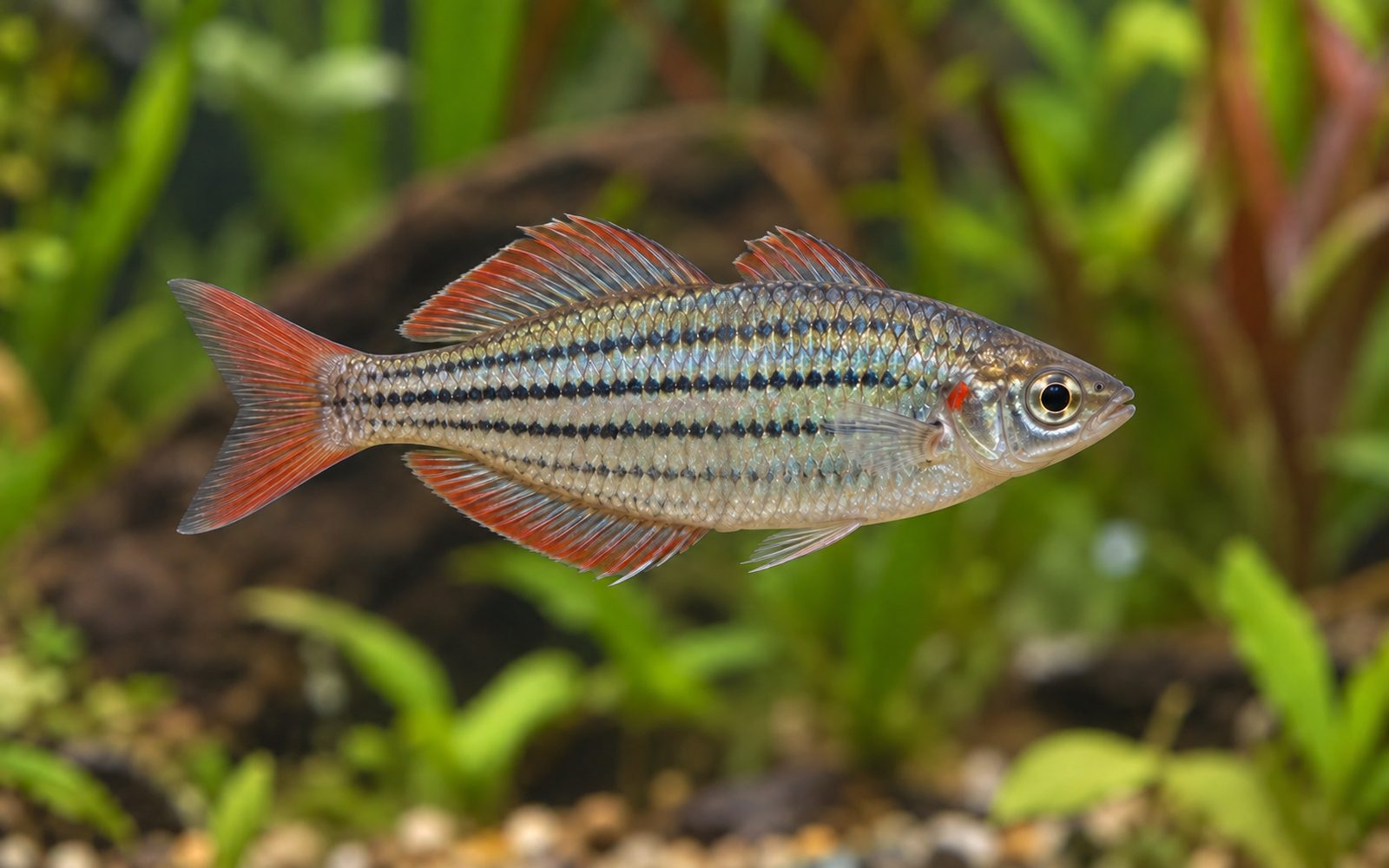
McCulloch's rainbowfish has a simple but elegant look, with several thin black stripes running along its silvery body and reddish fins. At 6–7 cm it is one of the small members of the group and is known in English as the "dwarf rainbowfish".
It has many separate populations in Australia and Papua New Guinea; color tones and the distinctness of the stripes vary by population. It is widely bred in the hobby, adapts to a wide range of water values and is comfortably kept in 100-liter community tanks.
Natural Habitat
It lives on the coastal plains of northeastern Queensland and southern Papua New Guinea, in planted streams, swamps and pools. These waters are usually soft and slightly acidic, full of dense plants and submerged branches.
Tank Setup
- Volume: at least 100 liters and 80 cm in length for a school of 6–10.
- Water: 23–26°C, slightly acidic to slightly alkaline, soft to moderately hard water.
- Decor: Densely planted edges with swimming space in the middle; floating plants soften the light.
- Flow: Gentle flow is enough.
- Lid: It can jump; use a lid.
Diet
Omnivorous. It readily accepts small granules and flakes; vary the diet with frozen brine shrimp, cyclops, daphnia and small bloodworms. Its mouth is small, so choose fine food. Feed small amounts 2–3 times a day.
Behavior and Compatibility
A peaceful, calm schooling fish; it is less hectic than its larger relatives. Males make short displays among themselves. It may eat shrimplets but generally leaves adult dwarf shrimp alone.
Good companions: small tetras and rasboras, corydoras, otocinclus, blue-eye species, dwarf gouramis, nerite snails.
Avoid: fin-nipping barbs, large and aggressive fish; if you plan to breed, other Melanotaenia species.
Group and Colony Structure
At least 6, ideally 10 or more individuals. A female-heavy group (2 females per male) is balanced. In a larger group the fish become bolder and more colorful; the red fins stand out when males display to each other.
Breeding
It breeds easily. In the mornings pairs lay a few eggs every day on fine-leaved plants, moss or a wool spawning mop; the eggs attach with sticky threads. Because the parents eat the eggs, move the mop to a separate container every few days. The fry hatch in 7–10 days; start with infusoria and liquid fry food, then move on to newly hatched brine shrimp.
Hybridization: It can hybridize with other Melanotaenia species such as the neon dwarf rainbowfish. Different populations should not be mixed either; pass on the fry with information on their origin.
Health and Common Problems
- White spot: can appear after sudden temperature drops.
- Fading color: a sign of a small group, stress and poor water.
- In general it is very hardy; it lives without problems in a mature aquarium.
Sexing
Males are deeper-bodied and more colorful; their fins are distinctly red and their stripes darker. Females are slightly smaller and slender; their fins are pale yellowish or colorless.
Tank mates
This list is calculated automatically from the species profile and grows as new species are added to the catalog. Try it in the planner for a definite answer.
Usually compatible
 Flame Tetra
 Blackfin Corydoras
 Polystictus Corydoras
 Emerald Betta
 Emerald Cory
 Emerald Dwarf Rasbora
 Porthole Catfish
 Keyhole Cichlid
 Cupid Cichlid
 Geophagus surinamensis
Should not be kept together






Hobbyist notes
Things you won't find in books, learned by trial and error. The most helpful ones are on top.
Change history and contributors
- Page created · October 16, 2026