
Water parameters
Overview
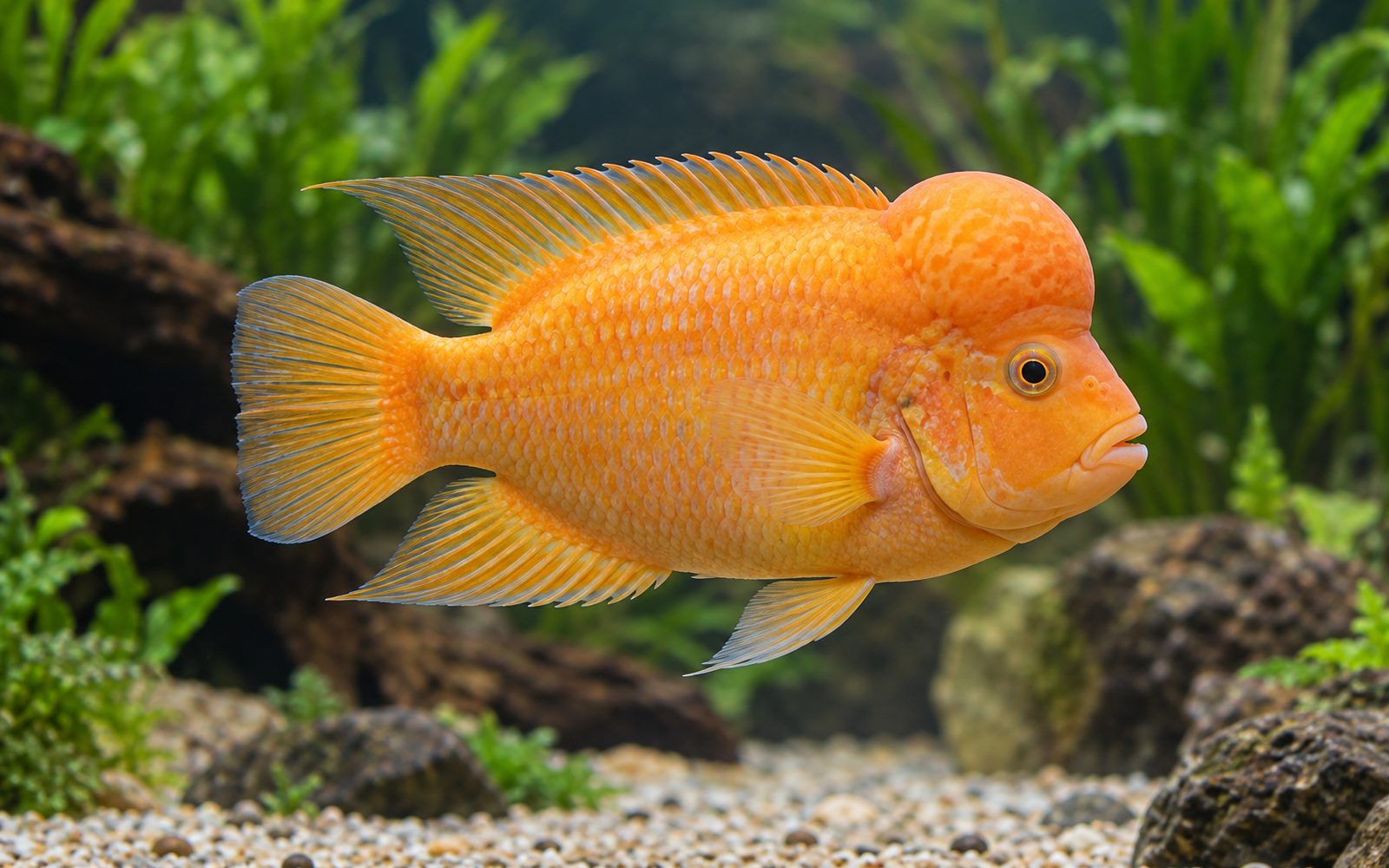
The midas cichlid is one of the best-known large cichlids of Central America. In the aquarium its deep, full body is mostly yellow, orange or mottled white-orange; mature males develop a large, knob-like hump on the forehead. In the wild most individuals are gray and banded, and colored ones are in the minority.
It lives in the same lakes as the red devil (Amphilophus labiatus), and the two are often confused. The midas has a deeper body, a shorter snout and thinner lips. Related populations living in the crater lakes of Nicaragua form a species complex frequently studied in evolutionary research.
The midas is also one of the ancestors of hybrids such as the flowerhorn and the blood parrot.
Natural Habitat
It lives in Lakes Nicaragua and Managua, the surrounding crater lakes and the San Juan River system. Along rocky and sandy shores it sets up territories among the stones; it feeds on insect larvae, snails, small fish and plant matter.
Tank Setup
- Volume: At least 300 liters for a single adult; 450 liters or more for a pair.
- Decor: Large, stable stones; it constantly digs in the sand and moves light decor around. Plants are not practical.
- Equipment: A strong canister filter or sump, a protected heater and a sturdy lid.
- Maintenance: A 30–40% water change every week.
Diet
Omnivorous. Use a large cichlid granule as the staple; vary the diet with frozen shrimp, mysis, mussels, peas and other vegetables. One meal a day is enough for adults; overfeeding leads to digestive problems.
Behavior and Compatibility
Interactive and intelligent; it recognizes its owner. On the other hand, it is extremely aggressive toward anything that enters its territory and can kill even fish of its own size.
Good companions: It is best kept alone. In a very large tank, only large, robust fish: big plecos, large Central American cichlids.
Avoid: Community fish, shrimp, snails, calm South American cichlids, plants.
Group and Colony Structure
Keeping it alone is recommended. To form a pair, raise juveniles together and separate the pair that forms; even in bonded pairs the male can seriously injure the female. A divider and a spare tank should be ready.
Breeding
The pair cleans a stone or the aquarium glass and lays 600–1000 eggs. The larvae are moved into dug-out pits, and both parents guard the fry for a long time. In the first weeks the fry are known to also feed on mucus secreted from the parents' skin; this is supplemented with brine shrimp nauplii.
Health and Common Problems
- Hole-in-the-head disease (HLLE): With poor water quality and vitamin deficiency.
- Injuries: From fighting and crashing into decor.
- Digestive problems: With a monotonous diet and overfeeding.
Sexing
The male is larger, with a much bigger forehead hump and long, pointed fins. The female is smaller; she has no hump or only a small one. A reliable distinction is made by the papilla.
Tank mates
This list is calculated automatically from the species profile and grows as new species are added to the catalog. Try it in the planner for a definite answer.
Usually compatible
 Flowerhorn
 Banded Jewel Cichlid
 Spotted Tilapia
 Jack Dempsey
 Jaguar Cichlid
 Red Devil Cichlid
 Red Terror Cichlid
 Convict Cichlid
 Cryptocoryne Parva
 Wolf Cichlid
Should not be kept together








Hobbyist notes
Things you won't find in books, learned by trial and error. The most helpful ones are on top.
Change history and contributors
- Page created · October 16, 2026