
Water parameters
Overview
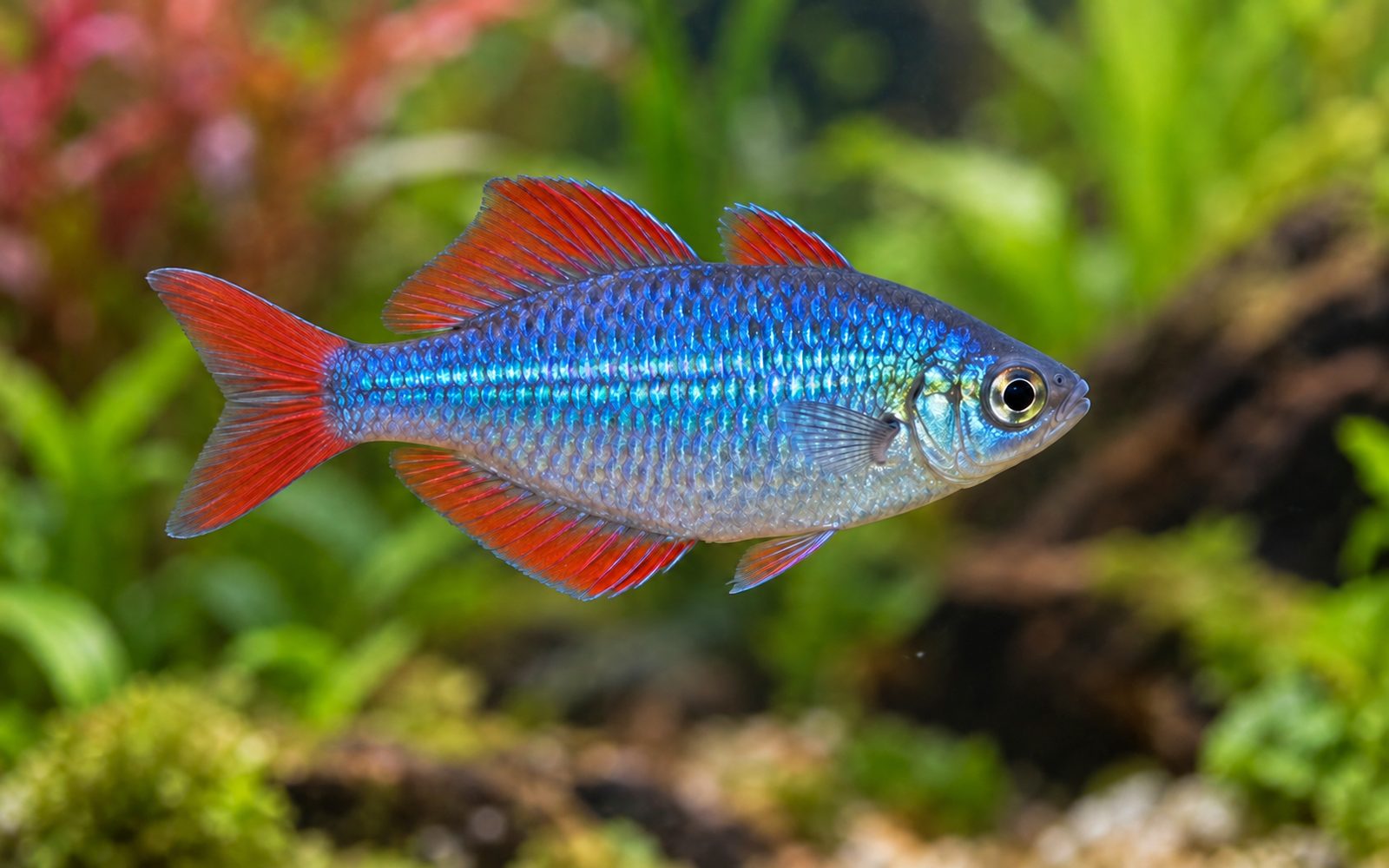
With its metallic blue body that turns from silver to turquoise when the light hits it, and the bright red fins of the males, the neon dwarf rainbowfish is one of the smallest and best-loved rainbowfish. At 5–6 cm it does not need the large aquariums its bigger relatives require; it is comfortable in a 100-liter community tank.
Because of its hardy, hungry and peaceful nature, it is one of the best choices for getting started with rainbowfish. Individuals sold are captive-bred; their colors develop within a few months with good feeding and clean water.
Natural Habitat
It lives in the Mamberamo River basin in northern New Guinea, in small streams surrounded by rainforest and along planted swamp edges. The water is warm and clear; the fish move in small groups near plants and submerged branches.
Tank Setup
- Volume: at least 100 liters and 80 cm in length for a school of 6–10; because it is very active, choose a long tank.
- Water: 25–27°C is ideal; around neutral, soft to moderately hard water. Keeping the values stable is important.
- Decor: Plants along the edges, open swimming space in the middle; a dark substrate and background bring out the blue sheen.
- Flow: It enjoys gentle to moderate flow and likes to swim against the filter outlet.
- Lid: It can jump; do not leave the lid open.
Diet
Omnivorous. Make quality flakes and micro granules the staple; vary the diet with frozen brine shrimp, cyclops, daphnia and small bloodworms. Its mouth is small, so choose fine food instead of large granules. Feeding small amounts 2–3 times a day maintains color and condition.
Behavior and Compatibility
Peaceful, curious and constantly on the move. Males display to each other by spreading their fins; chasing females is also natural and usually harmless. It can leave very slow and shy fish behind at feeding time. It may eat shrimplets but generally leaves adult dwarf shrimp alone.
Good companions: Corydoras, otocinclus, bristlenose plecos, medium-sized tetras and rasboras, blue-eye species, dwarf gouramis, nerite snails.
Avoid: fin-nipping barbs, large and aggressive cichlids; if you plan to breed, other Melanotaenia species.
Group and Colony Structure
At least 6, ideally 10 or more individuals. A female-heavy group (2 females per male) keeps the females from being worn out; having more than one male makes the males display to each other and show their brightest colors. Neon dwarf rainbowfish kept in small numbers become skittish and stay pale.
Breeding
A continuous-spawning egg scatterer: with the morning light, pairs lay a small number of eggs every day for days on end on fine-leaved plants or a wool spawning mop. The eggs attach with sticky threads. Because the parents eat eggs and fry, move the mop to a separate container every few days. Depending on temperature, the fry hatch in 7–12 days; in the first week they are fed infusoria or liquid fry food, then newly hatched brine shrimp.
Hybridization: It hybridizes easily with other Melanotaenia species. For a pure line, breed the species separately; do not pass hybrid fry on as the pure species.
Health and Common Problems
- White spot and velvet: can appear with the stress of transport and sudden temperature changes; keep new fish in quarantine for two weeks.
- Fading color: colors dull with poor water, a small group or a monotonous diet.
- In general it is hardy; in a mature, regularly maintained aquarium it rarely falls ill.
Sexing
Males have bright red fins, a deeper body and a more intense blue sheen. Females have yellow-orange fins and a slimmer, silvery-blue body. After 3–4 months of age the difference is easy to tell from fin color.
Tank mates
This list is calculated automatically from the species profile and grows as new species are added to the catalog. Try it in the planner for a definite answer.
Usually compatible
 Flame Tetra
 Blackfin Corydoras
 Polystictus Corydoras
 Emerald Cory
 Porthole Catfish
 Keyhole Cichlid
 Cupid Cichlid
 Geophagus altifrons
 Geophagus surinamensis
 Cryptocoryne Parva
Should not be kept together






Hobbyist notes
Things you won't find in books, learned by trial and error. The most helpful ones are on top.
Change history and contributors
- Page created · October 16, 2026