
Water parameters
Overview
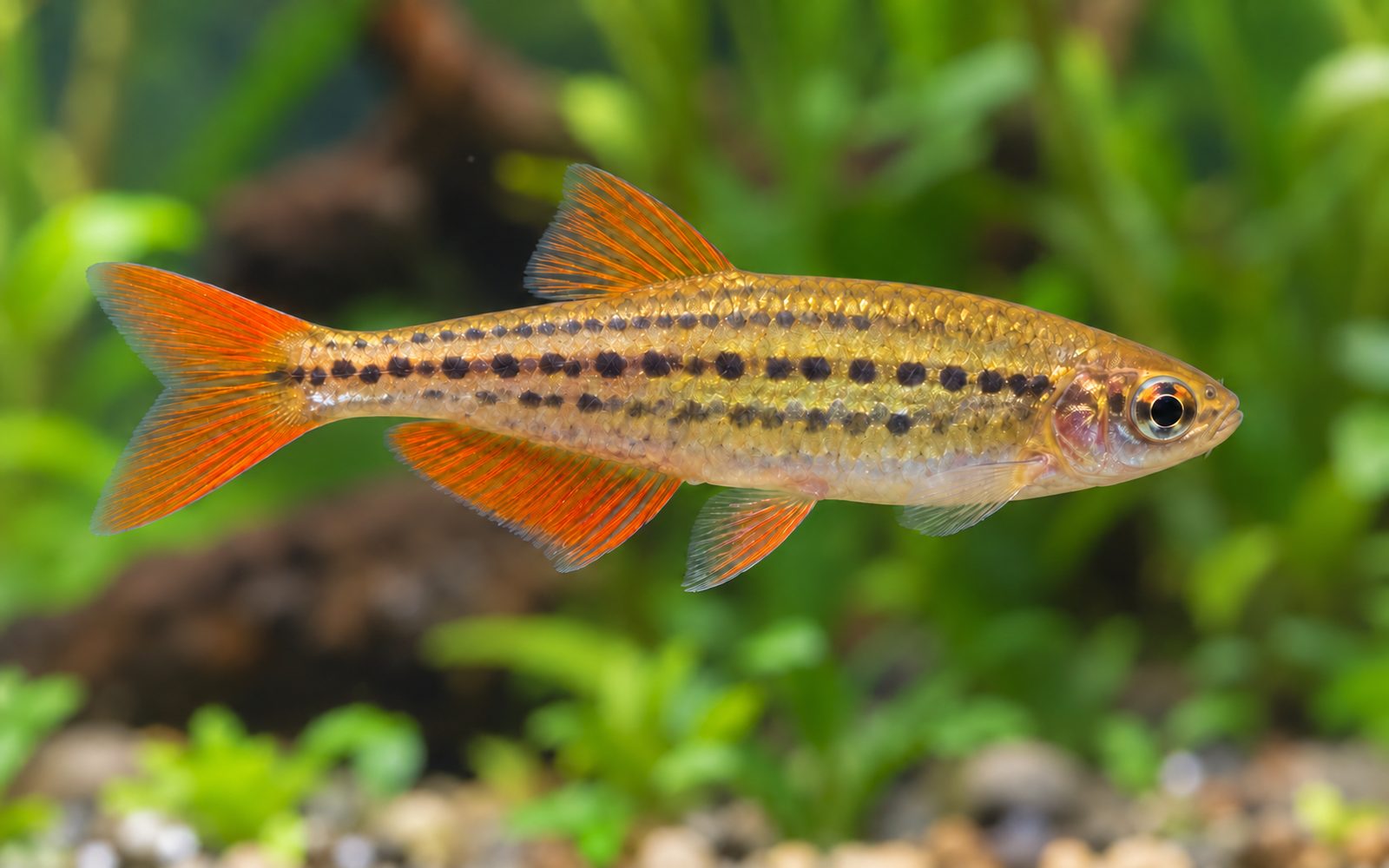
The orange-finned danio is built like the zebra danio but has a finer pattern and warmer colors. Two natural patterns occur on its light golden body: in one form there are dark horizontal stripes along the body, while in the other these stripes are replaced by rows of dark spots. In both forms the fins, especially the anal and tail fins, are bright orange-red.
It grows to about 4 cm. It is a hardy species that is easy to feed; because it is somewhat calmer than the zebra danio, it is a more compatible choice for planted community aquariums. The spotted form is sometimes sold under a separate name in the trade, but it is the same species.
Natural Habitat
It lives in northern Myanmar, in clear streams flowing through the hilly regions of the upper Irrawaddy River basin and in the shallow, vegetated stretches along their banks. The water is flowing, rich in oxygen and close to neutral; it cools down with the seasons.
Tank Setup
- Volume: at least 60 liters and 60 cm in length for a school of 8–10.
- Water: 21–25°C, pH 6.5–7.5, moderately hard water.
- Flow: gentle to moderate current and high oxygen.
- Layout: sand or fine gravel substrate, plants along the sides, open swimming space at the front.
- Lid: it jumps; a lid is essential.
Diet
Omnivorous. It readily accepts flakes and small granules; frozen brine shrimp, daphnia and mosquito larvae bring out the orange tones. It takes most of its food from the surface.
Behavior and Compatibility
Peaceful and active. As a school it moves through the upper layer; males chase the females and each other and display by flaring their fins. It is not aggressive towards other species.
Good companions: other small danios, rasboras, small tetras, corydoras, kuhli loaches, otocinclus, Neocaridina shrimp.
Avoid: large predatory species, very slow fish with flowing fins, species that need warm water.
Group and Colony Structure
At least 8, ideally 10 or more individuals. In a large school the chasing is spread out and the fish swim in the open. Kept in small numbers, a dominant male can wear out the others. The striped and spotted forms can be kept together, but breeders who want to preserve the separate forms raise them apart.
Breeding
It scatters its eggs among plants and gravel; there is no parental care and the eggs are eaten. A well-fed group spawns easily in a separate aquarium with an egg grid or moss. After the adults are removed, the fry become free-swimming within a few days; they are fed infusoria and then newly hatched brine shrimp.
Health and Common Problems
A hardy species. Constantly warm, oxygen-poor water, jumping from a tank without a lid and poor water quality are the main risks. A 25% weekly water change is sufficient.
Sexing
Males are slimmer; the orange-red in their fins is more intense and their base body color is more golden. Females have a fuller belly and are paler.
Tank mates
This list is calculated automatically from the species profile and grows as new species are added to the catalog. Try it in the planner for a definite answer.
Usually compatible
 Flame Tetra
 Blackfin Corydoras
 Polystictus Corydoras
 Emerald Cory
 Emerald Dwarf Rasbora
 Porthole Catfish
 Keyhole Cichlid
 Cryptocoryne Parva
 European Bitterling
 Adolfo's Cory
Should not be kept together







Hobbyist notes
Things you won't find in books, learned by trial and error. The most helpful ones are on top.
Change history and contributors
- Page created · October 16, 2026