
Water parameters
Overview
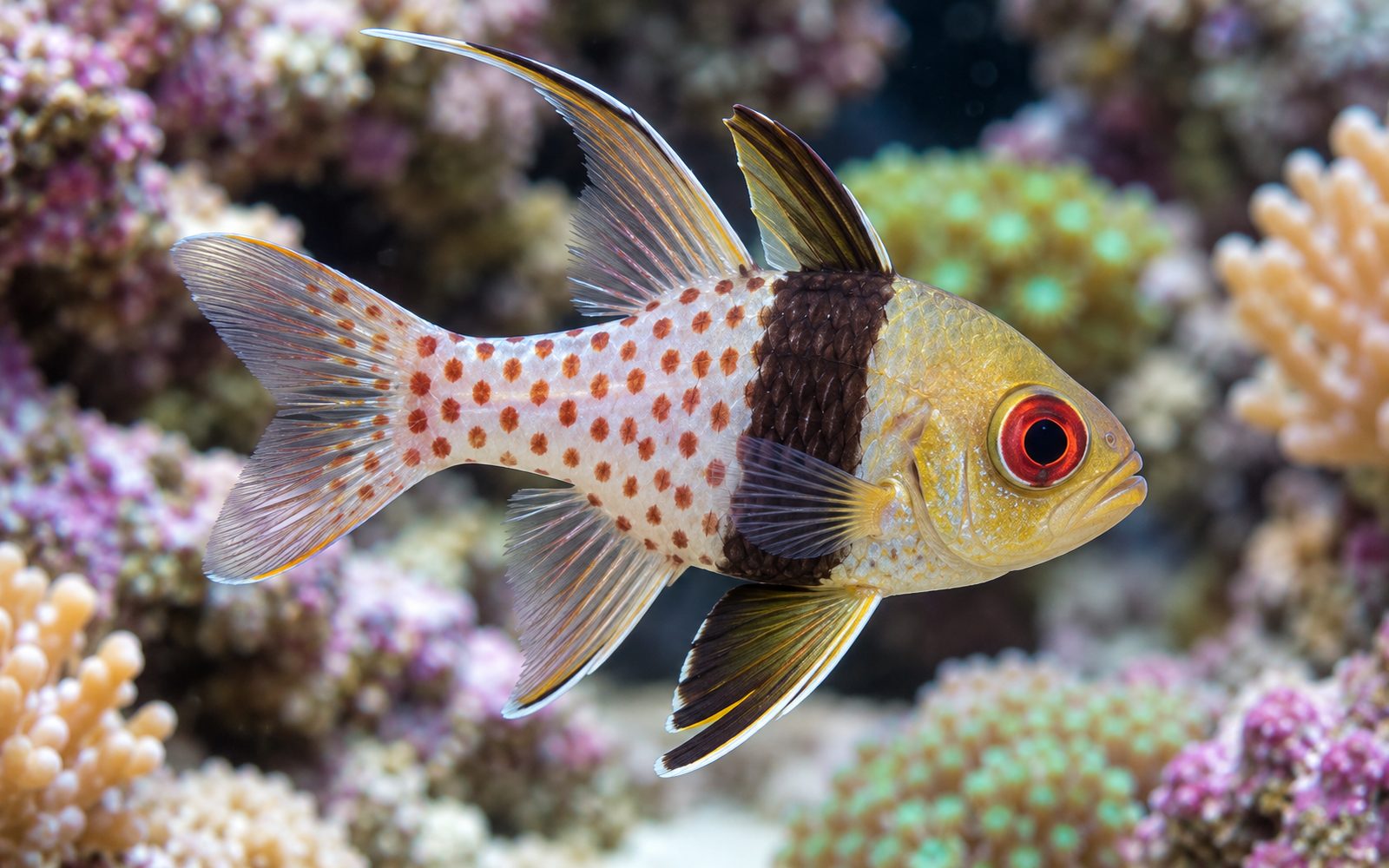
The pajama cardinalfish owes its name to its unusual pattern: after its yellowish head and large red eyes comes a broad, dark brown band across the middle of the body; the rear half of the body is covered with red-brown spots on a pale background. Its appearance resembles pajamas.
It is a calm, hardy and docile fish; it swims slowly and hovers in small groups in the shaded corners of the aquarium. It is more active in the evening hours. It is one of the species that can be recommended with confidence for reef aquariums.
Natural Habitat
It lives in groups among branching coral colonies in the sheltered lagoons and bays of the Western Pacific. During the day it waits motionless among the coral branches, and at dusk it comes out into the open to feed on small crustaceans and plankton.
Tank Setup
- Volume: At least 150 liters for a group of 3–5.
- Water: Salinity specific gravity 1.023–1.026, pH 8.1–8.4, temperature 24–27°C.
- Reef compatibility: Reef-safe; it leaves corals, shrimp and snails alone.
- Flow: Calm or moderate flow; shaded areas and branching corals or rock overhangs.
- Lighting: It adapts to strong lighting, but having a shaded corner reduces its stress.
Diet
Carnivorous. Frozen mysis, brine shrimp, copepods and krill should be the staple; it also accepts granules over time. Feeding twice a day is enough; giving the last meal of the day before the lights are dimmed matches its natural feeding time.
Behavior and Compatibility
Extremely peaceful towards other species. A pair that forms within the group may claim a small area for a short time during spawning.
Good companions: Clownfish, gobies, firefish, blennies, Banggai cardinalfish, royal gramma, cleaner shrimp.
Avoid: Aggressive damselfish, dottybacks, lionfish and predators that can fit it in their mouths.
Group and Colony Structure
Kept in a small group: at least 3, ideally 5 or more individuals. Adding the group at the same time makes it easier for them to get along. Pairs may form within the group over time; if a paired couple chases the others away from its nesting area, plenty of hiding places solves the problem. A single specimen also does fine, but it is more relaxed and bolder in a group.
Breeding
It is a mouthbrooder: after the female lays her eggs, the male takes them into his mouth and carries them until they hatch. The male does not eat during this period. Spawning is seen in the aquarium; however, unlike the Banggai, the fry go through a planktonic stage and are difficult to raise.
Health and Common Problems
- A hardy species.
- Marine white spot and velvet: Use quarantine.
- Feed the male well after brooding; he becomes weak during the period when he does not eat.
Sexing
There is no reliable external difference. The belly of a female carrying eggs becomes fuller; the mouth area of a brooding male looks swollen.
Tank mates
This list is calculated automatically from the species profile and grows as new species are added to the catalog. Try it in the planner for a definite answer.
Should not be kept together



Hobbyist notes
Things you won't find in books, learned by trial and error. The most helpful ones are on top.
Change history and contributors
- Page created · October 16, 2026