
Water parameters
Overview
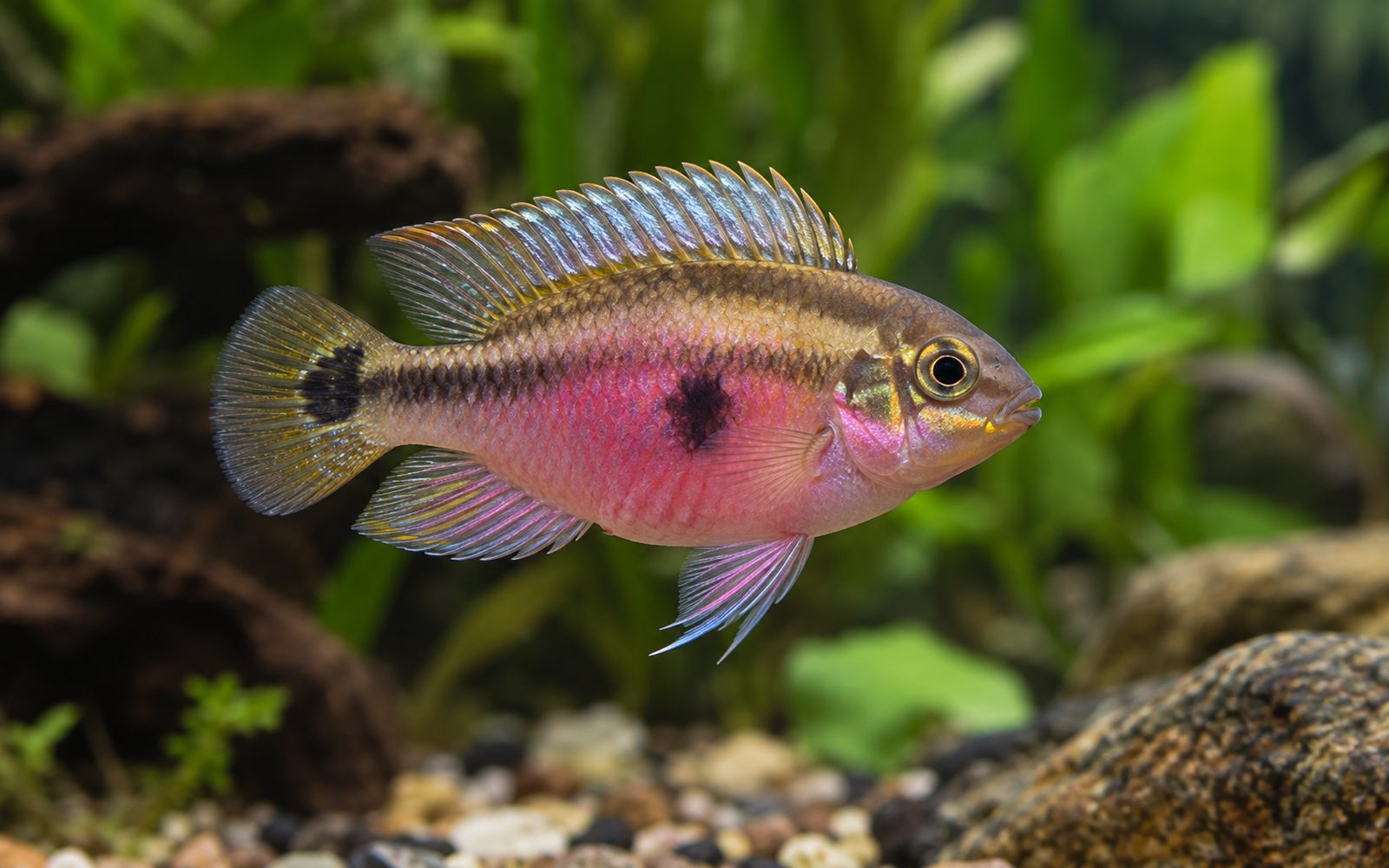
Pelvicachromis subocellatus lives in lakes and slow streams, some of them brackish, along the coastal strip from Gabon to the mouth of the Congo River. Compared with its relatives it has a shorter, deeper body; the spots on the upper part of the tail are sparser. In the breeding season the female's flanks turn deep pink, a black blotch appears in the middle and the dorsal fin gives off shining silvery reflections. Local forms such as "Matadi" and "Moanda" should be kept separate.
Tank Setup
- At least 80 liters for a pair.
- 23–26°C; it adapts to water from soft to fairly hard, and pH 5.5–6.5 at 24–26°C is suitable for breeding.
- Caves (coconut shells, flowerpots), fine sand, roots and plants.
Diet
Omnivorous. Sinking granules, frozen bloodworms, brine shrimp and daphnia, with occasional plant-based food, are suitable.
Behavior and Compatibility
It forms monogamous pairs and raises its fry in a cave; the female usually initiates, and up to 200 eggs can be laid in a single spawning. During breeding it defends the area around the cave and chases bottom dwellers. It eats shrimp.
Good companions: midwater schooling fish (tetras, rasboras, African characins), bristlenose plecos (Ancistrus).
Avoid: bottom dwellers (in a small tank), shrimp, other Pelvicachromis pairs, large aggressive cichlids.
A short profile for this species
The Pelvicachromis subocellatus page has the basics, but the sections below have not been written yet. If you keep this species, write a section from your own experience; it will be published under your name after editor approval.
Tank mates
This list is calculated automatically from the species profile and grows as new species are added to the catalog. Try it in the planner for a definite answer.
Usually compatible
 Emerald Betta
 Emerald Cory
 Porthole Catfish
 Keyhole Cichlid
 Firemouth Cichlid
 Buffalohead Cichlid
 Festivum
 Geophagus surinamensis
 Rainbow Cichlid
Should not be kept together





Hobbyist notes
Things you won't find in books, learned by trial and error. The most helpful ones are on top.
Change history and contributors
- Page created · October 16, 2026