
Water parameters
Overview
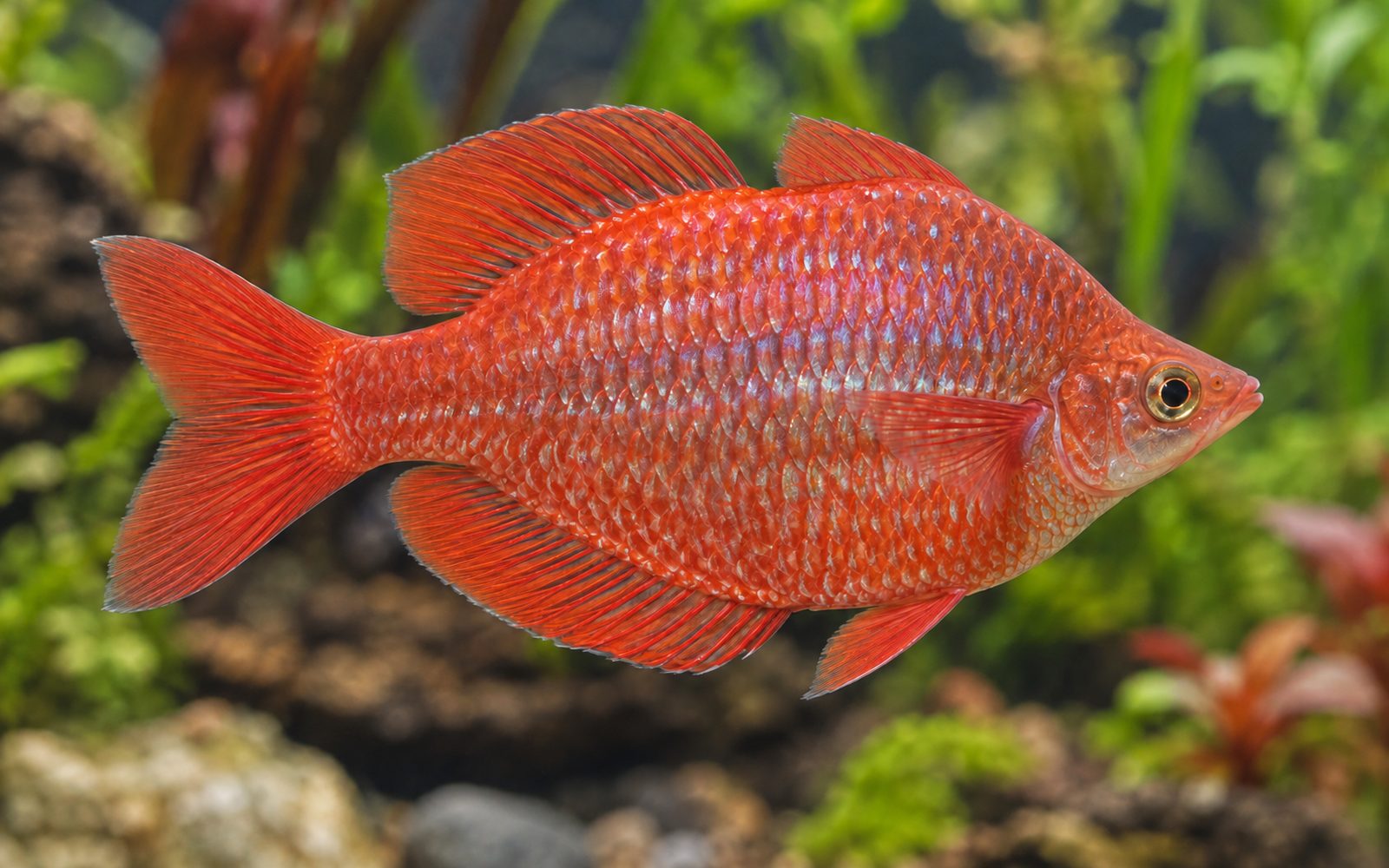
The red rainbowfish is one of the most striking species in the group, thanks to the head-to-tail color of mature males, ranging from salmon red to bright red, and their humped back that becomes noticeably deeper with age. Females are in olive-gold tones; when the two sexes are seen side by side, they could be mistaken for different species.
It is endemic to Lake Sentani in New Guinea, and the lake's habitat is under pressure from introduced non-native fish species and pollution. The individuals in aquariums are captive-bred. Young fish in stores are silvery-olive; the red color develops in males over months and reaches its full intensity at around one year of age.
Natural Habitat
Lake Sentani is a lake surrounded by hills, near the north coast of New Guinea. The fish live along the lake's planted, shallow shores and around submerged branches. The water is warm, clear and slightly alkaline.
Tank Setup
- Volume: at least 250 liters and 120–150 cm in length for a school of 6–10; mature males are large and powerful.
- Water: 25–27°C, pH 7–8, moderately hard water. In acidic and very soft water the colors fade.
- Decor: Dense plants and roots along the edges, plenty of open space at the front.
- Lighting: Good light and a dark substrate deepen the red.
- Lid: It jumps; the lid must fit tightly.
Diet
Omnivorous and greedy. It is fed quality flakes and granules, frozen brine shrimp, mysis, bloodworms and daphnia. Foods containing carotenoids (astaxanthin) noticeably intensify the red color; foods with plant content should also be included. Feed small amounts 2–3 times a day.
Behavior and Compatibility
Peaceful, but with its large size and speed it dominates the tank. Males display to each other by spreading their dorsal fins; during this their colors darken. It eats juvenile and adult dwarf shrimp and frightens very small fish.
Good companions: large rainbowfish from other genera (e.g. turquoise rainbowfish), Congo tetras, rosy barbs, corydoras, bristlenose plecos, synodontis, botias.
Avoid: Neocaridina shrimp, slow long-finned fish, very small fish, aggressive cichlids.
Group and Colony Structure
At least 6, ideally 10 or more individuals. A female-heavy group (2 females per male) is balanced. Multiple males displaying to each other bring the red color to its most intense; a single male can wear out the females.
Breeding
A continuous-spawning egg scatterer. In the morning hours pairs lay a few eggs every day on fine-leaved plants or a wool spawning mop; the eggs attach with sticky threads. The parents eat eggs and fry; move the mop to a separate container regularly. The fry hatch in about 7–12 days; start with infusoria and liquid fry food, then move on to newly hatched brine shrimp.
Hybridization: It can hybridize with other Glossolepis species and with closely related rainbowfish (Melanotaenia, Chilatherina). Do not raise fry from different species kept together; for a pure line, breed the species separately.
Health and Common Problems
- Fading color: poor nutrition, acidic water and stress make the red fade.
- White spot: can appear after sudden temperature drops.
- Bloating: caused by overfeeding and a monotonous diet.
- In suitable water it is hardy; the main problem is a tank that is too short.
Sexing
Males are larger, with a noticeably deep, humped back; the body and fins are red. Females are smaller, with a lower back, and olive-gold in color; their fins are yellowish and carry no red at all. The difference can be seen from the color tone even at a young age.
Tank mates
This list is calculated automatically from the species profile and grows as new species are added to the catalog. Try it in the planner for a definite answer.
Usually compatible
 Flame Tetra
 Yellow Regal Peacock
Glass Tetra
Yellow Regal Peacock
Glass Tetra
 Blackfin Corydoras
 Polystictus Corydoras
 Emerald Betta
 Emerald Cory
 Porthole Catfish
 Keyhole Cichlid
 Buffalohead Cichlid
Should not be kept together






Hobbyist notes
Things you won't find in books, learned by trial and error. The most helpful ones are on top.
Change history and contributors
- Page created · October 16, 2026