
Water parameters
Overview
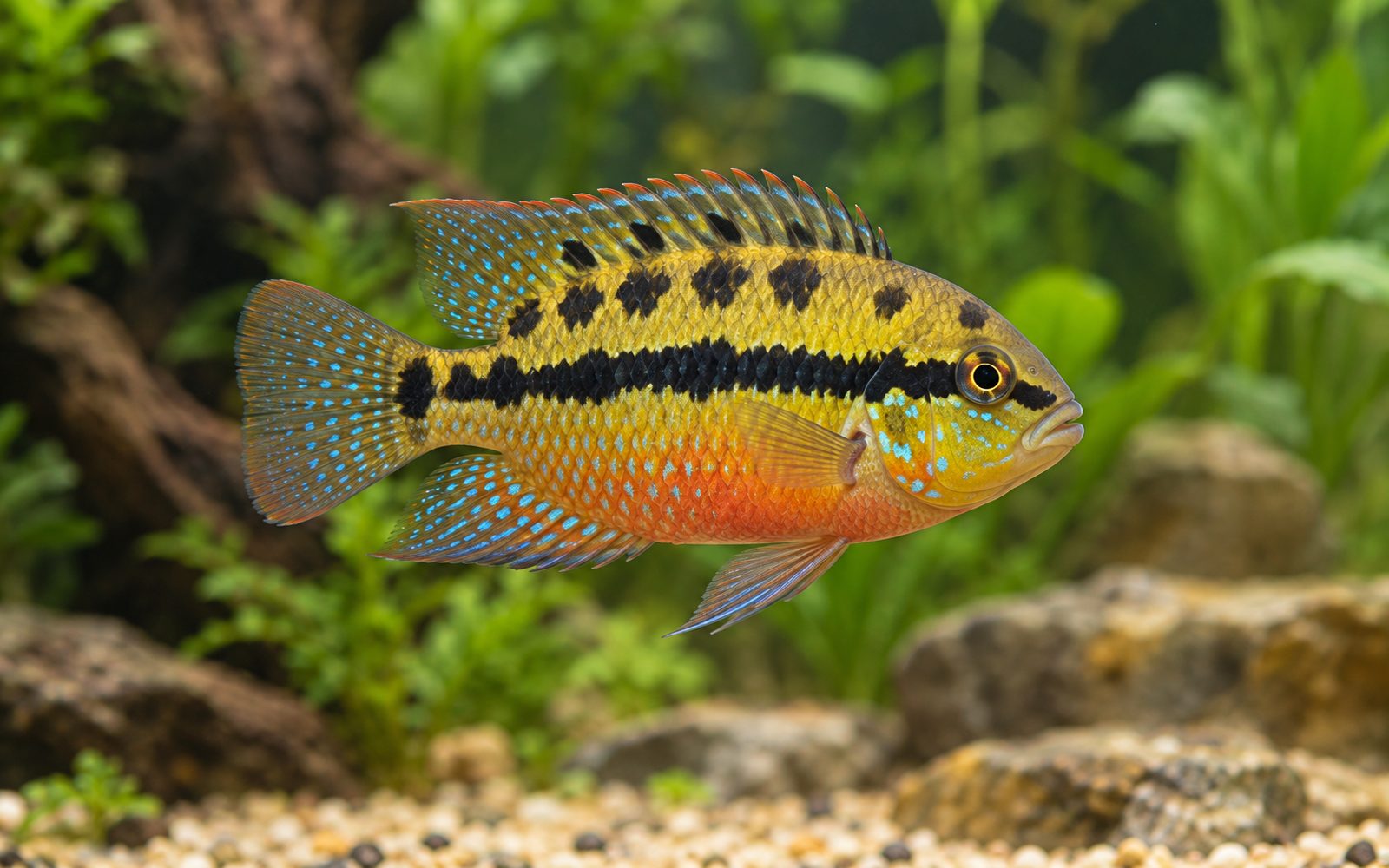
The salvini is one of the most colorful Central American cichlids, with a black horizontal stripe starting at the eye on a bright yellow background, dark blotches lined up along the back and a red–orange belly. There are shiny blue spots on its fins and lower body. Long known as Cichlasoma salvini, the species is now placed in its own genus, Trichromis.
Although it stays relatively small (15 cm), it is very aggressive for its size. Especially when breeding, it stands up even to fish larger than itself. For this reason it suits a Central American cichlid setup rather than a small community tank.
Natural Habitat
It lives in the Atlantic-draining rivers of southern Mexico, Guatemala, Belize and Honduras. It is found in waters with moderate current and rocky and sandy bottoms; it hunts small fish, insects and crustaceans. It hunts with fast lunges in open water, and this attacking behavior is seen in the aquarium too.
Tank Setup
- Volume: at least 200 liters and 100–120 cm of length for a pair; 300 liters or more with other cichlids.
- Decor: create several territories with rocks and caves; obstacles that break lines of sight reduce fights.
- Current: it likes moderate flow; good oxygenation is important.
- Water: change 25–30% weekly.
Diet
Mainly carnivorous. Alongside a quality cichlid granule, offer frozen bloodworms, mysis, brine shrimp and shrimp. Foods containing carotenoids help maintain its colors. One or two small meals a day are enough.
Behavior and Compatibility
A fast and bold predator; it constantly patrols the middle layer of the aquarium. A breeding pair chases off every fish that approaches its territory.
Good companions: robust Central American cichlids of similar size (firemouth, Thorichthys species, convicts in a large tank), large and fast livebearers, plecos.
Avoid: small tetras and rasboras, shrimp, slow species such as angelfish, very large and aggressive cichlids (jaguar cichlid, red devil).
Group and Colony Structure
Kept as a pair. Juveniles are raised together and a pair that bonds is selected. A second pair can only be added to the same aquarium in a very large, divided setup.
Breeding
The pair lays 100–500 eggs on a cleaned stone or on the ceiling of a cave. The eggs hatch in 2–3 days. The parents move the larvae into pits and guard the fry for several weeks. The fry are fed baby brine shrimp.
Health and Common Problems
- Injuries: from territorial fights.
- Hole-in-the-head disease (HLLE): in poor water conditions.
- Faded color: a sign of stress and a monotonous diet.
Sexing
The male is larger, with longer and more pointed dorsal and anal fins; its blue spots are denser. The female is smaller, and many females show a dark spot in the middle of the dorsal fin. Sexing is confirmed by the papilla.
Tank mates
This list is calculated automatically from the species profile and grows as new species are added to the catalog. Try it in the planner for a definite answer.
Usually compatible
 Banded Jewel Cichlid
 Spotted Tilapia
 Demasoni Cichlid
 Flowerhorn
 Jack Dempsey
 Redhead Cichlid
 Red Devil Cichlid
 Red Terror Cichlid
 Convict Cichlid
 Cryptocoryne Parva
Should not be kept together








Hobbyist notes
Things you won't find in books, learned by trial and error. The most helpful ones are on top.
Change history and contributors
- Page created · October 16, 2026